Starflight
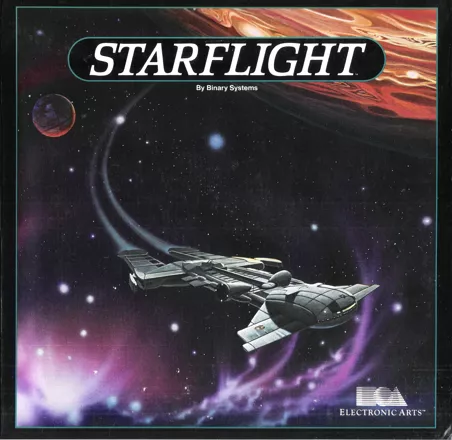
-
 Starflight 1+2
(2011)
Starflight 1+2
(2011)
Description official descriptions
A long time ago, a great empire comprised of Humans, Velox, Thrynn and Elowan ruled the stars. The Empire's currency was an energy source called Endurium. But something happened and this empire is no more. Furthermore, the small colony world named Arth has forgotten this heritage and technology. A thousand years have since passed and the people of Arth have rediscovered archaeological evidence of their empire. Using these discoveries, they create spaceships and form the Interstel corporation to govern the fleet. It's time to take the first steps back into space... but could it be the same enemy that destroyed the Empire still exists?
Starflight is a space exploration game with role-playing elements. The game is completely non-linear, allowing the player to venture to any star system and explore any of the vast amount of available planets. The main plot is advanced by following cryptic clues either received as transmissions at the initial spaceport, or obtained as a result of successful communication with various alien races populating the universe.
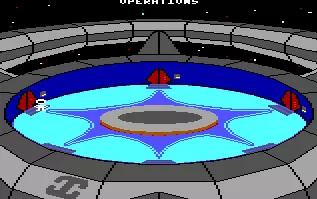
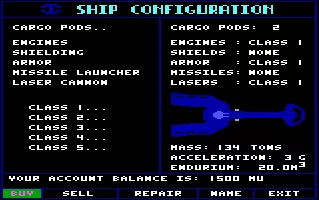
The player must first form a crew, assign their positions and customize the spaceship before blasting off from spacedock. Besides the captain of the ship, a science officer, a navigator, an engineer, a communicator, and a doctor have to be assigned to the ship. The player can choose between Humans, Velox, Thrynn, Elowan, and Android races when creating the characters. Each profession usually has a racial counterpart with the highest proficiency in it. Except Androids, members of every race can be trained in their skills by spending the game's currency. In the starting location the player can also acquire better weapons, armor, and shields for the ship, as well as outfit it with cargo pods. Terrain vehicle can be customized as well.
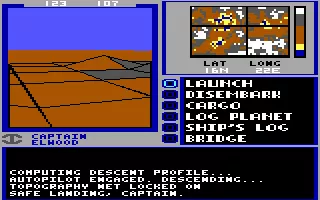
Once out into space, the standard interface allows access to different crew members and navigation. The entire galaxy is unknown and it's up to the player to travel to distant planets to explore and land on them. Planets may be inhospitable, with harsh weather conditions and various terrain types. Using a top-down interface, a planetary lander will venture out with the task of finding minerals and biological data to transport back to Starport. These resources can be sold for MU, the game's currency.
Different alien races control the galaxy and it will be up to the player to approach them diplomatically or face them in combat. Depending on the communicator's skill, the player may conduct successful conversations by assuming different postures, requesting information, or answering questions posed by the aliens. Each race has a different attitude and requires different approaches to peacefully end the negotiations. If all else fails, or if the player so wishes, the player-controlled ship may engage the aliens in combat, which is presented as overhead arcade action sequences. Successful exploration of the galaxy and alien cultures will yield clues and new leads as to the fate of the Empire.
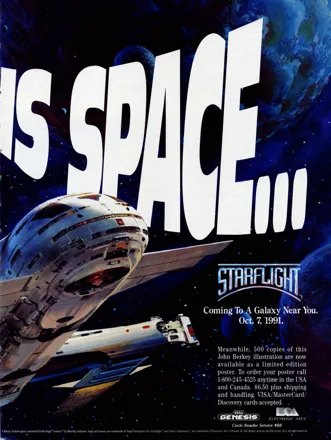
The Amiga version adds an auto-mining command. The Genesis version has updated graphics and sound, and is different in several aspects: locations of minerals and artifacts are different; there are new weapons for the ship and upgrades for the terrain vehicle; landing on planets is no longer automatic and must be controlled manually to avoid crashing; terrain vehicle exploration is more realistic, with visible weather conditions and various terrain types slowing down the vehicle.
Groups +
Screenshots
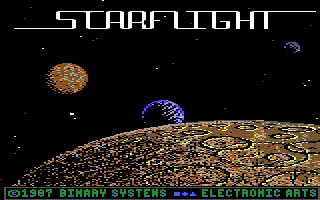
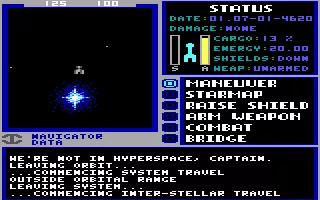
Promos
Credits (DOS version)
25 People (18 developers, 7 thanks) · View all
| Design | |
| Programming | |
| Music | |
| Documentation | |
| Producer | |
| Assistant Producers | |
| Technical Consultant | |
| Product Manager | |
| Art Director | |
| Package Design | |
| Package Illustrations | |
| Special thanks to | |
| [ full credits ] | |
Reviews
Critics
Average score: 81% (based on 26 ratings)
Players
Average score: 4.0 out of 5 (based on 95 ratings with 11 reviews)
The Good
Tremendous depth and space-opera quality. Wonderful story line, and wide-open choices for setting up your ship and crew. Absolutely non-linear. You could star-travel wherever you wanted to in their universe. How cool is that??? I cannot name another game before or since that lets you explore exciting (or boring!) star systems and planets... But pretty soon you started getting clues that you had to perform some tasks. Wonderful story there...
The Bad
It was very easy to get killed if you weren't careful. The save game feature absolutely sucked. Replay value was poor.
The Bottom Line
Rich interstellar story-telling and adventure. Great gameplay!
DOS · by ex_navynuke! (42) · 2005
Sleepless Nights and Bleary-Eyed Days
The Good
I remember my best friend having this game, and I knew I wanted it. I eventually found it in Newfoundland for 50 Canadian Dollars. I bought it and waited 2 weeks (I was on vacation) to play.
Needless to say, I was awe-struck by the sheer HUGENESS of Starflight. 2 Disks, 800 Planets to explore! It set an standard for story-telling and non-linear gameplay. Game Publishers in this day and age should get copies of the game, and learn from it. You don't need a 90 fps frame rate and a 300+ MB install w/ 128 Meg of RAM to make a fantasic immersing game. Starflight has it all.
The Bad
The Save Game Feature was a pain in the butt. If you crashed or ran out of fuel, and you didn't back up your game file in a long time, you could potentially have a HUGE amount of backtracking to do. Other that that it was excellent.
The Bottom Line
If you enjoy games that take more than 4 days to complete (and that's without cheat codes), and a storyline that will suck you in, and keep you there until the very end: Find Starflight, play it and enjoy it.
DOS · by Chris Martin (1155) · 2006
The Good
This game had everything going for it. It had character development, ship building, exploring, resource gathering, and space combat. It had hundreds of hours of gameplay, which is so hard to find in a game today. It had the endearing quality of "just one more hour before I quit" addictiveness. And all of this gameplay fit on two 360K disks. Game companies of today should take a lesson from this. I still consider this game my all time favorite, and it is 14 years old now. Hard to believe it has been that long, (and don't include the sequel, because it wasn't even half as good) and EA has never produced an update of any kind. I remember reading some time ago back in '94 that they were going to be producing Starflight 3, but nothing ever came of it. Everytime I buy an EA game, I put on my warranty card's additional comments field to "make a quality Starflight update".
The Bad
That I just wanted more. I know this sounds greedy, but I couldn't believe the game was over when I blew up the grey planet. I kept looking for the next challenge, but that was it. You could keep playing, but by that point in time, your ship was fairly invincible, and you had more than enough money to keep you going. I felt that a part of my life was gone, and wished that there was more. I guess that this isn't a bad thing, but just thought the people should know.
The Bottom Line
Think of this game as the game that spawned Privateer, Privateer 2, the Star Control Series, Homeworld, Independence War, and many others. It encompasses resource gathering, space travel, space combat, crew development, and exploration. Everything you would find in a classic Star Trek episode. I even named my crew after the Enterprise crew members.
DOS · by mclazyj (28) · 2000
Discussion
| Subject | By | Date |
|---|---|---|
| MGers assemble! Which artist drew the cover? | Somebody bring me Sisko! (8) | Jul 4, 2008 |
Trivia
Advertisement
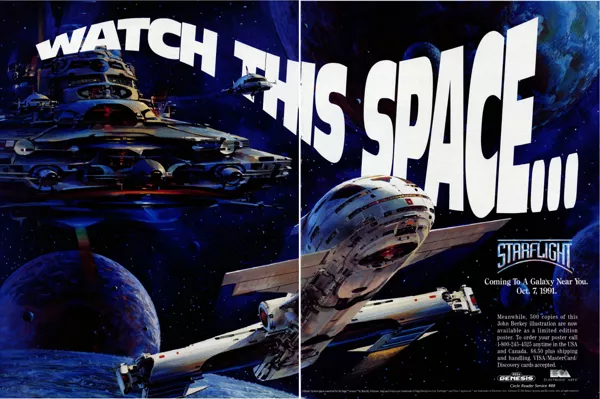
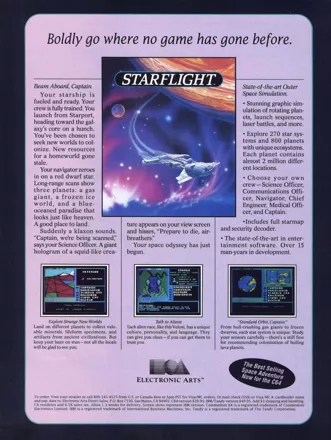
The advertising on the back of the box is strongly inspired by Star Trek, although the game itself is not. It shares a few elements with it, however.
Compaq
The Starflight reference card lists this helpful hint if playing on an original Compaq "luggable":
Compaq(tm) users with an external composite monitor should type Control-Alt-< at the DOS prompt before starting Starflight to activate the composite display output.
This means that Compaq users could play the game in 16 colors (instead of the CGA 4-color palette) as long as they hooked up a TV or composite monitor to the composite output.
Copyright notice
The DOS version of the game features a copyright notice written in the spirit of the game and reproduced below:
*INTERSTEL POLICE WARNING
As provided by the Galactic Treaty of 4410, this computer software product is hereby declared the Intellectual Property of the Human authors, Binary Systems. All rights are henceforth reserved in space and time.
Provision for the protection of Intellectual Property is covered under section 8.9.1A-F of the Intangible Property Act of 4506, ratified by all beings except the Gazurtoid.
Included in Section 8.9.1A-C is the provision for Interstel Corporate Police to enforce the Law.
WARNING: Any being caught with an unauthorized copy or version of this Software Product will be punished by Interstel Corporate Police. Punishment may include the destruction of the offending being.*
Additionally, players will be visited by an Interstel Police Vessel at some point in the game and forced to give a passcode. Oh, and it has level 75 shields.
Development
Starflight and Starflight 2 were written in a mixture of Forth (!!) and assembly.
In an interview, the creators stated that what they did for both games was to create the universe first, populated all the various races, and then let them tell their own version of the story. This is directly opposite to most modern designs, where you have the story first, and the art/universe come later.
EGA re-release
Electronic Arts re-issued Starflight packaged in a box (as opposed to the album-cover packaging) with proper EGA support a couple of years later its initial release, but this version had an extremely limited distribution and is considered very rare. The gameplay in this release is also slightly different, which is seemingly unintentional because the gameplay differences conflict with established rules (shields stay up in nebulas, etc.)
Extras
The package came with a colored starmap listing every single system in the game and their star class. One quickly learned to add the "wormhole" jumps to the map in order to save fuel and/or avoiding enemies.
Game design notes
The inside tri-fold lists notes from the game designers:
The Dream:
Back in 1982, we approached Electronic Arts with the idea of creating a universe on a disk that would let people experience the feeling of exploring the universe. It was an ambitious idea. We knew it would require a lot of time and the development of some new technology. We were more right than we knew.
The Cutting Room Floor:
We rewrote the game several times as we struggled to achieve our goals. We wanted the universe to convey a gigantic sense of space, complexity, and life. And we wanted an exciting fantasy role-playing game, with a wide spectrum of character interaction and activity. It seemed like whenever we were close to finalizing the script, we'd find another way to make the game more fun.
The Planet Builder:
About nine months after we started the actual programming, we came up with the idea for the fractal generator. A fractal generator so powerful that it could create surfaces in space. It took 6 man-years to create the technology, but it gave us the ability to cram 800 complex and unique planets into each game, instead of the 50 we'd had before. There are so many that even we haven't explored them all.
The Aliens:
To find the right names for each race, we wrote long profiles and histories for each, then tossed random syllables at each other for several days. To handle their languages, behavior, and combat-action, we had to devote months to building a sophisticated artificial intelligence system. We threw away the communications module three times before we had exactly what we wanted. Sometimes we wondered which would come first, flying to the stars in Starflight, or flying to the stars in real life.
Breathing Ammonia:
Once the fractal generator builds a planet, the eco-system generator creates environmental conditions for it, like gravity, atmosphere, minerals, and temperature. Once we took a journey back to Earth, only to find the eco-system generator had given it new continents and an ammonia atmosphere. It took two years to perfect the technology.
15 Man-Years Later:
The last several months were spent tying all the various technologies together. Because of the program's complexity and scope, the play-testing alone took months. But all that time and effort has proven worthwhile. We had a vision of what an outer space fantasy game could be, and now that vision is a reality.
Saving
For the DOS version of the game, all of the player's information is saved onto a single save file. For this reason, the game points out you NEED to make a backup and should not play off of the original disks. And also, the game needs to be saved prior to exiting or the progress can get stuck "in-progress".
Size
Starflight (and the sequel) contains over 800 planets, each with specific artifacts and minerals to find and mine--all on two 360K diskettes (which also have to share space with program code and graphics) and without needing more than 256K of RAM. Consider the following: You could go to any arbitrary planet, find a cluster of artifacts and take only one of the artifacts in the cluster, leave the planet, spend another 20 hours exploring other planets, fighting battles, saving the game, etc., then go back to that same planet and find everything exactly as you left it, including the cluster of artifacts with only one taken. This was (and still is) an astonishing technical achievement!
Awards
- Computer Gaming World
- August 1988 (Issue #50) – Introduced into the Hall of Fame
- November 1996 (15h anniversary issue) - #55 in the "150 Best Games of All Time" list
- Happy Computer
- Issue 01/1988 - Best Role Playing Game in 1987
- Power Play
- 1987 - Best MS-DOS Game '87
Information also contributed by Adam Baratz, Kasey Chang, PCGamer77 and WildKard
Analytics
Upgrade to MobyPro to view research rankings!
Related Sites +
-
AtariMania (Electronic Arts, UK, Atari ST)
For Atari ST: game entry database; downloadable release; game packaging; advertisement; manuals; magazine reviews; additional material. -
Bones' Starflight page
A nostalgic rememberance of Starflight. -
DOSBox, an x86 emulator with DOS
Compatibility information page about the original game and its DOSBox versions. -
Lemon 64
For Commodore 64: game entry database; advertisement; magazine reviews; music; documentation; cover art; additional material. -
Lemon Amiga
For Amiga: game database entry; magazine reviews; music; manual; additional material. -
Macintosh Garden, an abandonware games archive
For Macintosh: reviews; game packaging; downloadable releases; manual; screenshots; additional material. -
Orbital StarPost Yards
Looking for Starflight? -
SECAT
A group of people working on another sequel to Starflight. -
StarFlight X: Proxima Nova
Fan fiction and a Starflight-based MUSH game. -
Starflight
Looking for Starflight? -
Starflight 1 Codewheel Code Generator
Automatically provides codes required for ship launch. -
Starflight Resource Pages
Fan site on Starflight and Straflight II, containing extensive guides and featuring a forum. -
The Starflight III project page
A group of people working on another sequel to Starflight. -
The Starflight and Starflight 2 fan page
Probably the most comprehensive Starflight and Starflight fan page in existance. Contains mini-interviews with the game designers, and has links to other Starflight pages. -
Wikipedia, the free encyclopedia
Encyclopaedic entry for the combined platforms of the game.
Identifiers +
Contribute
Are you familiar with this game? Help document and preserve this entry in video game history! If your contribution is approved, you will earn points and be credited as a contributor.
Contributors to this Entry
Game added by Trixter.
Genesis added by PCGamer77. Amiga added by Rebound Boy. Commodore 64 added by 80. Macintosh added by Terok Nor. Atari ST added by Belboz. Windows added by eWarrior.
Additional contributors: Shoddyan, Patrick Bregger, ZeTomes, click here to win an iPhone9SSSS.
Game added May 12, 1999. Last modified January 19, 2024.