Tom Clancy's Splinter Cell: Chaos Theory
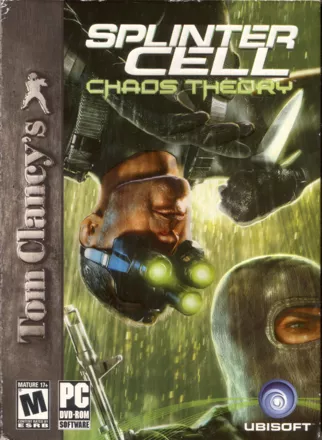
- Gold Games 9 (2006)
- Hits Essentiels: Collection 2006/2007 (2007)
- Kollekzionnoe izdanie: Tom Clancy's EndWar / Tom Clancy's Splinter Cell: Chaos Theory (2010)
- Splinter Cell Bundle: SC + SC Chaos Theory (2012)
-
 Tom Clancy's Splinter Cell Collection
(2017)
Tom Clancy's Splinter Cell Collection
(2017) -
 Tom Clancy's Splinter Cell Trilogy
(2006)
Tom Clancy's Splinter Cell Trilogy
(2006) -
 Tom Clancy's Splinter Cell: Complete
(2008)
Tom Clancy's Splinter Cell: Complete
(2008) -
 Tom Clancy's Splinter Cell: Elite Echelon Edition
(2010)
Tom Clancy's Splinter Cell: Elite Echelon Edition
(2010)
-
 Splinter Cell: Collector Edition
(2007)
Splinter Cell: Collector Edition
(2007) - The World of Splinter Cell (2006)
-
 Tom Clancy's Splinter Cell: Chaos Theory (Limited Collector's Edition)
(2005)
Tom Clancy's Splinter Cell: Chaos Theory (Limited Collector's Edition)
(2005)
-
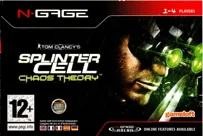 Tom Clancy's Splinter Cell: Chaos Theory
(2005 on
N-Gage,
Nintendo DS)
Tom Clancy's Splinter Cell: Chaos Theory
(2005 on
N-Gage,
Nintendo DS)
-
 Tom Clancy's Splinter Cell: Chaos Theory
(2005 on
BREW,
J2ME)
Tom Clancy's Splinter Cell: Chaos Theory
(2005 on
BREW,
J2ME)
Description official descriptions
Set in the not too distant future, Japan creates the Information Self-Defense Force (I-SDF). The creation of this force is seen as a violation of international law and Japan's constitution, and it causes tensions to rise between Japan, China, and North Korea. In time, North Korea and China set up shipping blockades around Japan, and Japan calls on the United States for help, citing article nine of the Postwar Constitution. Throughout this time, Japan uncovers more and more information that the infamous Black Gold Day was caused by intentional information warfare attacks. As the U.S. prepares to launch the USS Clarence E. Walsh, Third Echelon sends the famous Sam Fisher on a mission that appears to be unrelated to the incident, but which may end up being the most important element of it all.
In Splinter Cell: Chaos Theory, players take on the role of field operative Sam Fisher for a third outing. Fisher has some new moves this time around, and he also has a new weapon always at his disposal; a combat knife. Utilizing the knife, Sam can either kill his enemies, or simply knock them out. At the end of each mission, the player is given an overview of how they did. The more people that the player spares, the better the success score.
The single-player game is more open-ended than the past two Splinter Cell games. While players are still forced through some areas in a "tunnel" like fashion, with no choice of where to go, there are many instances where they can decide how they'd like to get there. For example, in the caverns, one can either kill two enemies and cross the bridge, or leave them alone, sneak along the side path, and climb a ladder at the end, bypassing the fight entirely, but still winding up in the same location.
Throughout the game many different locations are visited, such as a lighthouse, a Japanese tea house, Seoul, New York City during an East Coast blackout, and other such exotic locales.
The Spies-vs-Mercs multiplayer mode that appeared in the previous game has returned, with some new features. There are several new, large maps to play on, as well as updated versions from the past game. The PC, PlayStation 2, and Xbox versions feature this mode.
Spellings
- スプリンターセル3D - 3DS Japanese spelling
- 汤姆克兰西 之 细胞分裂:混沌理论 - Simplified Chinese spelling
- 湯姆克蘭西 之 縱橫諜海:混沌理論 - Traditional Chinese spelling
Groups +
- 3D Engine: Unreal Engine 2
- Game with creator's name
- Gameplay feature: Body dragging
- Gameplay feature: Lock picking
- Games with dynamic advertisements
- Green Pepper releases
- Middleware: Bink Video
- Middleware: Net-Z
- Physics Engine: Havok
- Setting: 2000s
- Setting: City - New York
- Setting: City - Tokyo
- Setting: Future now past
- Setting: Ship / Boat
- Software Pyramide releases
- Splinter Cell series
- Tom Clancy licensees
- Ubisoft eXclusive releases
- Xbox Platinum Hits releases
Screenshots
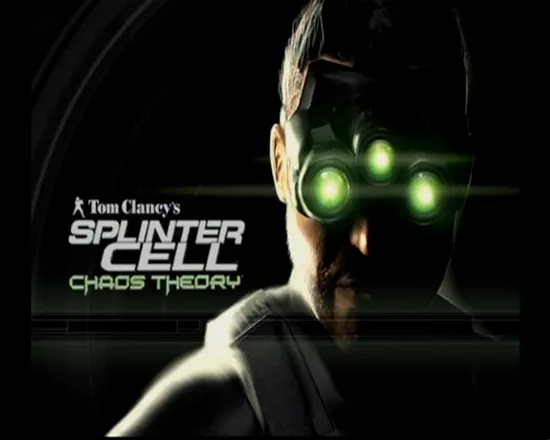
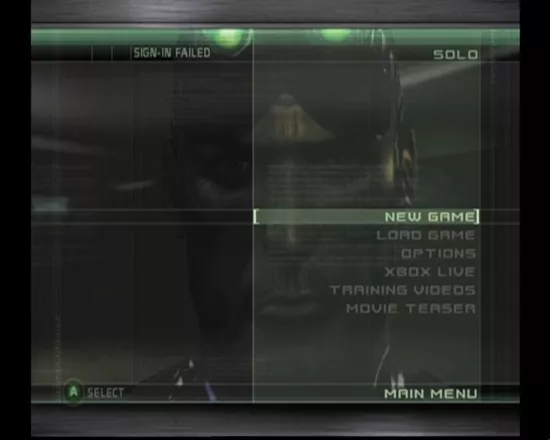
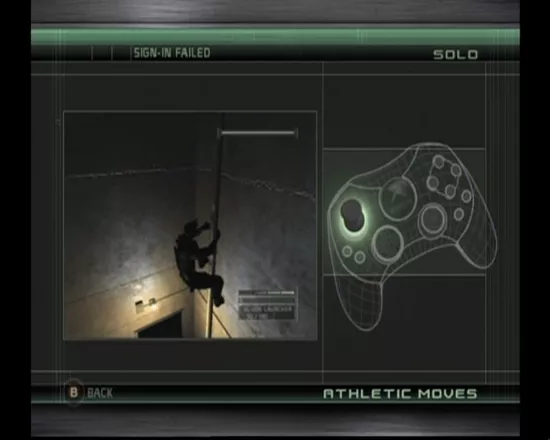
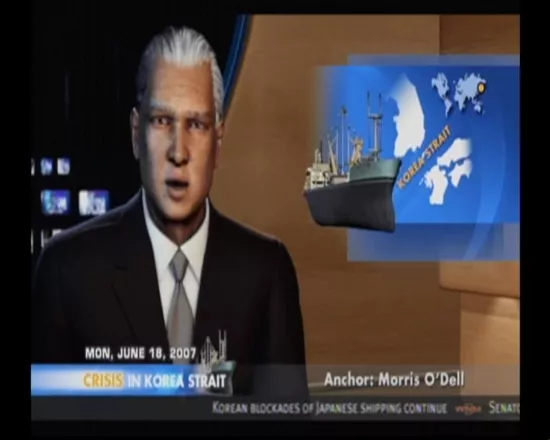
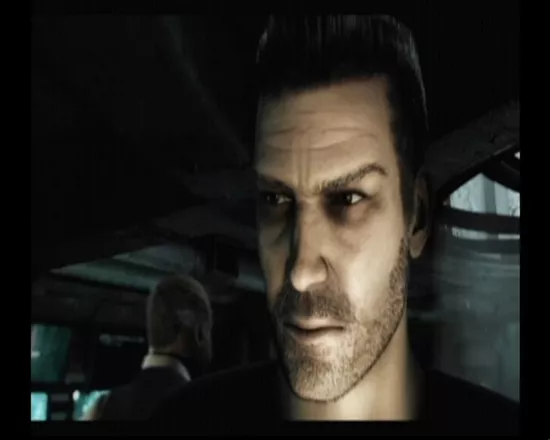
Promos
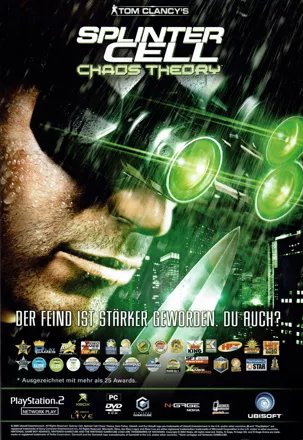
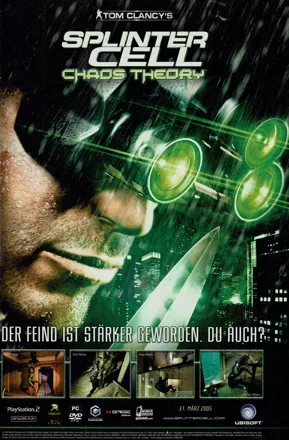
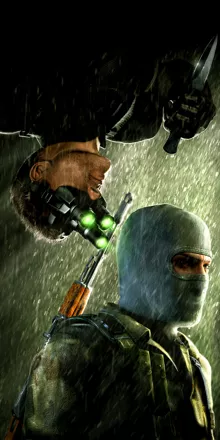
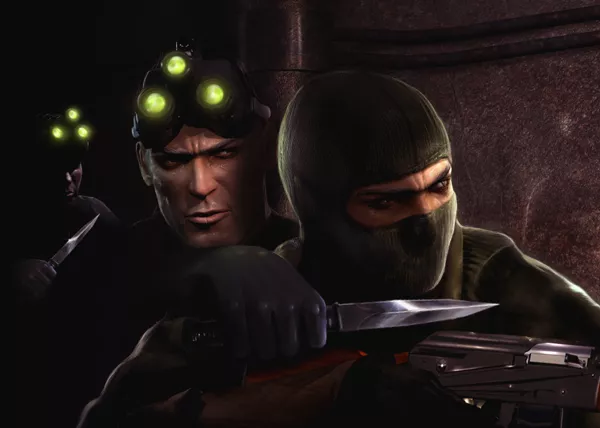
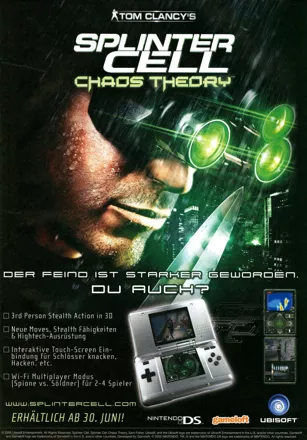
Videos
Add Trailer or Gameplay Video +1 point
See any errors or missing info for this game?
You can submit a correction, contribute trivia, add to a game group, add a related site or alternate title.
Credits (Windows version)
702 People (672 developers, 30 thanks) · View all
| Producer | |
| Creative Director | |
| Art Director | |
| Lead Level Designer | |
| Script Writer | |
| Lead Animator | |
| Animation Artistic Director | |
| Single Player Lead Game Designer | |
| Lead Artist | |
| Technical Art Director | |
| Lead Sound Designer | |
| Lead Character Modeler | |
| Single Player Associates Producer | |
| Coop Mode and PC Version Associate Producer | |
| Coop Mode Lead Game Designer |
|
| Coop Mode Lead Level Designer |
|
| Coop Mode Lead Artist |
|
| Coop Mode Art Director |
|
| Co-Producer - Project Closer | |
| [ full credits ] | |
Reviews
Critics
Average score: 84% (based on 113 ratings)
Players
Average score: 3.9 out of 5 (based on 112 ratings with 1 reviews)
Intense, Stealthy, and Interactive
The Good
Chaos Theory had many ups for me, including graphics, storyline, audio, and action. Unlike many gun-bearing games, the goal in this game is to NOT use your gun (as much as possible at least), which is also the goal of the Splinter Cell series. You will encounter various enemies which get extremely complex and show you the real side to being stealthy. The A.I. in Chaos Theory had to one of the best I've seen, even in Normal mode they were quite intelligent and could pick up your sounds, and see you if you moved to close to a light, they also kept you on your toes and at times very nervous.
The Bad
Occasionally Sam Fisher (the main character) can brag about his past experiences over the communications a bit, making him seem almost godly, and the enemy can get stereotypical (you may notice Koreans speaking English in the "funny" American accent). Also, if your a big head-on-FPS fan, you may not have the patience to wait in the shadows for your prey, this game defiantly requires a player's patients. The foremost thing that sub-consciously got on my nerves was the music, granted, it was good, but when it plays an "Action tune" (when you engage an enemy head on), the beat of it may be enough to send you off the wall. Which could be a plus for gameplay.
The Bottom Line
This game is defiantly a good buy, excellent A.I., storyline, and action. I think anyone could enjoy this game on some level.
PlayStation 2 · by Aaron A. (39) · 2006
Trivia
1001 Video Games
Tom Clancy's Splinter Cell: Chaos Theory appears in the book 1001 Video Games You Must Play Before You Die by General Editor Tony Mott.
Advertisement
The game features fairly prominent product placement during cutscenes, in loading screens and on the screensavers of in-game computers. For instance, there's a gratuitous closeup of a Wrigley's Airwaves pack of chewing gum in one cutscene; the Airwaves logo later shows up on a zeppelin seen in the background.
Amusingly, the advertising features both popular brands of PC CPUs; the main sponsor in Europe is the AMD 64 brand, whereas Intel logos adorn the North American version.
Knife
Tom Clancy's Splinter Cell: Chaos Theory was the first game in the Splinter Cell series to feature a knife as a part of Sam Fisher's arsenal.
References
The game makes numerous references to Metal Gear Solid 2, the most obvious one being in a particular knife-to-throat interrogation: "It's not like you can shake me and make my ammo fall on the floor to pick up" -- which is of course something you can actually do in Metal Gear Solid 2.
Awards
- GameSpy
- 2005 – #10 Game of the Year
- 2005 – #2 Xbox Game of the Year
- 2005 – Xbox Action Game of the Year
- 2005 – #4 Online Multiplayer Game of the Year
- 2005 – Xbox Multiplayer Game of the Year
Information also contributed by CrankyStorming and Kantokid
Analytics
Upgrade to MobyPro to view research rankings!
Related Games
Released 2002 on Xbox, Windows, PlayStation 2...
Released 2006 on Xbox 360, Windows, 2007 on PlayStation 3...
Released 2004 on PlayStation 2, Windows, Xbox...
Released 2013 on Windows, Xbox 360, PlayStation 3
Released 2003 on N-Gage, Game Boy Advance
Released 2008 on Windows
Released 2006 on Windows, 2009 on PlayStation 2
Released 2004 on Windows
Released 2009 on Windows, 2010 on Xbox 360, 2012 on Macintosh
Related Sites +
-
Tom Clancy's Splinter Cell: Chaos Theory
Official US game website -
UHS Splinter Cell: Chaos Theory
Full solution in question and answer format
Identifiers +
Contribute
Are you familiar with this game? Help document and preserve this entry in video game history! If your contribution is approved, you will earn points and be credited as a contributor.
Contributors to this Entry
Game added by Sciere.
Nintendo 3DS added by CrankyStorming. Xbox 360 added by Parf. PlayStation 3 added by MAT. Xbox Series, Xbox One added by Eufemiano Bullanga.
Additional contributors: MAT, Ola Sverre Bauge, JPaterson, Wizo, Patrick Bregger, CrankyStorming, FatherJack, 一旁冷笑, Kayburt.
Game added January 6, 2006. Last modified April 7, 2024.