The Terminator: Future Shock
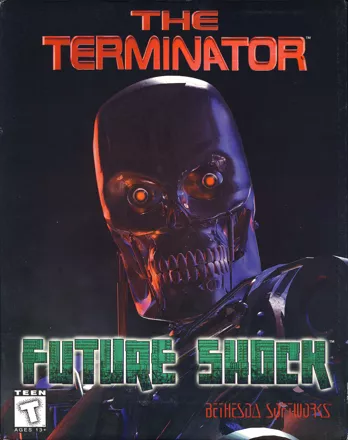
Description official descriptions
The year is 2015, and machines, under the leadership of the super-computer Skynet, control the Earth. Deprived of their civilization, the surviving humans continue to resist the mechanical rulers. The protagonist escapes from the machines' extermination camp with the help of resistance soldiers. Eventually he meets the leader of the resistance, John Connor, and the young Kyle Reese, who send him on missions which are vital for humanity's survival. However, a strange phenomenon begins to occur, with enemies appearing out of nowhere. It seems that Skynet has perfected its technique of time manipulation.
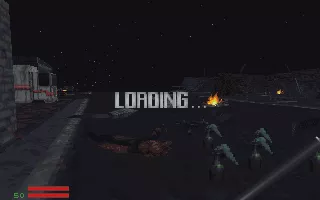
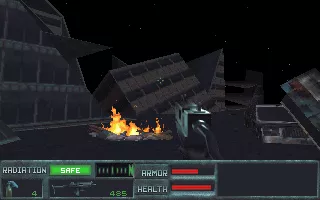
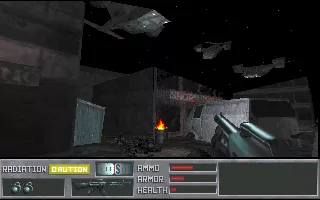
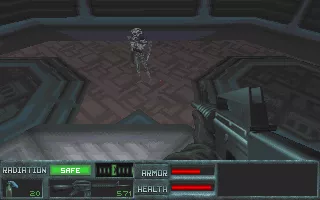
Terminator: Future Shock is a first-person shooter based on the Terminator movie series. The game is notable for being among the first in the genre to feature fully 3D environments and enemies, as well as mouse-based camera rotation, before those features were popularized by Quake. The game has an evolving story and missions with a military feel, including briefings in which it is possible to talk to several people and gather info. There are seventeen different weapons available.
It is often necessary to navigate hazardous terrain, avoiding the effects of radiation. The protagonist can move on foot, or navigate vehicles such as a jeep with mounted weapons, or an aerial combat robot. There is no multiplayer component in the game.
Groups +
Screenshots
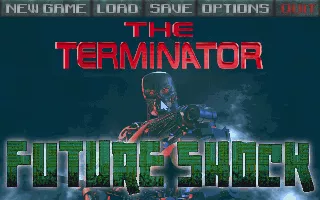
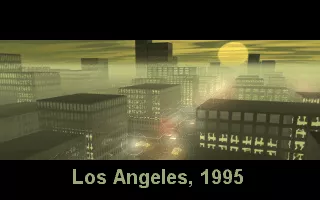
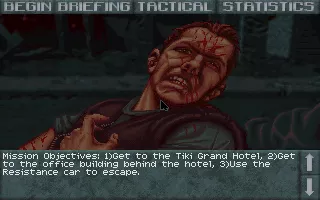
Promos
Credits (DOS version)
34 People (24 developers, 10 thanks) · View all
| Team Leader | |
| Game Programming | |
| Original Story and Design | |
| Producer and Additional Design | |
| Art | |
| Music | |
| Additional Programming | |
| Manual and Box Layout | |
| Cover Art | |
| Testing | |
| [ full credits ] | |
Reviews
Critics
Average score: 79% (based on 19 ratings)
Players
Average score: 3.5 out of 5 (based on 34 ratings with 2 reviews)
Just about the best attempt for Terminator game. Which is not much
The Good
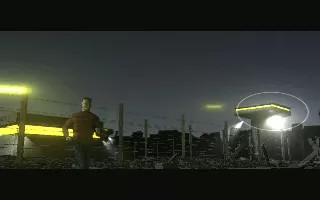
Best thing about this game is, that it's a Terminator game, where you actually get to destroy a lot of, and all kinds of terminators. Also it's quite fascinating to experience the future, we all know from Terminator movies. Some weapons are quite refreshing, at least was for the time when the was made. The game engine is not really that bad, even if it does have it's faults. It had "full 3D" engine before Quake, so it could be called a pioneering game. Intro look cool, especially the nuclear strike.
The Bad
First of all the title says "The Terminator", so you know that the game is going to suck, or if not suck, at least inhale a lot. I really don't believe there are any Terminator games that aren't total bull (and there aren't that many Arnold movie based games either, that were actually good).
Secondly, even if it is kinda fun to destroy terminators, it's just not believable. Most enemies can be destroyed with the steel pipe, you get in the beginning, and the rest are too difficult to destroy with any weapon (not counting flying Terminators, like Hunter Killers). Enemies take too much hits, which is just wrong. If the gun is powerful enough, the Terminator should go to pieces with one or two hits, and if there isn't enough power, no amount of shooting should be efficient. As we all could see in the movie (all of us who's actually seen the movie, but no one else should find any interest to this game), Terminator could take endless amount of hit's from bullets, and it does nothing, but then a gun that's powerful enough, does the trick instantly, not after 15 seconds of shooting. If this game was suppose to be a good Terminator game, the Terminator would be fast, and bullets would make the slow down. But shooting at enemies (which are too scarce by the way) 15 second each, is just awful. Just imagine if doom had like 1/20 of it's enemies, and they all were Barons Of Hell. Would that be fun? I don't think so. Also there are too much enemies, that are only seen in the game, and aren't recognizable from the movies. Why not just infiltrator Terminator? why not just fight Arnold clones, since there are too few enemies anyway? This game would have been much more fun, if there were friendly NPC:s, which you could confuse with infiltrators. But no, that would have make the game somehow original, and would make more like Terminator. It actually would have been fun, if every once in a while you would have been persecuted by a model 101. But no, you just walk around shooting unrecognizable robots, that are scarcely scattered around, and take 50 million hits each, but can still be killed with steel pipe. Enemy AI doesn't actually save much, as it only know to attack when ever player gets too close (too close is sometimes WAY TOO CLOSE). Does that sound like good use of The Terminator licence? I don't think so.
In Terminator movies, scenes about the future were most thrilling. Well ,at least to me they were. They were like freak circus, with oddities. But does that mean it's a good Idea to put in a game. Well maybe, if the game is strategy game or something with a lot of action. But wondering around in 3D future, with very few enemies, is not fun at all. Anyone who has even little knowledge of game designing, could make levels with unrecognizable landscape and very, very simple ruins. That takes about zero creativity and only little effort. Only good things about this games world are gas stations, which give some clue that it used to be a city, and not just dark grey desert with brick walls scattered around. By the way, if gas pups explode when get shot by few bullets, why didn't they explode or burn in the intense heat of nuclear explosion? Nothing really looks like anything.
Why are there no other people? What is our hero doing alone in the field? Shouldn't he have at least a backup? I don't remember in the movie, soldiers wondering mindlessly alone, just looking for another place to go. What I do remember, are intense battles between terminators and humans, but non of that is seen in the game.
Even though some weapons are bit fun, most of them are just boring. Almost all weapons are too powerless, and fighting is always just long rapid fire. Well. Then again, shotgun is much more powerful on terminators, that assault guns or explosives. Even though in the movies, terminators were quite tolerant for intense heat, they are too easily killed by molotovs. But it's too hard to get them hit anything.
The gameplay itself if bad too. Controls are awkward and your character sometimes gets stuck on nothing. All that, combined with the fact that in most levels you have to jump on platforms, makes it quite awful to play. All bad things at controls, are exponentially increased in driving sequences. Little comfort is that, there isn't too much driving in the game. Oddly though HK-flight works quite well, though there is no explanation given, why does a computer driven machine have a cockpit and manual controls, as it was designed to be used against humans.
The ending sucks too.
The Bottom Line
A hardcore die hard etc. Terminator fan might find some redeeming factor for this game. Rest should just avoid it like it was a sex offender.
DOS · by Hannu Siivonen (15) · 2007
An amazing and revolutionary game overlooked by many.
The Good
For it's time, the game had amazing graphics. It was one of the first game to actually utilize texture mapped polygon objects, leading to some really good graphics and animations, although weapons still remained sprites because at this time, the sprites still looked much better than any polygon based gun could do. The sound was very immersive, with a low haunting score playing in the background. Of course, all this was simply shadowed by the amazing mission driven gameplay with more variety than you could shake a lead pipe at. The game actually had a lot of story, and was played out through the sometimes extensive missions. The coolest aspect corresponding with the variety statement was the ability not only to traverse the decimated LA area on foot, but in a Jeep or a downed Hunter-Killer aircraft. The game was also one of the first to use the keyboard/mouse movement pattern we are all much too used to now. The game was incredibly ahead of its time.
The Bad
Well, until the patch came out, one thing in this game could be a real pain. If you were to jump into an unscalable surface, you'd slide down and die or lose almost all your health. That shouldn't have happened and it really ruined some missions for me. Also, mission 6. Mission 6 just pissed me off I spent hours trying to jump into the friggin factory. It's tricky but heres a tip for those who cant get in, you have to sideways strafe jump and change direction mid air and get in running. The graphics compared to some sprite based games still were pretty bland (games like Cybermage still well outshined it in the graphics department.
The Bottom Line
In all, if you're a fan of FPS games, Terminator games, Half-Life or any other 3d story driven game, you are doing yourselves a great injustice by NOT playing this wonderful game, if it weren't for the fact it didn't include multiplayer, I would easily consider this game one of the finest ever made. The sequel, SkyNET fixed this, and added some extras for the install of Future Shock, completing it into one large impressive package that shouldn't have been missed by anyone.
DOS · by Rekoil (28) · 2003
Discussion
| Subject | By | Date |
|---|---|---|
| Freelook | Ace of Sevens (4479) | Nov 19, 2007 |
Trivia
German Index
On September 28, 1996, The Terminator: Future Shock was put on the infamous German index by the BPjS. For more information about what this means and to see a list of games sharing the same fate, take a look here: BPjS/BPjM indexed games.
Secrets
In the demo you could shoot the moon and it would fall down from the sky with a silly sound. In the final game shooting the moon will cause a red "OW" to appear.
SkyNET
If you have the sequel, SkyNET, you can use it to run this game in high resolution (640x480).
Title
The title "Future Shock" can be seen as a reference to common concepts which are discussed/projected in the so-called Futurology (or futures studies). Part of Futurology is the concept of a Technological Singularity, an event where artificial intelligence in combination with raw computing power reaches a stage where it surpasses the capabilities of a human (or of humanity in general). Alvin Toffler's first book on this topic, Future Shock (1970), describes his observations of the effects the technological (r)evolution has on society. Since then the term Future Shock was referenced in numerous publications of different kind (books, music albums, comic strips like Futurama, pen&paper roleplaying games, etc.).
Information also contributed by NGC 5194, NisseBosseLasse and Rola
Analytics
Upgrade to MobyPro to view research rankings!
Related Games
Released 1986 on BBC Micro, 1986 on Electron, 1987 on Commodore 64
Released 2017 on iPhone, Android, iPad

Released 2019 on Xbox One, PlayStation 4, Windows

Released 1986 on Commodore 64

Released 1993 on Atari 8-bit
Released 2003 on ExEn, J2ME, BREW
Released 1993 on SNES

Released 1992 on Genesis, Game Gear, SEGA Master System
Released 1991 on Dedicated handheld
Related Sites +
-
IGCD Internet Game Cars Database
Game page on IGCD, a database that tries to archive vehicles found in video games.
Identifiers +
Contribute
Are you familiar with this game? Help document and preserve this entry in video game history! If your contribution is approved, you will earn points and be credited as a contributor.
Contributors to this Entry
Game added by Wolfang.
Additional contributors: Xoleras, Patrick Bregger, Victor Vance.
Game added August 25, 2000. Last modified May 12, 2023.