The Last Express
-
 Adventure Collection #3
(2014)
Adventure Collection #3
(2014)
Description official descriptions
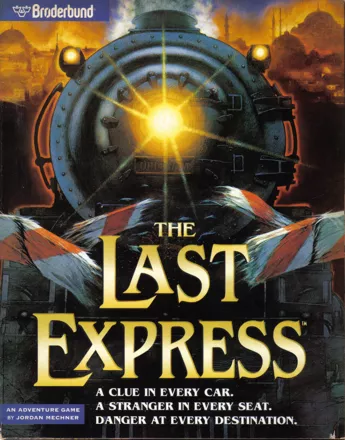
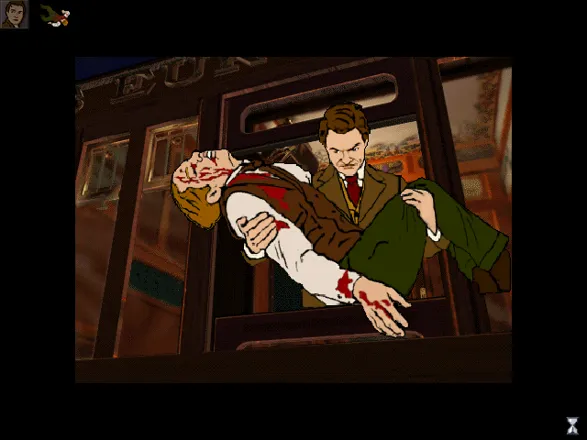
The Orient Express is about to depart from Paris to Constantinople. As the train slowly begins to move away from the station, a young, courageously looking man jumps on it from his motorcycle and makes his way inside. This man is an American doctor named Robert Cath, escaping from authorities as a suspect in the murder of a policeman. In the train, he finds the dead body of the person he was supposed to meet. Now he has to act quickly. The only way not to arise the suspicions of the police is to disguise himself as the murdered man. A very dangerous investigation begins, and the hero soon finds himself involved in a deep net of personal intrigues and political conspiracies.
The Last Express is a real-time adventure game set in 1914, shortly before the outbreak of the World War, in a concrete historical and geographical environment. The game uses a simple point-and-click interface for interacting with people and objects, and navigating the character from a first-person perspective through pre-rendered backgrounds. From the moment the player gains control of Robert Cath, time begins to flow. If the player fails to solve a part of the mystery until the train arrives at the next station, certain events the player was supposed to prevent will occur, ending the game prematurely. It is impossible to permanently die in the game, as the player has the ability to rewind the clock in order to replay a specific period of time.
The player is for the most part free to explore the train, and the story progression has a certain degree of non-linearity. Characters follow their own schedules, frequently moving between locations, talking to each other, and generally acting independently of the player's input. The player can decide to interrupt conversations, remain unnoticed, or openly follow characters and witness their activities. For example, at a certain moment in the game's timeline two characters will perform a classical sonata for violin and piano; the player can opt for staying and listening to the performance, or use the time to explore other locations. Along with detective work and a few inventory-based and logical puzzles, the player's main task in the game is to eavesdrop on people's conversations, talk to characters, and solve the mystery by finding out more information about the bizarre case. There are also several timing-oriented fighting sequences in the game.
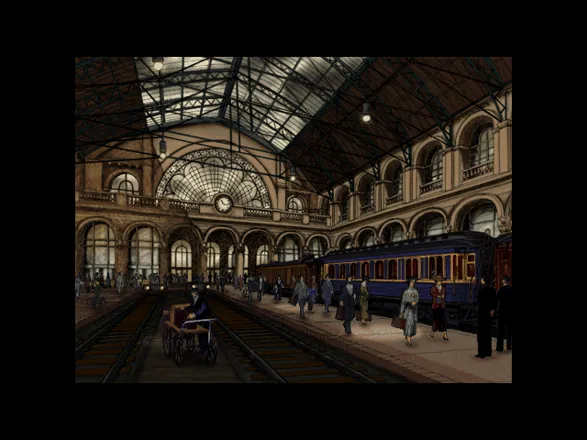
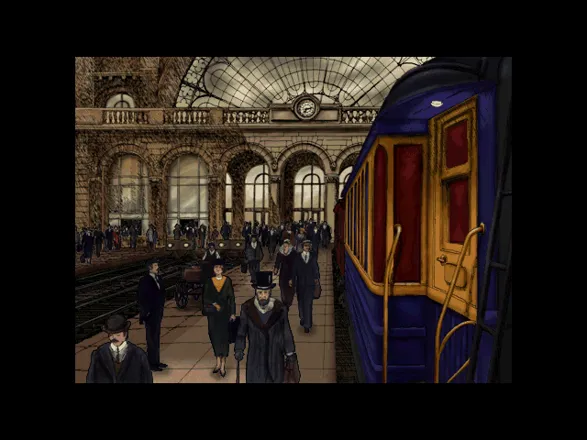
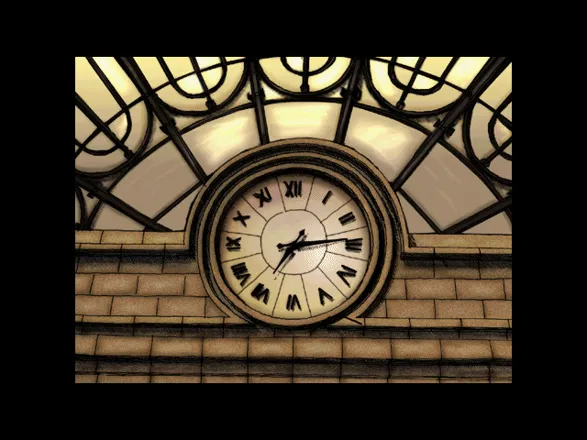
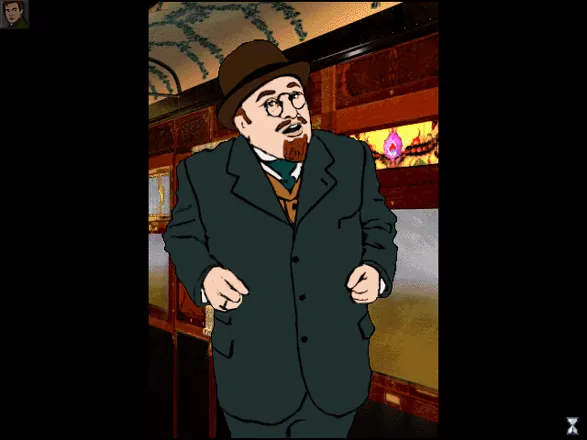
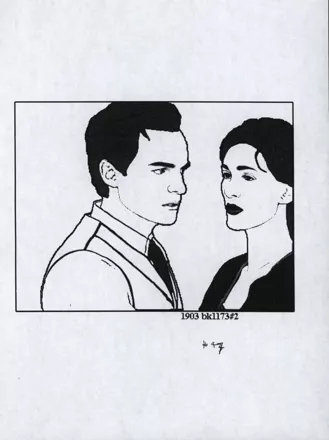
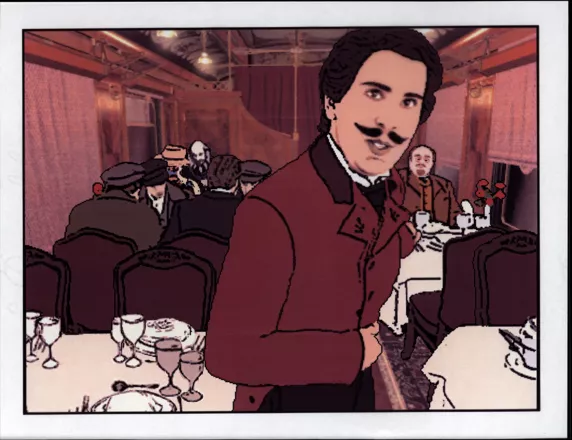
The game's visuals resemble "art nouveau" style that was prominent in the historical time period described in it. The similarity to the style is achieved by using rotoscoping technique. Actors wearing distinctive make-up and costumes were filmed against a bluescreen, digitized, turned into black-and-white frames and colored by hand. The game is also notable for including authentic dialogue recorded by native speakers of several languages (French, German, Russian and others), with English subtitles displayed.
Groups +
Screenshots
Promos
Credits (DOS version)
353 People (280 developers, 73 thanks) · View all
| Game Designer/Director | |
| Written By | |
| Technical Director/Director of Software Development | |
| Art Director | |
| 3D Art Director | |
| Producer | |
| Programming and Technical Design (Lead) | |
| Programming and Technical Design | |
| Executive Producers | |
| Assistant Art Director | |
| Technical Production Supervisor | |
| Background Illustrations | |
| Rotoscope Designer | |
| Supervising Sound Editor/Mixer | |
| Music Composed By | |
| Principal 3D Artist | |
| Windows Programming | |
| Macintosh Programming | |
| Additional Programming | |
| NIS Manager | |
| [ full credits ] | |
Reviews
Critics
Average score: 82% (based on 32 ratings)
Players
Average score: 4.1 out of 5 (based on 125 ratings with 8 reviews)
The Good
How innovative can an adventure game be? We had it all, hadn't we: Point 'n Click, real actors, 1st perspective. And yet the Last Express is so very much different from other games, that it is no wonder it didn't get very good reviews. One needs some time to realize the depth of the game.
This adventure is the one and only real time adventure I have encountered so far. Not like Blade Runner, where the label reads real time, but the story development still focuses on your progress. The train offers the designers a closed area, where the time really runs through your fingers. The other passengers lead a live of their own, walk through the coaches, talk to each other, eat and sleep. I played through the game four times and still I encountered some new stuff.
The graphics are interesting, too. Real actors have been caught in stills, repainted and integrated in the game as "cartoon" characters. This works much better than the usual blue boxed personnel in front of a rendered background. Last Express looks very different from other adventure games. This is of course also due to the first person perspective.
The Bad
The main character is, well, no one you would go out on a beer with. He is a terrorist, a killer and his arrogance adds into the picture. This makes it kind of difficult to identify yourself with Robert Cath. Unless you're a terrorist yourself, I guess.
Unfortunately has the graphics style also a big minus on the other side. While adding to a great atmosphere, the pictures are stop-motion. Meaning that the game blends over from one still picture to the next one. Much like movement in the ZORK graphic adventures. Only important scenes are completely animated.
I guess this is due to the high amount of data. The Last Express already eats up three CDs. But boy would I be happy about a DVD Rerelease - with smooth animation all over. ( I know this is less than probable)
The Bottom Line
The Last Express is a great adventure with an impressive, luring story. You'll need some time though, to get into the plot and to become familiar with the strange stop motion first perspective view. Try to buy the game with the packaging. At least the German release had a great double cover with some beautiful pictures and printing on the inside.
DOS · by Isdaron (715) · 2001
The Good
What I really like about this game is the fact that I feel that I AM a character. Unlike any other game I can think of, the character actually means something and interacts perfectly with other characters. And it's not like other games where time doesn't pass by unless you do something. No, just like in real life, time passes by regardless of whether you do anything or not, and characters just interact with each other. It just feels too real, and the characters are really deep and each has its own story. The train is beautifully remade, and you can just chill out, do nothing, go talk to people, overhear their conversations, listen to a concert by its passengers, steal things, read people's diaries... and most importantly find out who killed your friend who was on the train before you jumped in. 100/100
Job perfectly done.
The Bad
The animations might be a little primitive, but considering the year the game was made they're excellent, and after a while, you'll get used to them.
The Bottom Line
JUST BUY THIS GAME!
Windows · by Fares Najem (3) · 2004
The Good
Note: this review if for the Gold Edition release distributed on Steam. No noteworthy modification from the original game intervenes.
The Bad
(review is below)
The Bottom Line
One can not really see Jordan Mechner's self-assigned mission with The Last Express as unambitious. This adventure game is a videoludic reinterpretation of Agata Christie's masterwork Murder on the Orient-Express. A work realised in the end of XX century, based on a book from ---- narrating events and intrigues taking place on a train in the 20s. If porting works of art from one media to an other one is always a risky enterprise at least, porting a masterwork is risky all the more, specially since the source book belongs already with contemporary art, that which is conscious that reality is not reality. Mechner's adventure finely fulfils subtle surrealism, yet this is not going to be what the player notices firstly, for sure. More likely, that will be the environment, the inside of the train, with that visual, bodily narrowness that feels like a minacious cage. Controls reveal to be simple once getting accustomed to them, which, because of the introductive tutorial's inadequacy, does not occur much early. One feels constrained, and surrounded by peril. Relaxation and relief are to be waited for: they'll come once the time-manipulating mechanism that is the core of the gameplay becomes familiar. At any time in the game it is possible to move back to any time in the past and change the course of the story: by there, game overs though many are all painless.
Meanwhile, the train proves as spatially limited as dense with facts, words actions emotions purposes passions, and of course deceit mystery, and murders: it takes it not long to stop looking small. Like life, and the book, it houses many lives, or rather many games, as parallel as to seem one, in reality each alternative to the others. To play The Last Express naturally implies not to see all what happens, not to hear all what is said: conversations, happenstances, take place simultaneously, and everywhere. The perplexing clock, on the user interface marks fundamental moments with its heart-beat; many other ones flow free, unknown. One can subvert this realistic logic by replaying several times each section prime gameplay innovation, moving back and forth in time at will. And then follow the actions and speeches of each of the characters for the entire trip. It is a different way to live the game, as right and wrong, if less natural, as the opposite one.
Graphics are exquisite in animation, drawing, technique; the relatively narrow spaces are represented with the subtlety of a mosaic: the hands of a clock, the feather of a hat, the texture of a leather chair, everything is given the richness of a painting. But there is no invention, no alteration, no addition to reality: just faithfulness to the source: just an authentic portrait. Which requires of the author respect and courage. Drawing is that of an animated film, joined with a vivacious Victorian palette, having an aristocratic scent. One actually feels on the Orient-Express, a train of a gone time for an aristocratic class that is not there anymore, which goes along a route that is not covered anymore. In regards with the gameplay, it is proficient in design. Puzzles, the range of possible interaction with the environment and the non-playing characters: all is no less than well designed, less for the initial tutorial.
The myriad of stumbling blocks and chances for inconsistency threatening a game which deals with a multitude of characters all in action for the whole time is nearly completely prevented. Voicing, most essential here, is on par with that in a serious film, far from what is found in TV series or fiction. Since graphics are the same, shat would elsewhere be cutscenes is an integral part of the gameplay, well-played to the point of asking for repeated watching. The whole game is pictured in a technique similar to full-motion video, animations taken from actors with excellent results.
It gets to unexpected details. See how voices that reach us from nearby are differentiated from those coming from another room or compartment. What about the thunder and noises from rain, coming through windows? This is what tells about a work: that M.me Wolff often changes her dress and if we inspect her baggage we see the one she was wearing before; the whistle of the train stopping, the clatter of the train leaving; a philanderer nervously checking his clock in the wait for a date, a little rascal who turns his curiosity ripe eye on us while going to dine with his parents, the quantity of train staff members and how their characters and appearance differ from each other (even assistant cooks and waiters aren't mistakable for the head waiter and the chef, li they usually are not in reality), while all of them remain easy to distinct from the travellers, as easy as in real life... Notwithstanding a non-negligible part of these will go unnoticed in the standard walkthrough, subtleties are countless.
None of this grants The Last Express its height, instead it does that while it deals with numerous questions one would see as contingent it is a drama about the hinges of human existence. The slavery to greed and even further to the irrepressible desire for power, which make conflict triumphant and endless; the fact that love be a draught promptly secured by the hermetic seals of reciprocal self-centredness. Apart from, of course, the innocent; melancholic shadows destined to fade after the sunset: Alexei, Tatiana... above all Max... that can love and loves, while he obviously finds strange the totality of events around him. This is a trip going to inspire keen passion in the kind of traveller who will notice that, at a certain moment, the slave muslim women have freed themselves from their burka and will be glad to hear, by then, their lively chit-chatting; and to earn no less than appreciation from any player having the slightest inclination for adventure games.
Windows · by click here to win an iPhone9SSSS (2261) · 2015
Discussion
| Subject | By | Date |
|---|---|---|
| Hopelessly stuck... | vedder (70822) | Apr 28, 2011 |
| Paul Verhoeven! | Depeche Mike (17455) | Apr 15, 2010 |
| Revisiting An Unsung Classic | St. Martyne (3648) | Nov 29, 2008 |
| Why couldn't there be more games like this? | Unicorn Lynx (181775) | May 21, 2007 |
Trivia
1001 Video Games
The PC version of The Last Express appears in the book 1001 Video Games You Must Play Before You Die by General Editor Tony Mott.
Cameo
Designer Jordan Mechner makes a cameo appearance, as one of the porters loading August Schmidt's merchandise crate onto the train at the Munich station.
Inspiration
In Marc A. Saltzman's Game Design: Secrets of the Sages (BradyGames 1999), Mechner points out several sources of inspiration for The Last Express: * The Alfred Hitchcock movie The Lady Vanishes (1938) provided the idea to use a train as the setting * The plot was modeled after spy novels such as John Buchan’s The 39 Steps and stories by John Le Carré * European comic artists François Schuiten and Enki Bilal inspired Mechner to use stylized drawings instead of real-life actors * Characters were drawn in the style of the Art Nouveau period * The game is set during World War I because “the Second World War as a scenario is overstressed, in games as well as in movies”
Music
The soundtrack of the game is available on audio CD. Its composer, Elia Cmiral says the following about the score:
The Last Express was my first composition for a computer game, as well as my first serious assignment after moving to Los Angeles. It was a large project that took three months to complete. Before I could begin, however, I had to learn the requirements of writing for this new medium, and plan how to write such a large number of short cues. Director Jordan Mechner was a great help and a good teacher to help me navigate both the game and the new genre. The story has many unique characters of different ethnicities, exotic environments and a wide range of moods including suspense, drama and love. I developed groups of cues and assigned them themes or orchestral colors. Each group expresses a certain feeling and is tied thematically to the others in the group. This reduced the number of themes and kept me focused on the characters’ emotions. The main theme evokes a touch of sadness, romanticism, and tension on the eve of the First World War. The score relies on a small ensemble of strings with violin solo, some hand percussion, and extensive use of synthesizers for color and texture.
The music Anna and Kronos play at the concert in Kronos' private car is Sonata for Violin and Piano by C. Franck, a Belgian/French composer of the end of the 19th century. It is one of the most famous violin sonatas of all times. It can be heard any time the player goes to Kronos' car.
Orient Express
Developer Smoking Car Productions went to great pains to digitally replicate the Orient Express accurately. When they tried to find an authentic train car from the period before World War I, they soon learned that there were two versions: Teakwood wagons that were in service just up to 1914, and the steel cars that replaced them since. Unfortunately, few of the fragile wooden cars had survived World War I, even less the chaos of WW II.
Through a network of train buffs, however, the production team was able to track down a sleeping car. A man in France gave the team the name of a man in Italy who knew of a car in Athens, Greece. It had lain there abandoned for some 50 years.
Lead 3D artist Donald Grahame and his crew took hundreds of photos of the car and complemented them with contemporary pictures. The design staff also rummaged through archives and dug out original blueprints, train schedules and logbooks, read pre-war newspapers and magazines, traveled and dined in trains, and watched any Orient Express movie they could lay their hands on – all this to ensure that they would be able to recreate the Orient Express and the atmosphere on board in detail.
Languages
Most characters in the game talk to each other in their native tongues, but strangely enough, the native German speakers Anna and Schmidt rarely use German when talking to each other. Also, unlike in most movies, the Russians (as well as the French and the Germans) of The Last Express are absolutely authentic. All the Russian characters speak Russian without a trace of an accent.
Sales
The project took nearly four years to complete and included a month-long blue-screen filmshoot and a round-the-clock staff of up to 50 animators, artists, asset wranglers, and programmers. The game only remained in stores for a few months. Broderbund's marketing department quit just weeks before the game was released, resulting in virtually no advertising for it. Softbank pulled out of the game market, dissolving its subsidiary GameBank and canceling several dozen titles in development, including the nearly finished PlayStation port of the game. The Last Express was out of print long before its first Christmas season and nearly a million units shy of breaking even. By dropping their support of an already completed game, Broderbund and Softbank most likely increased their losses.
Style
All the game’s characters are drawn in Art Nouveau style. Art Nouveau (French for "New Art") was a major movement in European arts, starting in the 1880s and declining with the beginning of the First World War in 1914, the time The Last Express is set in. Artists of all kinds (writers, sculptors, painters like Henri de Toulouse-Lautrec in France, architects like Gaudi in Spain) aimed for a unification of all arts and for an erasure of stylistic boundaries. Art Nouveau paintings are naturalistic, yet minimalist through the use of clear lines, strong colors and little to no shading. To modern eyes, this makes them sometimes look like cartoon drawings. The Last Express mimics this style.
Despite their ink-paint look, the passengers of The Last Express were not hand-drawn, but played by real-life actors. Smoking Car artists processed the blue-screen footage of the characters into thousands of black-and-white stills, which were then recolored in Art Nouveau fashion, rotoscoped (i.e. cut out) and finally projected into the 3D-rendered Orient Express backgrounds. To increase the cartoon look, the actors had to have distinctive features such as beards and hats and wore special costumes with marked lines and strong colors. Make-up artist also tortured them with colored streaks in the hair and a homogeneous facial make-up. Take a look at the behind-the-scenes movie here.
Awards
- Buyers Guide
- 1998 - Best Adventure and Role-Playing Game
- Computer Games Magazine
- One of the Top 10 Graphic Adventure Games of the 1990s
- Family PC Top Rated Awards
- 1997 - Best Adventure Game
- Macworld Game Hall of Fame
- 1998 - Best Role Playing Game
- Washington Post
- Golden Fez Award
Information also contributed by -Chris, CaptainCanuck, Isdaron, Unicorn Lynx and Ye Olde Infocomme Shoppe.
Analytics
Upgrade to MobyPro to view research rankings!
Related Games
Released 2011 on Windows
Released 2018 on Macintosh, Windows
Released 2013 on Windows, 2015 on Macintosh

Released 2019 on Windows, Macintosh

Released 2016 on Linux, Windows, Macintosh
Released 2008 on PlayStation 2

Released 2014 on iPad, iPhone, Android

Released 2024 on Linux, Windows, Macintosh
Released 1984 on Commodore 64, 2019 on Antstream
Related Sites +
-
Crap Shoot
A humorous review on PC Gamer -
FAQ for The Last Express
A thorough FAQ, including all possible endings plus detailed discussion of plot. -
Hints for The Last Express
These hints will get you through the game without spoiling the game. Authored by Robert Norton. -
Jordan Mechner's The Last Express
Dedicated section on game author's site (official site), with comments on the game making experience and the exclusive patented animation technique, and more. -
The Last Express Review
A review of the Macintosh version of Brøderbund's pre-war adventure game, The Last Express, by Marc Khadpe (Sept. 12, 1998). -
Zarf's Review
A Mac review of The Last Express by Andrew Plotkin (January, 1999). -
interview (November 28, 2008)
for Gamasutra with Mark Netter and Mark Moran
Identifiers +
Contribute
Are you familiar with this game? Help document and preserve this entry in video game history! If your contribution is approved, you will earn points and be credited as a contributor.
Contributors to this Entry
Game added by Shane k.
Blacknut added by Sciere. Android added by Kabushi. Macintosh added by Martin Smith. iPad, iPhone added by Isdaron.
Additional contributors: Eurythmic, Unicorn Lynx, Jeanne, Zeppin, Dennis Ploeger, Cantillon, Patrick Bregger, FatherJack, click here to win an iPhone9SSSS.
Game added March 27, 2000. Last modified February 28, 2024.