Outcast
-
 Outcast 1.1
(2014)
Outcast 1.1
(2014)
- Play the Games Vol. 3 (2000)
-
 Play the Games Vol. 3
(2000)
Play the Games Vol. 3
(2000)
-
 Outcast (Limited Edition)
(1999)
Outcast (Limited Edition)
(1999)
-
 Outcast
(1987 on
ZX Spectrum, 2020 on
Antstream)
Outcast
(1987 on
ZX Spectrum, 2020 on
Antstream)
Description official descriptions
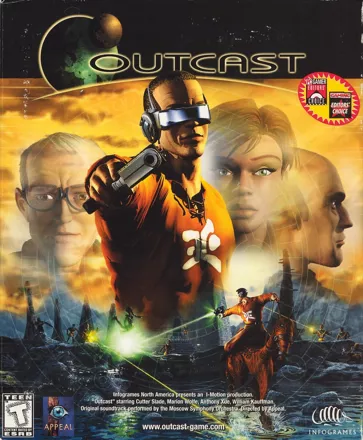
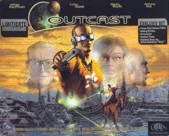
In the year 2007, a parallel universe is discovered by scientists. The U.S. government sends a probe to that universe and learns of the existence of an entire alien civilization there. However, an apparently hostile alien damages the probe, leading to the creation of a black hole threatening the very existence of our own world. Former U.S. Navy S.E.A.L. Cutter Slade is assigned to escort three scientists to the parallel universe in an attempt to repair the probe and avert the danger.
Upon arrival, Cutter is separated from the scientists and is greeted by the local inhabitants, the Talan. It appears that their world, Adelpha, has its own troubles: a mysterious being known as Faé Rhan has been assembling an army consisting of Talans who think themselves superior to the rest of the population and willing to rule over them with violence. Cutter is proclaimed the Ulukai, a savior mentioned in a prophecy, and entrusted with the task of retrieving five sacred relics needed to overthrow Faé Rhan - all while trying to locate the scientists and save the Earth as well in the process.
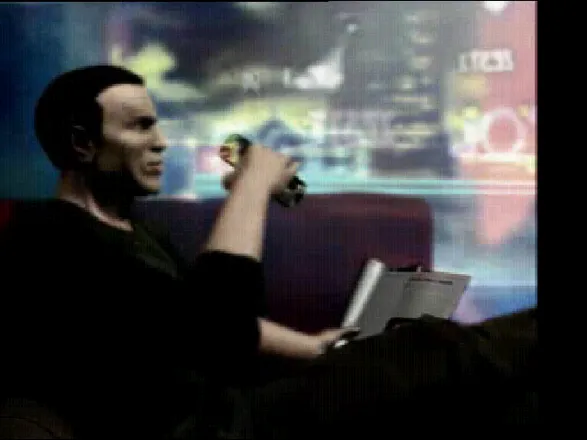
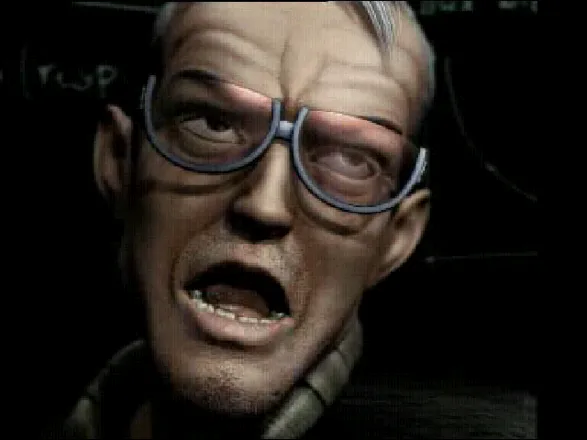
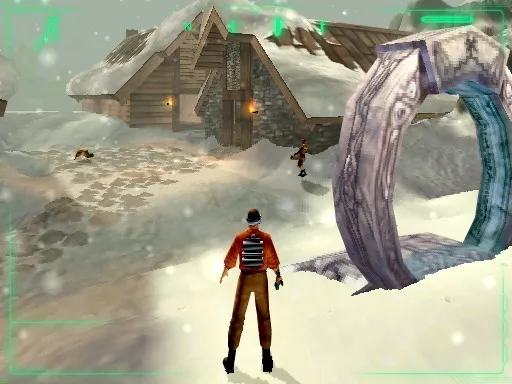
Outcast is a 3D third-person (with optional first-person view) action game with adventure elements. In search for five sacred relics, the protagonist travels through the five continents of Adelpha (plus one tutorial island). Each land has its own landscape (mountains, lakes, forests), populated areas, as well as dozens of minor problems - small quests that the hero is required to solve. Most Talans populating the world can be conversed with about a variety of topics. A large portion of the game consists of finding key characters and performing quests for them; some of these are optional, though most must be completed in an adventure-like linear fashion in order to advance the plot. Cutter is free to travel between the continents using special portals.
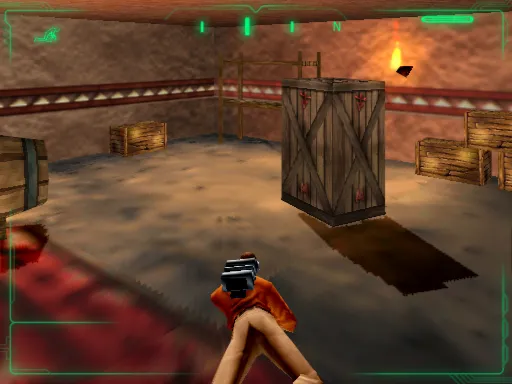
Apart from exploration and completing quests, Cutter will also fight many guards and creatures. At his disposal are six futuristic weapons (railgun and others); ammunition for those guns is scattered around and can also be produced by mixing items. Aiming help is provided in the form of laser sights. Sneaking up to the enemy and punching him out silently is also possible. Gadgets such as a holo-decoy can be used to help Cutter gain the upper hand in combat. The player character can also jump, climb, swim, dive, crawl, and ride a local animal known as Twon-Ha for faster travel.
Spellings
- 时空英豪 - Simplified Chinese spelling
Groups +
Screenshots
Promos
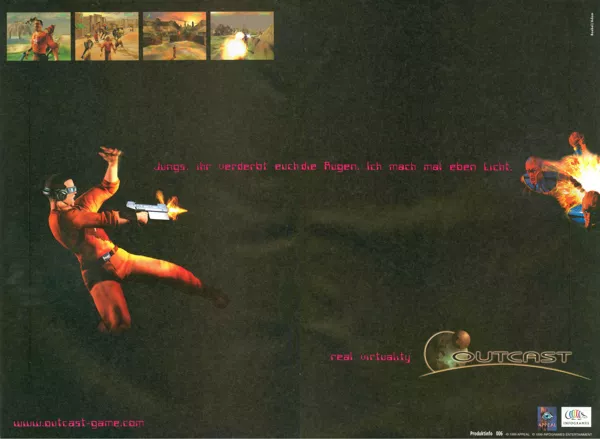
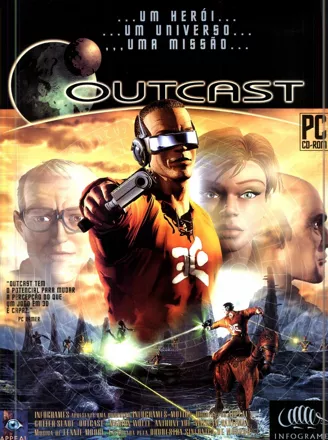
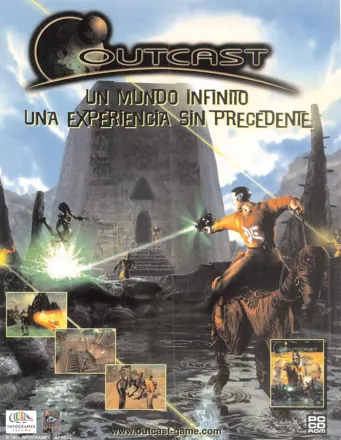

Videos
Add Trailer or Gameplay Video +1 point
See any errors or missing info for this game?
You can submit a correction, contribute trivia, add to a game group, add a related site or alternate title.
Credits (Windows version)
161 People (135 developers, 26 thanks) · View all
| Presented by | |
| Design | |
| Programming | |
| Additional Programming | |
| Graphics / 3D Programming | |
| Music / Sound Programming | |
| [ full credits ] | |
Reviews
Critics
Average score: 86% (based on 34 ratings)
Players
Average score: 3.9 out of 5 (based on 92 ratings with 12 reviews)
Most fun I've had playing a PC game!
The Good
This game is a nearly perfect blend of action and adventure. It takes place mostly outdoors with expansive vistas (many games tend to have a very limited visual field, whether due to primarily interior or urban environments). It has many supporting characters with individualized personalities. The musical score is performed by the Moscow Philharmonic, and gives the game a "cinematic" feel. The interface was very easy to learn and uses a combination keyboard/mouse. This game is vast and will keep the player busy for many enjoyable hours.
The Bad
I suppose the use of voxels to render the imagery was one thing that could be improved upon. There is a lack of rendered detail of objects. Oddly enough, this did not really detract from the game a bit. I have read that the sequel will not be using voxels and that the detail will be much better.
The Bottom Line
Outcast is a game to try if you are an adventure gamer and you need a break from hardcore puzzle solving. There are puzzles but they are so well integrated into the storyline, and they are usually solved within the context of the action. FPS/action gamers will probably find the action a bit tepid but this game is "aimed" more at the adventure gamers who like some action elements too. My wife and I both enjoyed this game very much!
Windows · by Rodney Mayton (17) · 2001
A very pretty, but very bad European imitation of Hollywood's "worst-of"
The Good
"Outcast" is an interesting game which tried to emulate an alien world complete with creatures and inhabitants when other 3D games were mostly still limited to in-door levels or only short outdoor sequences in need of constant reloading ("Half-Life") and, to some degree, it succeeded.
"Outcast" is an action-adventure. The story is hardly worth mentioning, it's about some growing portal to another world threatening to devour earth entirely, thus requiring the player to enter said alien world to close said portal. Naturally, something goes wrong and one ends up trapped on the "other side" with some alien race which takes the player for their god-like saviour figure "Uluk-Hai" - resulting in the fact that one has to safe two worlds instead of one (just what video gaming needed) within a limited amount of time (although there is no time limit), but more of that in the "bad" section.
Visually, this game is a true masterpiece. I played it very recently and it doesn't look bad at all, in fact, the animations, water reflections and colouring are extremely well done and will most certainly look good forever. The game's resolution is quite low but after one has gotten used to the resulting blur (easy for us DOS-gamers) it's not a problem anymore since important items or creatures are still easily recognizable. The blurry images in combination with the non-polygonal, "smooth" feeling of its employed voxel-engine give "Outcast"s graphics a sort of watery notion, though, as if one would move through an impressionist painting. However, I didn't object to that in the slightest, for me, it even enhanced the unreality and overall alien feel of the world and rather heightened than lowered its artistic qualities. Moreover, apart from being very good, "Outcast"s graphics are quite unique, too: the few other voxel-based games (i. e. "Blade Runner") share only a limited set of technical features while the more common polygonal games appear to be altogether different in style. Since every 3D game uses polygons nowadays, the development of other voxel games gets more and more unlikely. Thus, "Outcast" will most probably keep its unique status as a very differently looking, beautiful game with a masterful use of colours, a great feel for the right effect at the right time (this game definitely got that lens-flare thing right!) and a variety of cool design ideas, like some interesting vertical structures.
Another great point about "Outcast" is controls. Game controls are easy and quick to learn, yet allow an adequate amount of different movements, standard stuff like jumping and crouching goes together with riding on (sort-of) horseback and climbing ledges. Control reactions are great and really give the impression of being able to intuitively move around with one's character.
This leads to the game's best gameplay side: the combat. Due to its precise controls, some great sound-effects, a rather intelligent (or at least sufficient) A. I. and a very limited but clever arsenal of weapons, fighting in "Outcast" is exciting. There aren't too many types of enemies, but the way one can use the (beautiful) environment, the ease with which one can control one's character's every move, and the well balanced amounts of damage one can deal and take make for some fine challenges nonetheless. Adding to that, battles in "Outcast" aren't graphic at all, an enemy gets hit and dies without a single drop of blood being spilled - another proof of the fact that simulated combat doesn't need to be overly violent to be engaging. The only problem with "Outcast"s combat is: there's simply too little of it, and too much of everything else.
The Bad
As a world simulation, and that was certainly one of it's aspired main goals, "Outcast" falls flat on its face. Of course, every aspect of realism is instantly vaporized when one finds the first ammunition and health packs on a rooftop and starts jumping from house to house in search of gadgets someone (?) deliberately placed there for one's convenience. But the problems start earlier on. The game world is just not believable. There are creature, yes, but of too little variety. People walk around and do interesting things like push-ups or harvesting rice, but there is no day/night cycle and most of the aliens are just there to molest the player with uninteresting, generic tasks they could easily do themselves if they would possess any real "life". Moreover, there are neither women nor children. This is explained in the game, but in a thoroughly unbelievable way ("They live on some distant island...") - one immediately realizes that it was a game design choice to omit them and that it had nothing to do with a better way to depict the aliens' culture: this would have been far easier and a lot more convincing if the game would have been able to depict their "normal" family life, especially because they appear so very human in most other matters. Adding to that, the male NPCs are far from being interesting themselves. With a few exceptions, most of them are dull, generic and stupid to an unbearable degree, even worse, some of them appear to be merely present to give the main character enough opportunity to wise-crack juvenile jokes at their expense. This does not only render the game's world extremely lifeless, since all on-going conflict appears to directly involve the player in some way and since there's is no sense of any "progress" or any "action" when the player's not around, it even omits a minor, but still unpleasant feeling of racism.
SOME SPOILERS AHEAD!!!
Without over-interpreting anything: here you have an alien race which wears Arab clothing and lives in Arab-style buildings, situated mostly in desert regions, harvesting rice. They are not able to do anything without the help of their "saviour" Uluk-Hai, a white American marine (in a French game!) whose main and final act of "saving" is actually getting rid of an omnipotent Asian midget impostor. I am certainly not the most "politically correct" person on this planet myself, but the stubbornness with which just everything in "Outcast" is centered around the one white "action" guy is really something to behold. Quite simply, this game, while employing an extremely poor, predictable and most of all short plot, does a wonderful job at being perfectly chauvinistic. Just imagine: a world without women and children, led by a small, Asian tyrant, inhabited by helpless Arabs - what more could the average video gamer want as a playfield to live out his/her (and I doubt the "her" in this case) own omnipotence fantasies? For this is clearly one reason for the existence of so many games where the player takes the role of a god-like saviour figure: the human urge for an easy, understandable world which one can conquer and dominate as an all-knowing, all-seeing, benevolent god who's able to save and load. However, the slight fascist tendencies of this common cliché were hardly ever more present in any other game than in "Outcast". Just because the player does nothing but help everyone out and act as Messiah, the questionable ethics of depicting a white guy as the only "active" person in an otherwise completely inactive and helpless "alien" world whose own visible purpose is to serve as said white man's playground gets apparent.
Still, this is not where this game's trail of tears ends. "Outcast" does not only employ a weak plot, puffed up with unbearable loads of "epic" music, "cool" one-liners and, worst of all, some noticeable chauvinist omnipotence tendencies, moreover, the adventure parts of this game are to laugh at. Either they are no puzzles at all or they involve unbearable degrees of running to and fro across miles of terrain carrying around despicable amounts of "MacGuffins" (objects which get a story going without having any real purpose or meaning by themselves) from person A to identically looking person B. While some side-quests are not that bad, these are completely overrun by the sheer mass of generic errand quests. This is quite a serious problem in a game which does not have an interesting main quest to begin with (although I think that saving Earth could be interesting, it isn't in "Outcast"). To top it all, the game's main character Cutter Slade (what a name!) and his "supporting cast" from Earth are almost as numb and uninteresting as the indigenous people to be found - there is not only no character development, these are no real characters to begin with. Everything about them appears to have been copied/pasted from a random oh-so epic Hollywood flick - which leads to this game's last major weakness: it tries to emulate the "movie"-feeling far too hard, it doesn't want to be a game, it wants to be "more", it wants to be an "interactive experience", whatever that is.
The Bottom Line
Zovni's review mentions that this game is filled with European "art-house" pretentiousness. I disagree. Of course, European "art-house" pretentiousness does exist, but that's more like filming a cup of coffee for fifteen minutes and ending on a girls lips uttering a soft: "This is your life getting cold". The pretentiousness of "Outcast", on the other hand, is the pretentiousness of Europeans trying to emulate Hollywood's "worst-of" (note: of course, there are a lot of good Hollywood movies, too). It's filled to the teeth with everything that screams "epic", but doesn't contain any intimacy - in fact, compared to "Outcast", "Independence Day", also done by a European guy, is a psychologically intriguing melodrama. It's extremely conservative with chauvinist tendencies and doesn't assign any really meaningful piece of the action to any other character but to the main jack. It's puzzles and plot are not only dumb, but completely unoriginal and it's whole content is little to none across the board.
However, its graphics are wonderful, its controls are crisp and the fighting is well executed. In the end, "Outcast" is a sad game. It could have been at least a piece of good entertainment if only the designers had concentrated on the combat aspects. Maybe the stereotype story and characters wouldn't have been so terrible in such a context, and with less text and less meaningless tasks depicting the sheer inactivity of the indigenous population, with an added female touch and perhaps a different main villain (he would actually have been great if this game would have had but a slight ironic undertone), "Outcast"s chauvinist tendencies could have been drastically lowered. However, it wasn't meant to be: as it is, this is far from being a good game. It's worth seeing for its graphical splendour, but it's not worth playing through and the opposite of a "rewarding" game, since it doesn't leave a stone unturned to remind the player that we Western people sometimes have indeed peculiar views of what's "entertainment" (of course, this probably goes for any other culture, too).
Windows · by worldwideweird (29) · 2008
The definitive 3rd person adventure
The Good
The story,graphics, cast and atmosphere.Its a living world with great environments, fantastic soundtrack and a cool hero.
Outcast might look dated today...but only for ten minutes, then You just forget about pixel and vertex shaders and admire the viewing distance, landscape and environment.
Only recently polygon based games achieved this level of quality.
The game is stable even on win2000 (not even the patch is needed !) and the voxel engine is beautiful. The quests and plot work flawlessly.
A true masterpiece both in design and execution.
The Bad
It spoiled it all for me.No other game comes close, so its pretty hard for me to decide which game to play next.
Outcast is so full of it all and so perfect that You might not "need" any other game of that kind anymore.
Except for a sequel.
The Bottom Line
A living, alien world, a Bruce Willis-like hero, a great plot with great characters, good speech, good handling, great graphics.
The right game for any gamer, especially during christmas holidays.
Windows · by Emmanuel Henne (23) · 2002
Trivia
1001 Video Games
Outcast appears in the book 1001 Video Games You Must Play Before You Die by General Editor Tony Mott.
Cancelled Dreamcast version
A Dreamcast version was planned by Infogrames, which would feature a new, fully polygonal engine to replace the original one. However, thanks in no small part to Outcast's small sales and the self-destruction of the Dreamcast console, on September 22, 2000 Infogrames announced the cancellation of the port's development. This is sad indeed, since Infogrames had hinted that a 3D acceleration patch for the PC version would be available thanks to the Dreamcast port (since the console uses DirectX as its core API for 3D acceleration).
Graphics engine
A common misconception is that Outcast employs a voxel engine. Franck Sauer, though, said in an interview with gaming magazine "Strana Igr": "We've all misused the term voxel for what actually is just an height field with some software raycasting". The engine allows for a complex architecture and a wide range of sight. However, it features only low resolutions up to 512 x 384, does not support 3D accelerator cards and requires a potent processor (preferably 500 Mhz) to run smoothly.
Legacy
On November 1999, Appeal announced a sequel Outcast 2: The Lost Paradise, a PS2 game with a PC release to follow. Appeal however declared its bankruptcy on August 12, 2002 and the game was canceled. A major part of the team moved to elseWhere Entertainment and a petition was started to persuade Infogrames to allow Elsewhere Entertainment to use the Outcast license, but with no result. A team called Eternal Outcasts started working on Open Outcast as a mod for different types of engines, first the one of Gothic, then the Crystal Space engine, next CryENGINE2 and finally settling on CryENGINE3. After two tech demos (Oasis 1.0 & 1.1) that can be played as mods through Crysis Wars, the project was re-branded on 1st April 2013 as Outcast: Legacy of the Yods.
On 3rd July 2013 it was announced that Yves Grolet, along with the other two original Appeal founders Franck Sauer and Yann Robert, bought back the rights to Outcast from Atari. The game will be developed through Grolet's company AMA Studios and Sauer and Robert will work for AMA through their own company Fresh3D S.A.R.L. Tentatively dubbed Duality, it was then confirmed that it would become the official successor to Outcast. Duality was already announced as the third AMA title at least one year earlier, but with no details except for the title.
Outtakes
Appeal created 15 movie outtakes for Outcast. They could be downloaded as mpg-files from the game's official website. Ideally, any viewer should have played the game, in order to understand the puns.
Promotion
A lengthy gameplay demonstration of the game was shown on the main projection screen at the Belgian demo party Wired 1998, nearly a year before its official release.
References
- Listen closely, and it's possible to recognize the main notes of Luke's Theme from the Star Wars soundtrack being played by some of the flute players in the region of Okriana, particularly those west and east of the palace. Fitting, considering the city is in the desert.
- The word Okriana could be seen as an anagram of the Russian word okraina, which means the outskirts. However, according to an interview with Franck Sauer, it actually comes from ochre, the yellow colour that dominates the area.
Save
The crystalline object used to save your game is called a Gaamsav. Carefully listening to that name makes its use more than apparent.
Voice actors
In both the French and the German version of the game, the actors providing the main character's voice are the dubbing voices of Bruce Willis in the respective languages: Patrick Poivey and Manfred Lehmann.
Awards
- Computer Gaming World
- March 2000 (Issue #188) – Adventure Game of the Year
- GameSpot
- 1999 - Adventure Game of the Year
- GameStar (Germany)
- Issue 03/2000 - Best Sound in 1999
- Issue 12/1999 - #57 in the "100 Most Important PC Games of the Nineties" ranking
- PC Powerplay (Germany)
- Issue 11/2005 - #8 Game Which Absolutely Needs A Sequel
Information also contributed by -Chris, Lumpi, Sciere, shifter, Supernintendo Chalmers, Xa4, Zack Green, and Zovni.
Analytics
Upgrade to MobyPro to view research rankings!
Related Games

Released 1996 on DOS

Released 1997 on Windows, PlayStation
Released 2007 on Arcade
Released 1990 on DOS, Amiga, Commodore 64...

Released 2001 on Windows
Released 1996 on DOS
Released 2000 on PlayStation 2

Released 1998 on Windows, PlayStation

Released 2013 on iPhone, Macintosh, Android
Related Sites +
-
Open Outcast
A fan-made sequel in the works. The team intends to use the CryEngine 2 for terrain modelling. Well worth a look. -
Outcast - Wikipedia
article about the game in the open encyclopedia -
Outcast Hints
Alex Burrell wrote these excellent hints for Outcast for the Universal Hint System. -
Outcast II.net
A very comprehensive site with news, resources, art, guides and interviews.
Identifiers +
Contribute
Are you familiar with this game? Help document and preserve this entry in video game history! If your contribution is approved, you will earn points and be credited as a contributor.
Contributors to this Entry
Game added by robotriot.
Additional contributors: -Chris, Unicorn Lynx, Jeanne, Chentzilla, Sciere, CaesarZX, Cantillon, Zeikman, Patrick Bregger, FatherJack.
Game added November 1, 1999. Last modified March 31, 2024.