Star Control II
Description official descriptions
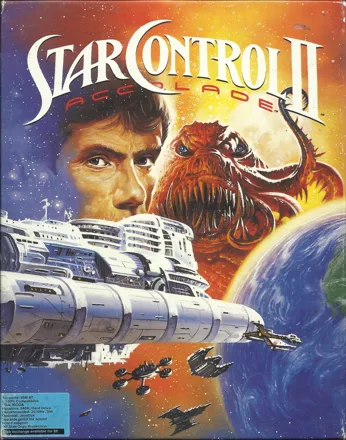
Following an ongoing war with the alien Ur-Quan race, the Alliance has lost. The Ur-Quan armada systematically hunts down the alliance races and imprisons them onto their homeworlds. However, unknown to the Ur-Quan, a small research vessel had been lost during the war while sent to a distant star system looking for evidence of the ancient Precursor race. The survivors of this research team had come across the controls to a Starship factory and used it to build a Precursor supply vessel, one of the largest vessels in the galaxy.
Upon return, the captain of the ship discovers, to his dismay, that Earth has become one of Ur-Quan's slave planets. The surface of Earth is glowing red, devoid of life, and a few humans are locked in a starbase orbiting the planet. The captain contacts the starbase commander and finds out that the only way to defeat the Ur-Quan is to convince other races populating the galaxy to join them in their struggle.
Star Control II is a hybrid game based on exploration, space combat, and ship customization. Unlike its predecessor, it has a heavily plot-driven, quest-based structure reminiscent of role-playing or adventure games. The game's main focus is on exploring a vast galaxy consisting of numerous star systems and interacting with various alien species populating it. Each species has its own personal traits and would usually require the player to exploit conversation trees or perform different tasks to convince them to join. The main objective is to gather as many allies as possible, though only a few alliances are required to complete the game.
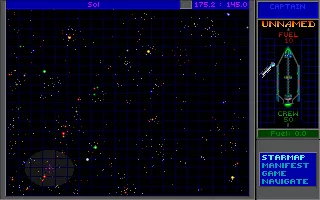
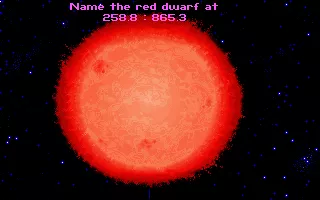
While in deep space, the starship can approach any star it comes across, and then the player can guide the ship around its system and land on its planets and their moons. Space is treated as two-dimensional and presented in a top-down view. There is also a starmap available which shows the entire galaxy and allows the player to set the ship on auto-pilot to any star.
Throughout space are different alien civilizations. These are represented on the starmap by a sphere of influence. Within the sphere, the aliens have a controlling presence and their ships will venture freely. Outside the sphere, encounters are rarer. Aliens can be dealt with diplomatically, through a series of dialog options, or engaged in combat.
Alongside the main plot objective, the player also configures and upgrades his fleet in a role-playing fashion. The main starship is the Precursor vessel and it can be used to travel between star systems, which uses up fuel. Raw materials are used as currency to make purchases in the starbase. It is possible to buy fuel, as well as improve the player-controlled fleet in various ways. These include purchasing smaller ships to accompany the main one on its travels and participate in combat; hiring crew members, which effectively act as the hit points of the ships; and upgrading the main ship with enhancements that improve its speed, maneuverability, and combat efficiency. Successfully completing a quest for an alien race may also result in their combat ships joining the fleet.
Raw materials are found on the surfaces of planets and moons throughout the galaxy. The player has to send a landing module to the planet and then guide it around the surface as it picks up materials found earlier with a scanner. Each planet is unique in the type of minerals and metals it is formed of. Some planets are plagued by natural dangers such as lightning storms, earthquakes, or lava, which can damage or destroy landing modules. Non-sentient lifeforms can also be found and stunned to obtain biological samples. Special installations, objects, and ruins can also be found on certain planets and explored.
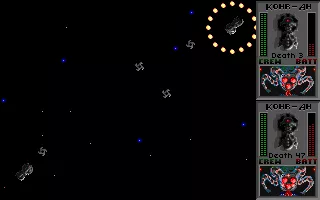
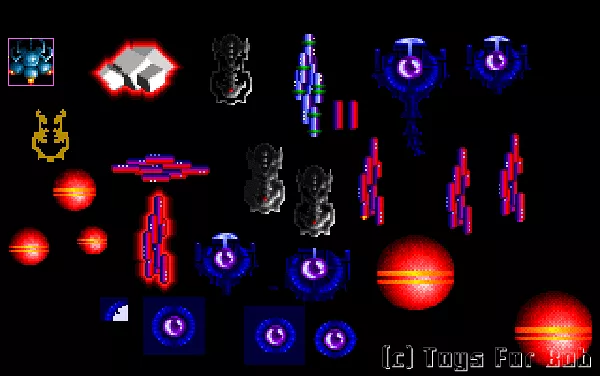
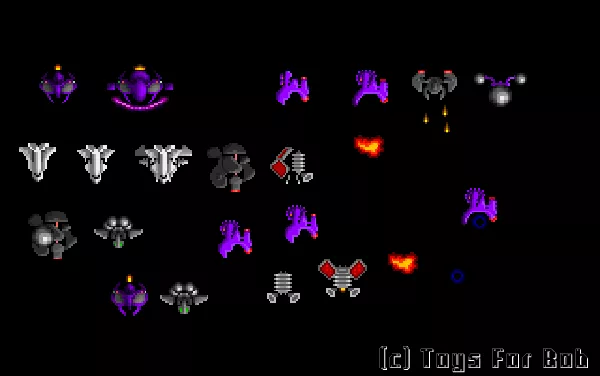
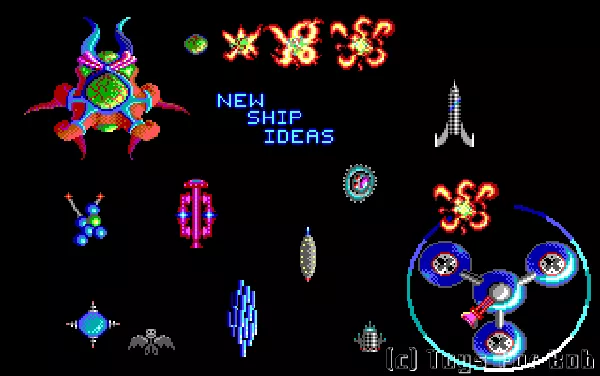
Combat is action-based and utilizes the same engine as the first game, where action is controlled from a top view and influenced by the gravity of nearby planets. Each alien vessel has unique abilities, and the player can select any ship from his fleet to participate in battles, attempting to find the best combination against specific enemies. Combat can also be played as a standalone game (melee mode), separate from the main storyline. It can also be set on a cyborg mode within the main game, allowing the computer AI to take over the battles and calculate their results depending on the attributes of the ships.
Versions of the game titled The Ur-Quan Masters and Free Stars: The Ur-Quan Masters are freeware, open-source ports which combine DOS and 3DO content. These releases, alongside the source code, are handled by the original developers Paul Reiche III and Fred Ford, who own the copyright to all parts of the original games except the Star Control trademark.
Spellings
- Star Control 2 - Alternate spelling
- スター・コントロールII - Japanese spelling
Groups +
Screenshots
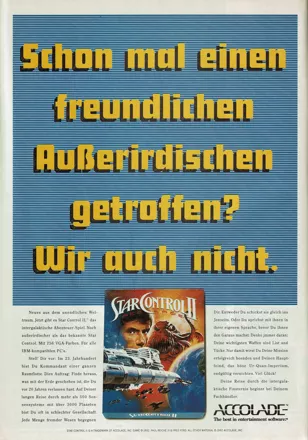
Promos
Credits (DOS version)
50 People (46 developers, 4 thanks) · View all
| Game Design & Fiction | |
| Game Program & Technology | |
| Additional Design | |
| Art & Animation | |
| Music | |
| Sound Effects | |
| [ full credits ] | |
Reviews
Critics
Average score: 80% (based on 28 ratings)
Players
Average score: 3.9 out of 5 (based on 239 ratings with 20 reviews)
One of the best games I've ever played.
The Good
I have not played any other game which offers such amazing replay value. It is practically impossible to get to see every single plot point without completing the game at least THREE times. It is nearly impossible to get bored with the game because of its humoristic conversations and engaging plotline. All the different starfaring races have their own distinct, well developed character.
Graphically, the game out classes nearly every other game I've seen in that time period. Even after 7 years, the graphics still look good, even though it is dated. The sound effects in the game are way ahead of their time, utilizing MOD files to create a soundtrack that sounds great. In fact, the standard set by Star Control 2 was unparrelled, until game developers started using CD music.
Combat in the form of Super Melee is simply addictive. There is a wide range of ships to choose from, and up to two players can duke it out.
The Bad
The game was optimized to run well in DOS. Unfortunately, it does not run in Windows 95 or later, unless you do some editing of the system files.
The Bottom Line
One of the greatest games of all time, well worth your money.
DOS · by Admiral Fwiffo (2) · 1999
Why it's not even best game of the year baffles me
The Good
Simply everything. The story, the battles, the gameplay, the adventure, the romance, the humor, the action, the mystery, and especially the feeling that you were a captain discovering new worlds and races rather than playing a brain dead shoot em up game.
The Bad
There wasn't a button that made the dialogue go to the next sentence if you know what I mean. Also, the manoeuvrability of the ship made most people give up immediately at the very beginning(not me :)), but I guess those are just people who don't look any further than their own noses
The Bottom Line
Don't give up at the beginning, the beginning is tough, but it will be soon be made much easier. This isn't a game like quake that excites you for half an hour and becomes more and more boring afterwards. It's quite the opposite. This game is boring the first half hour(unless you very quickly find out what to do) and makes you want to play more at the end.
DOS · by R M (2) · 2001
Finest space exploration game ever made!
The Good
What's not to like? The graphics are wonderful and moody, the music and sound effects are prefectly atmospheric, the storyline is both detailed and well-executed and the game plays like a dream. A brilliant game that leaves every other game of the genre eating dust specks, and will continue to do so for years to come.
The Bad
Maybe it was getting a bit too tough on the end there. But then again, endings are supposed to be tough, aren't they?
The Bottom Line
If you've got countless hours to spend on nothing but pure enjoyment, this is the game you should play. It'll blow you away.
DOS · by faceless (438) · 1999
Discussion
| Subject | By | Date |
|---|---|---|
| Classic Game Postmortem: Star Control (I and II) | vileyn0id_8088 (21040) | Jun 13, 2015 |
| Does anyone own the CD-ROM release? | Terok Nor (42013) | Aug 14, 2009 |
| Solution to the lack of an "objectives" screen | Matt Neuteboom (976) | Nov 4, 2008 |
| This game is how I found out about mobygames | Lumpi (189) | Nov 3, 2008 |
| PC speaker support. | Virgil (8563) | Jun 17, 2007 |
Trivia
Cancelled add-on
Fred Ford and Paul Reiche III confirm to have worked for four months on a add-on pack which was never completed due to Accolade's lack of interest.
Development
Ford and Reiche disappeared to Alaska and worked on this game for an additional six months without pay. Only that during this time, the game grew from two to nine megabytes, thousands of dialogue lines were added, the digital music appeared and a complete galaxy with hundreds of stars and thousands of planets made its way into the game.
Files
- The .SHP files are interchangeable meaning that you can rename them to swap them around. This can be used to change the ship you start with in the full game.
- All the music and victory ditties in the game are in .MOD format and can be extracted by a utility called a Mod Ripper.
Freeware release
The game was released free to the public in 2002 by its original designers. Everything except the name Star Control (still owned by the publisher) is now freeware. However, it not the true open source of the DOS version. When Toys for Bob set out to release their code they found that a lot of it had simply been lost. However what was available was all of the source code for the 3DO version of the game. So what happened is that all of that code was ported to the open source project and then several portions of it that were "different from the PC version" (mostly menus and interface issues) were then later re-coded. Incidentally many things in the game can be set to "3DO mode" or "PC mode" via command line parameters explained in the readme.
Influences
The game is suspiciously similar to the Starflight series of games. A direct comparison can be made of such gameplay ideas as the gathering of raw materials, the exploration of space, the coordinate map, even the alien diplomacy/interaction that makes this game famous. The first Starflight was able to do this years before Star Control.
Mods
A large-scale open-source project has been launched with the aim of updating Star Control II to run on pretty much all modern computers and operating systems, along with better graphics and other improvements. The homepage for the project is at http://sc2.sourceforge.net/.
Music
Musician Aaron Grier:
There was actually a contest for writing the music fo star control II advertised on comp.sys.amiga.audio. Nobody knew what game it was for, and Paul had asked a friend to troll usenet for entries. I submitted "Fuchia Fantasy" not even expecting it to be taken seriously, and ended up winning second place in the contest, (Riku being the big winner, of course,) which entitled me to $50 and a copy of the game when it came out. It took about a year after I was notified I had won for the paperwork and check to come, (along with an amusing apology,) and another six months or so after that for the game to actually get to me, (along with another amusing apology.) Both letters are still sitting somewhere in a box in my father's basement in Denver, and one of these days I'll have to dig through the files and post scans somewhere.
Dan and Riku (who met through SC2) got together and formed the 8-bit collective, which turned into KLF, which begat KFMF, and is still going strong.
Rainbow planets
If you discover the location of all the rainbow planets, they form an arrow pointing towards the galactic core (top right corner). The worlds were created by the Precursors and the arrow hints at where they disappeared to. The original purpose of the arrow was, according to the creators themselves, to point toward a single planet where the player would have an interactive conversation with the two creators. This was never completed.
References
- Several of the new races in the game (such as the Orz) were named from alien words on the copy protection wheel for the first game. "Melnorme" is a rather obvious corruption of the singer Mel Torme's name.
- During the game, when talking to Starbase Commander Hayes, if the player chooses "The United Federation of Worlds!" when being prompted to name the new alliance, Hayes will say: "That has a familiar ring to it... nonetheless, we will make it so - The United Federation of Worlds!" This is an obvious reference to the United Federation of Planets from Star Trek.
Stars and planets
Most of the Stars are named after real Stars, even though the distances and postions are mostly wrong. Their positions according to the starmap are actually hyperspace coordinates and not realspace coordinates. If you notice a little footnote in the bottom, it explains about this pretty clear.
The planet information is based on true astronomic readings and some of the parameters are calculated when you enter the planet. The planet surfaces are also calculated according to some of these parameters. When entering a star system, the planets are raytraced, which is the cause of the noticeable delay (on a 286 anyway) when entering a star system.
Awards
- Computer Gaming World
- October 1993 (Issue #111) – Adventure Game of the Year (together with Eric the Unready)
- November 1996 (15th anniversary issue) - #29 in the “150 Best Games of All Time” list
- November 1996 (15th anniversary issue) – #9 Most Rewarding Ending of All Time
- September 2006 (Issue #266) – Introduced into the Hall of Fame
- GameSpy
- 2001 – #26 Top Game of All Time
- VideoGames
- March 1995 - Best Adventure Game in 1994
Information also contributed by Aaron Grier, Aj Hege, Arvin Chandra, Big John WV, Fafnir, Luka Milutinovic, PCGamer77, Tiago Santos, Tomer Gabel, Toni Maki, Vance, WildKard and WizardX
Analytics
Upgrade to MobyPro to view research rankings!
Related Games
Released 1994 on DOS, 2011 on Windows, 2012 on Macintosh
Released 1996 on DOS, 1998 on Macintosh, Windows
Released 2023 on Windows
Released 2001 on Arcade
Released 1985 on DOS
Released 2019 on PlayStation 4
Released 2020 on Windows, PlayStation 4, Xbox One
Released 2019 on Windows
Released 1980 on Atari 8-bit, TRS-80
Related Sites +
-
Ganymede
Homepage of (among other things) the Pages of Now & Forever's official Star Control II walkthrough, a comprehensive guide to the game and its mysteries. -
Infogramme/Accolade Tech Support
Has a link to the latest (last :) Star Control 2 patch. -
More Control!
Webcomic Bob the Angry Flower spends an episode arbitrarily experiencing the world of SC2. -
QuasiSpace
Another quality SC site. -
Star Control 2 featured on PC Gamer!
This page has a screenshot from SC2 along with a featured description of MobyGames itself, scanned from the July 2000 issue of PC Gamer. -
Star Control II SuperMelee Extended Reference
Covers the SuperMelee module of Star Control II for the 3DO. Most of the information also applies to the PC game. -
Star Control Series Index
I've set up a section on DMOZ all about the Star Control series of games. -
The Pages of Now & Forever
A -huge- Star Control II fan site with comprehensive information, humour and everything a fan could possibly want (including links to other fan sites) has been set up by Chad Darrenbacker. (Contributed by Tomer Gabel) -
The Star Control Webring
A now frequently updated webring including most (if not all) of the major Star Control-related web sites. -
The Ur-Quan Masters Project
A free, open-source, cross-platform port of Star Control II for Windows, MacOS X, Linux, all BSD, BeOS, and other SDL-supported platforms. -
Time Warp
One of the more promising Star Control clones which emphasizes multiplayer (network, modem etc.) melee play.
Identifiers +
Contribute
Are you familiar with this game? Help document and preserve this entry in video game history! If your contribution is approved, you will earn points and be credited as a contributor.
Contributors to this Entry
Game added by Tomer Gabel.
GP2X added by Trypticon. 3DO added by Shoddyan. Android added by Sciere. Linux, Windows added by The cranky hermit. Macintosh added by Multimedia Mike.
Additional contributors: Trixter, ZogGop +, Ledmeister, Salim Fadhley, Shoddyan, Pseudo_Intellectual, Halleck, formercontrib, RealityHacker, Patrick Bregger, Omer Mor, Plok, Kayburt.
Game added August 3, 1999. Last modified March 2, 2024.