Guild Wars
-
 Guild Wars: Bonus Mission Pack
(2007)
Guild Wars: Bonus Mission Pack
(2007) -
 Guild Wars: Eye of the North
(2007)
Guild Wars: Eye of the North
(2007)
-
 Guild Wars: Platinum Edition
(2007)
Guild Wars: Platinum Edition
(2007) - Guild Wars: The Complete Collection (2008)
-
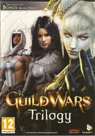 Guild Wars: Trilogy
(2008)
Guild Wars: Trilogy
(2008)
-
 Guild Wars (Collector's Edition)
(2005)
Guild Wars (Collector's Edition)
(2005) -
 Guild Wars (Edition 2006)
(2006)
Guild Wars (Edition 2006)
(2006) -
 Guild Wars (Special Edition)
(2005)
Guild Wars (Special Edition)
(2005)
Description official descriptions
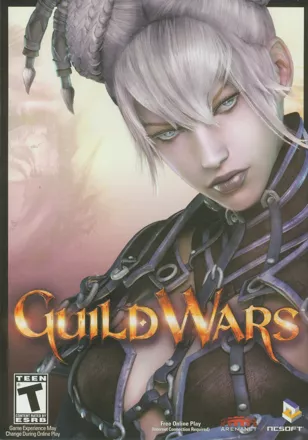
Guild Wars: Prophecies (renamed after the release of Guild Wars: Factions) sets players in the fantasy world of Tyria.
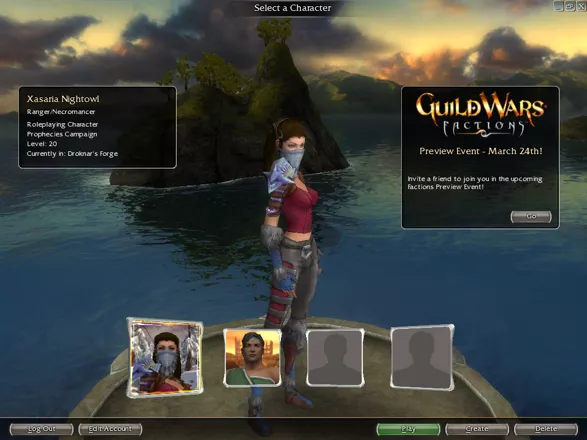
When creating a character, the player has to choose whether they want to create a Role-Playing character or a PvP-character and what character class they want to play (Warrior, Ranger, Elementalist, Mesmer, Necromancer or Monk).
Role-Playing:
Shortly prior to the game start, the three human kingdoms of Tyria - Ascalon, Kryta and Orr, fought each other in many guild wars. The last guild war abruptly ends when the Charr began to overrun the weakened kingdoms.
The Charr, a violent race from the north (whose homeland can be visited in Guild Wars: Eye of the North) began an invasion of the kingdoms of Tyria. Kryta's expelled Saul D'Alessio and his White Mantle repelled the invasion, Orr was annihilated when Vizier Khilbron cast a forbidden spell to protect the capital city of Arah resulting in the Cataclysm and the sinking of the kingdom to the ground of the Sea of Sorrows, what still stands is the Kingdom of Ascalon protected by their Great Northern Wall.
The player starts at the day of, and just some hours prior to, the "Great Searing", the Charr ritual that turned the green lands of Ascalon into a wasteland. At the beginning of that day, Ascalon looks for heroes help fighting the Charr and here is where the game starts.
In this tutorial area, the player can play alone or with another player, to complete the first quests, acquire the first skills and get in touch with the game world. After choosing a secondary profession, the player can leave the tutorial and start the "real" game.
Note: choosing a secondary profession is a crucial part in the design of Guild Wars, as the player does not play just a monk or a warrior, but a combination of the professions. With the six character classes, Prophecies effectively has 30 different character combinations.
For example, while a Elementalist/Mesmer (E/Me) and a Mesmer/Elementalist (Me/E) might look similar, the differences are that the armor can only be used for the primary profession and each profession has a primary attribute which only this class can use. As an Elementalist, the E/Me has Energy Storage increasing the available energy drastically. While the Me/E has base energy, they can cast spells twice as fast because of their Fast Cast.
The secondary profession is locked for about 75% of the Prophecies game, but can later be changed unlimited times. (With access to Factions and/or Nightfall even much earlier.)
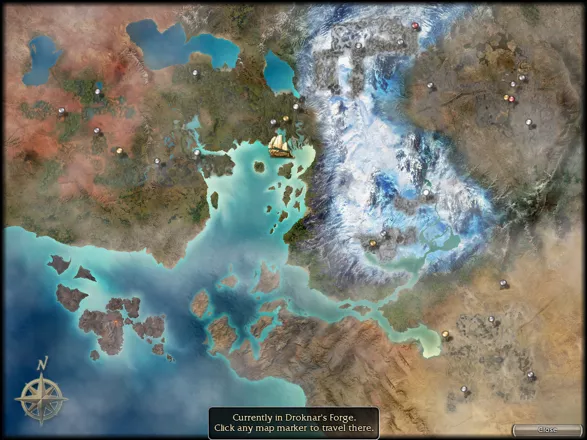
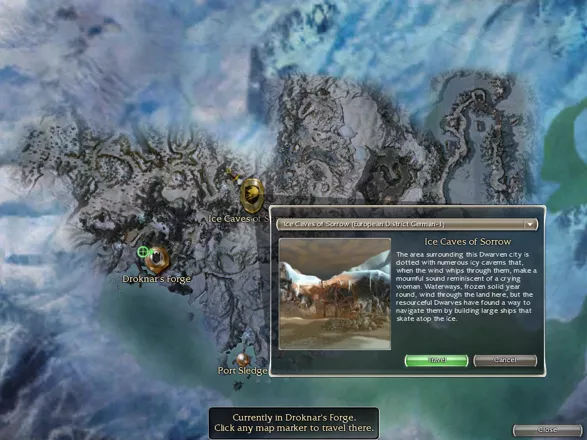
After leaving the tutorial, the player can play many side quests (to gain experience, gold and skills), primary quests (which lead to missions) and missions itself (which advance the story). Prophecies offers 25 missions (with primary and secondary (bonus) objectives) to play and hundreds of quests with many plot twists on various game settings (wasteland, green lands, jungle, dessert, snowy mountains, volcanic islands).
The player also has access to all PvP content while reaching those outposts in the storyline. Each skill acquired, each rune or weapon upgrade identified will be unlocked on the account for use with PvP-only-characters.
The game would is fully instanced, means each player (or a group of players) get their own area/mission "copy" from the server. While no one can join you while the player(s) is/are adventuring, no one will "steal/corrupt" you a boss or missing objective you try to reach. Each enemy slain in an area keep dead (don't respawn) unless they are resurrected per skill like the own group can do it with their own team members.
Furthermore, the game is almost only played in teams, as the game area are balanced for the maximum size of a team (2, 4, 6 or 8 players). Therefore you can either play co-op or with the lack of human players, fill in with NPC henchmen.
The game has a level cap of 20 and easily obtainable max-level armor and weapons with the design of getting "better looking" stuff instead of weapons with ever increasing damage, and increasing the difficulty as the players have to deploy tactics as the enemies aren't capped at level 20 nor are they limited to groups of 8.
For those that "played through the campaign", Prophecies offers four "elite mission" like areas: The Fissure of Woe, The Underworld, Sorrow's Furnace and The Tomb of the Primeval Kings (the last once was a PvP outpost prior to the release of Factions).
Finally, the game offers titles to display achievements the character (or the whole account) has made, like exploring the entire map (Grandmaster Cartographer), capping all elite skills (Skill Hunter), beating the missions in normal and hard difficulty (Protector/Guardian) or even "cleaning" an area of all enemies (Vanquisher), and much more. All these achievements can be displayed in Eye of the North's Hall of Monuments.
PvP-character:
When creating a PvP-character, this character is always at level 20 and has max-level armor and weapons. They can be fully customized with all the skills, runes and weapon upgrades available at the account (unlocked via PvE or PvP itself).
PvP-characters starting at the Isle of the Nameless, a PvP tutorial with all the stuff the player needs (testing weapon ranges, different armor class targets, etc.).
PvP mechanics applying to both character types:
After each enemy kill in an arena or for winning it, the player cumulates Balthazar faction (named after Guild Wars's God of War and Fire), with this skills, runes, upgrades and heroes (the latter one requires an account combination with Nightfall and/or Eye of the North) can be unlocked and therefore used in PvP.
The following "arenas" are present in Prophecies (for PvE and PvP characters):
- Ascalon Arena - 4vs4 Team - PvE-only (level 1 to 10)
- Shiverpeak Arena - 4vs4 Team - PvE-only (level 1 to 15)
- Random Arena - 4vs4 at random
- Team Arena - 4vs4 Team
- Heroes' Ascent - 8vs8 Team Tournament, 8vs8vs8 at final map
- Hero Battles - 1vs1 human players, each with 3 Heroes (requires an account combination with Nightfall and/or Eye of the North)* Guild vs. Guild (GvG) - 8vs8 Team
Similar to pure PvE-achievements, the PvP content also has titles for achievements for winning in PvP. In addition, GvG and Hero Battles also featuring ladder play.
Final note: all the Guild Wars campaigns - including Prophecies - have, despite being a MMORPG, no subscription fees.
<hr />The Game of the Year Edition (also known as 1 Million Edition) provided seven special weapons (Luminescent Scepter, Nevermore Flatbow, Rhino's Charge, Serrated Shield, Soul Shrieker, Tiger's Roar, Wolf's Favor), which can be created as many times as needed, but are bound at the character who created them.
The Guild Wars Prophecies 2008 release adds the Igneous Summoning Stone (which summons a Fire Imp which helps players levelling to level 20) on top of the GOTYE items.
Spellings
- Guild Wars Prophecies: иэдание "Игра года" - Russian 2006/2008 Guild Wars In-Game Store spelling
- ギルド ウォーズ: Game of the Year Edition - Japanese 2006/2008 Guild Wars In-Game Store spelling
- 激战 - Chinese spelling (simplified)
Groups +
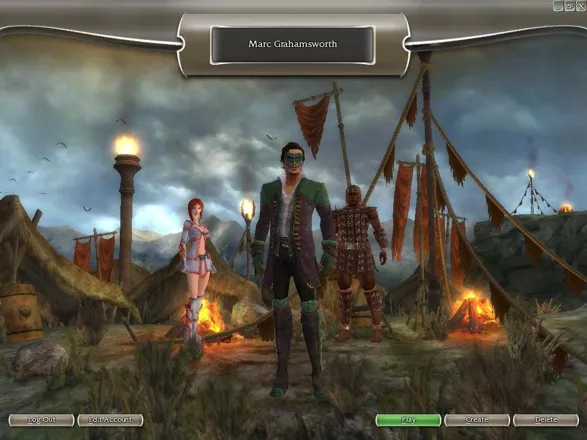
Screenshots
Promos
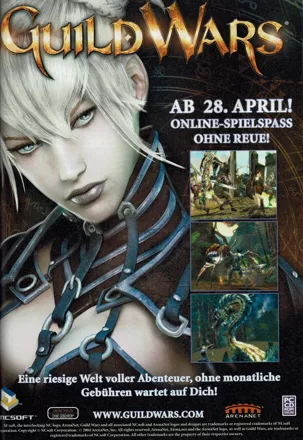
Credits (Windows version)
521 People · View all
Reviews
Critics
Average score: 89% (based on 50 ratings)
Players
Average score: 3.8 out of 5 (based on 40 ratings with 2 reviews)
Solid online role-playing without the subscription fees.
The Good
The graphics are truly astonishing for this game. Perhaps the best seen in an online RPG so far, even after the "bloom effect" (if you don't like this effect, you can turn it off in the options under "Post-processing effects"). Graphics aren't everything but it definitely helps immerse you in this world. The world is rather large and there are several places to visit with different terrain, whether it be the sand dunes of the Crystal Desert, the beautiful tropical beaches of Kryta or the volcanic wastelands of the Ring of Fire - each area is quite breath-taking in its splendour.
In terms of gameplay, Guild Wars is probably more similar to Diablo than World of Warcraft (which many people like to compare it with). Guild Wars isn't strictly an MMORPG. True it has several people playing it online (so that's the MMO part) and true it is basically an action-based role-playing game (so that's the RPG part) but it's more of a CORPG (Competitive Online Role-Playing Game as Arena.Net likes to call it). Unlike traditional MMORPGs, "dungeons" or the wilderness, is "instanced" for a player and his/her party, this is similar to how Diablo creates dungeons (except in Diablo the actual terrain was randomised too). The only places where you get to interact with the entirety of the game's population is either through the in-built messaging system or in towns. This may not appeal to some but since I'm a fan of Diablo it suits me just fine. In fact, the benefit of instancing is that you dramatically reduce the workload on server resources as dungeons can be created on demand, rather than being online 24/7.
Although everyone has different tastes in music, I think the music for Guild Wars is fantastic. Critically-acclaimed composer, Jeremy Soule, responsible for the music in classics like Morrowind and Knights of the Old Republic, continues to create beautiful orchestral music that is a perfect fit for the fantasy world of Tyria. The sound effects and voice acting are on par with other quality RPG titles.
The Bad
There's nothing I have much to complain about in this game, although I have read a number of complaints from players about what they didn't like. For starters, your level is capped at 20, so if you're one of the sorts that likes to thunder on their way to level 99, this isn't the game for you. Also some people have complained about the PvE (Player-versus-Environment) aspects of the game getting in the way of PvP (Player-versus-Player) and vice versa. However, this is already changing with Arena.Net releasing patches every week to attempt to bring about not only game balance changes but features that will help to satisfy both people who prefer pure combat or ones who like a little bit of storyline on the side.
With regards to what I personally don't like though - I think it would've been nice if there was the option like Diablo to play Guild Wars PvE on a LAN, disconnected from the Guild Wars servers, with local characters. If that was the case, Guild Wars would've been slightly more superior to Diablo in my humble opinion, but as it stands, it's probably as good :).
The Bottom Line
Guild Wars is like a contemporary, online-only version of Diablo or Diablo II. If you liked Diablo or its clones and aren't bothered with having to connect to a server each time to play, give Guild Wars a go. Also, for the ones that enjoy playing in a clan or team and fighting against other human players with a variety of skills, Guild Wars is definitely right up your alley as well.
Windows · by Rambutaan (2782) · 2007
This is the way it should be...
The Good
Before Guild Wars, I had never played an online title before, as much as the opportunity was always there. The one thing that always scared me off was the subscription based systems that every title had. I just didn't fine it reasonable to pay for the game at full price, then have to pay per month to continue on after the initial free period (they always try and suck you in, I might add), especially when I don't really get that much time to play video games every hour of the day, which in my eyes is the main reason to play an MMORPG.
So along came Guild Wars ... wait a second? Free? I can play as much as I want and not pay a cent more? Praise the heavens! Someone is listening to us!!
So off I went into the wide world of Guild Wars. It plays out much the same as, say, Everquest or World of Warcraft. Create your own character from a range of options, and then you build your character up through various missions, exploring the world within a game and maybe even making a few friends along the way.
Where GW differs from other titles is the emphasis more on strategy then 'point and click, hoping the spell works'. You can build up the most powerful beast you can imagine, but in the end they may not make any difference at all if you don't have some idea of your enemies ... or your allies. While working as a team is a priority, essentially you can play the game by yourself with assistance from AI bots, who do a decent job I might add. So you need to understand their strengths compared to yours, and use that as an advantage in battle.
Guilds, as the games name suggests, is the other key addition in the game. Outside of the 'world', there's an option to play against other Guilds or players separately. It's more then just a secondary add-on, too. Huge tournaments can be created, where by you and your Guild can compete against others in a deathmatch like environment. Any rewards you make can be transferred from the PvsP character to the World character, and visa versa, though with its limitations. For example, you can purchase improvements to your characters powers within the World, but only be able to use them for PvsP games.
Anyway, enough about explaining. How does it play? Very well, I must say, and not just because it's free. There's plenty to like about GW, from the visual splendour to a huge environment that can take many hours to explore ... hell I'm still going. Everything else falls into place well, from a solid musical score and voice-overs, to an interesting fable played out as you complete each mission. Speaking of, the main story will keep you occupied, but there's plenty of other things to complete on the side as well.
The Bad
It's hard to come up with any major criticism of Guild Wars. Granted, I do have the right machine to play the game the way it was meant to be played. Perhaps that's one minor gripe, then. But as with all MMORPG's, you can't expect to get the most out of them with a slow PC, so high specs are warranted.
Gameplay wise, exploring the game could be just a tad bit better. I find it at times frustrating that my character can't jump over a small ridge, making me have to backtrack a long, long way to get to that same point just a metre away. It does happen fairly often, those kinds of situations, and whether that's a design flaw or a reasonable move to reduce 'cheating' by evading conflict with enemies is an interesting debate.
The Bottom Line
It's free. It's arguably better then World of Warcraft. And with the constant updates flowing and a strong user base, it's hard to pass up the opportunity to join such a well crafted and well supported title. This, as my review summary suggests, is the way online games should be made. Do away with subscription fees and give people a reason to shell out for the game and the endless expansion packs that will follow it. If you build it right, they will come ...
Windows · by Kartanym (12418) · 2006
Discussion
| Subject | By | Date |
|---|---|---|
| No credits :( | Xoleras (66141) | Oct 16, 2008 |
Trivia
1001 Video Games
Guild Wars appears in the book 1001 Video Games You Must Play Before You Die by General Editor Tony Mott.
A history to player territory interaction and Realm of the Gods access.
Note: the following information applies to Prophecies, Factions and Nightfall.
Till August 2007 the following game mechanic was in place:
The Guild Wars game world was split into five territories (America, Europe, Korea, Japan and Taiwan (actually also Macau and Hong Kong, but this is commonly referred to as just Taiwan, probably as the server is located in Taiwan)). Players could either play in their own territories or meet each other in the International District for trade or joining groups for almost all PvE/PvP activities, with the only exceptions being the Realm of the Gods elite-mission-like areas The Fissure of Woe and the Underworld as well as the PvP-tournament Tomb of the Primeval Kings / Heroes' Ascent.
The only way for an joint-American-European-team to do those three things was for players to change the territory in their account. However, this was limited to three times and then the territory was locked (similar to how DVD manufacturers locking the Region Code after several changes). The reason behind this was the strong relation between Fissure/Underworld and Heroes' Ascent, as PvP wins in Heroes' Ascent granted access to those two PvE areas. And if people could change territory easily, the whole concept would be in vain. And while European/American teams could join Asian teams in the International District, changing the account territory wasn't possible because of the language barrier (and the implementation in the game client).
After five consecutive victories in the Hall of Heroes (the final map of Heroes' Ascent), the territory of the winning team takes Favor of the Gods and that territory get access to the Fissure and the Underworld for at least 30 minutes (5 consecutive wins in 6 minutes intervals). So if Europe was holding the hall until America has conquered it, Europe still had access to the PvE-areas until America completed the forth holding (one win to take the hall, 4 wins holding it = 5 consecutive wins). In this time neither Korea, Japan or Taiwan could access the Realm of the Gods.
In the beginning of Guild Wars, Korea and America had dominated the Hall of Heroes, followed somewhere by Europe. It was said that it was something special for European players to get access to Fissure/UW with only a short time windows (the above mentioned 30 minutes). However, this has drastically changed over the years. I don't know whether there are much more European players, those have more free time, have better skills or just playing more PvP, but Europe has dominated the Hall of Heroes ever since. If I should guess the percentages (no real values available), I would say that 70% of the time Europe had the favor, 27% America and the last 3% split over Korea, Japan and Taiwan. And a common, and very sarcastic, comment was "Taiwan took favor?? Nice. Have fun with your 30 minutes Fissure/UW-access this year!" And as the favor was territory based, there was no way to access Fissure/UW using the International District.
With the release of Prophecies, the Fissure and the Underworld were something special, but with Factions (The Deep, Urgoz' Warren), Nightfall (Domain of Anguish) and Eye of the North (Slavers Exile), Fissure/UW were just two other elite-areas, just with limited access.
The first step against the territory-discrimination was done when the Hardmode was introduced, as boss monsters had a chance to drop Fissure or Underworld passage scrolls (which allowed a team to enter those areas with no favor).
But the major step was done August 9, 2007 with the abolishment of the PvP-territory-independent-favor-system. It was replaced with a even more controversial PvE-global-favor-system using maxed titles to expanding the now so called "time window" (it's now common to have a few weeks time windows).
As a consequence of the removed tournament favor (Heroes' Ascent is still there and still the same, they just don't fight for the favor any more, as they actually never did by the way), the region locking mechanism between American and European accounts was removed and a direct jump-across-the-ocean option was implemented (when choosing the district, the hidden ones are now shown). It was said that the Asian districts get also incorporated into world access once the game limitations were removed.
As of March 2008, America, Europe and Korea were - for the player's point of view - merged into one territory.
Bad news happened on March 31, 2008, were most people thought this to be a early April's Fool joke, as ArenaNet announced that effective April 1, 2008 a new Taiwanese law will come into effect protecting the Real Money Trading companies (the commonly known China Farmers) from the server operators which hinder the Taiwanese "economic". This made it for ArenaNet illegal to take any steps including banning accounts against those companies/individuals even when they deliberately violated ArenaNet's "original" End User License Agreement. See statement from Gaile Gray, at the time ArenaNet Community Relations Manager.
So, with April 1, 2008, accounts from Taiwan, Hong Kong and Macau users had been disconnected from most of the Guild Wars world, including entering international districts (and therefore playing PvE) or trying to trade with accounts from other parts of the world.
Announced April 8, 2008, ArenaNet and NC Taiwan had decided to shut down the Guild Wars Taiwanese server and migrate the Taiwanese accounts to America, removing all restrictions which were applied a week earlier. The community's reaction for this was just that the Real Money Trading companies did that already at their own, for selling their "goods" in America. So it was assumed that this was just a step to restore the playing ability for the legit users.
As of May 24, 2008, the Guild Wars world is still split into 2 territories: America (with American and Chinese districts)/Europe/Korea and the other one is Japan.
Finally, as of October 9, 2008, the travelling restrictions to Japan were lifted, making the game globally accessible to all players around the world.
April Fools' Days
Since 2007 ArenaNet inserts some jokes on April Fools' Day into the Guild Wars world.
2007 transformed all characters temporarily in the opposite sex. More info about this can be found here.
2008 transformed all level 20 characters into stickmen. In addition, ArenaNet published a Patch on their website, which generated an outcry among those not realizing it's an April Fools' Day Patch (which of course never went live).
2009 transformed all players in outposts into Mini-Gwen-Dolls, which can be seen here. In addition, like the year before, a Joke-Patch was included too.
Campaigns
As of September 2008, 5,589,000 campaigns were activated in North America and Europe. Besides Prophecies, this also includes Factions and Nightfall.
Assuming that in average one account has access to two campaigns, the number of accounts would be around 2,794,500.
The number of users having more then one account before the Xunlai Tournament House was introduced could be neglected as in-game rewards (such as titles etc.) were bound to an account, so it was more common to buy additional character slots instead.
But with the Xunlai Tournament House, which allows players to bet freely (no costs) on monthly tournaments and are guaranteed to receive in-game rewards (even if the played mixed up the betting completely, they get a few points as a consolation prize), people started to buy second, third etc. accounts to simultaneously bet there and receive even more in-game prizes. Therefore it's impossible to tell how many users play or have played Guild Wars.
Guild Wars China
Between April 2006 and March 2008, two different Guild Wars versions existed.
The normal version published by NCsoft, targeted for worldwide. This version however was not available in mainland China, due to the Great Firewall.
So NCsoft made a deal with The9 Limited to let them operate Guild Wars in mainland China for 3 years. This agreement started in April 2006.
However the deal ended prematurely when The9 announced to stop registration on March 17, 2008, and to terminate Guild Wars China on March 31, 2008.
Note: unlike the Taiwan server shut-down a week later, where all Hong Kong/Macau/Taiwan Guild Wars accounts were migrated to the US server center, the Guild Wars China shut-down stopped the game their forever, as it ran on a completely different game network.
References
One of the warrior skills in Guild Wars is called "For Great Justice!". This is most likely a reference to the infamous "All Your Base Are Belong To Us" Internet phenomenon that spawned in 2001-2002. More about this phenomenon can be read here.
Story conclusion design, end-game areas and credits
When Prophecies was released in 2005, the game had to combine a story arc and the open-ended ability of a MMO at the same time.
The story arc, which is told over the 25 missions in the game, completes with the death of the Lich Lord in the Hell's Precipices mission (mission 25). After a cutscene, the players find themselves back in Droknar's Forge, which they have visited six missions earlier. From this point on, the players can continue playing whatever they want.
Due to the game design, two things were missing:* What happened to the Titans, which the Lich Lord unleashed one mission prior to his death? * Credits
Four months after the release, the big summer update was released, which added among other things five special quests - the Titan Quests - which dealt with the unanswered questions (even more later when Nightfall was released).
Credits however are another issue. Neither an in-game credit roll was integrated, nor were any credits printed in the manual. (And what I was told from a credit question, ArenaNet didn't created a credit list and - now 3 years after release - the game is "too old" for them to compile a list of the people who worked on the game.)
When Factions, Nightfall and Eye of the North were released, the flaws in the design were fixed right when the campaigns/add-on were released.
For example, when the player kills Shiro Tagachi in the Imperial Sanctum mission from Factions, the players are transported to a special end-game-area - the Divine Path - which is a special map where the players meet the key-NPC's from the campaign, can craft special armor, can exchange an end-game-collector-item, and after a long parade, the credits begin to roll. The same also applies for the Throne of Secrets from Nightfall and the Epilogue from Eye of the North.
On the third anniversary of Guild Wars, a similar end-game-area was added to Prophecies with all the player features: meet the NPC's from the Prophecies campaign, experience fireworks, trade an end-game-collector-item and craft special weapons. However, due to there is no credit listing, no credit rolls were added.
Awards
- Computer Games Magazine
- March 2006 - #4 Game of the Year 2005
- GameSpy
- 2005 – #6 PC Game of the Year
- 2005 – PC MMORPG of the Year
- 2005 – PC RPG of the Year (Readers' Vote)
- 2005 – #2 Online Multiplayer Game of the Year
- 2005 – Best Value of the Year (PC)
- PC Powerplay (Germany)
- Issue 04/2006 - #5 RPG/Adventure in 2005 (Readers' Vote)
Analytics
Upgrade to MobyPro to view research rankings!
Related Games
Released 2008 on Windows
Released 2007 on Windows
Released 2007 on Windows
Released 2006 on Windows
Released 2006 on Windows

Released 2006 on Windows
Released 2007 on Windows
Released 2008 on Windows
Released 1990 on DOS
Related Sites +
-
Guild Wars
Official game website -
Guild Wars Characters
German online character presentation website -
Guild Wars Wiki
Official Guild Wars Wiki -
Guild Wars Worldmap Kompendium
German online map & character management website -
GuildWiki
Unofficial Guild Wars Wiki -
GuildWiki
Unofficial German Guild Wars Wiki -
PvXwiki
Unofficial wiki specializing in character/team builds for both PvE and PvP
Identifiers +
Contribute
Are you familiar with this game? Help document and preserve this entry in video game history! If your contribution is approved, you will earn points and be credited as a contributor.
Contributors to this Entry
Game added by Rambutaan.
Additional contributors: Unicorn Lynx, Sciere, Xoleras, Patrick Bregger, FatherJack.
Game added May 30, 2005. Last modified March 11, 2024.