World Cup 98
-
 World Cup 98
(1998 on
Game Boy)
World Cup 98
(1998 on
Game Boy)
Description official descriptions
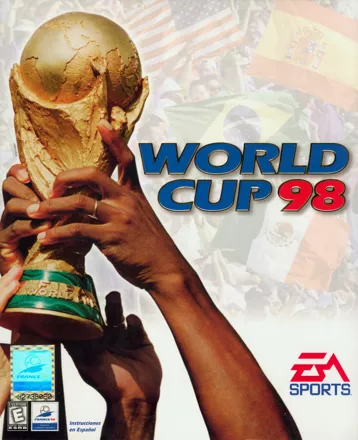
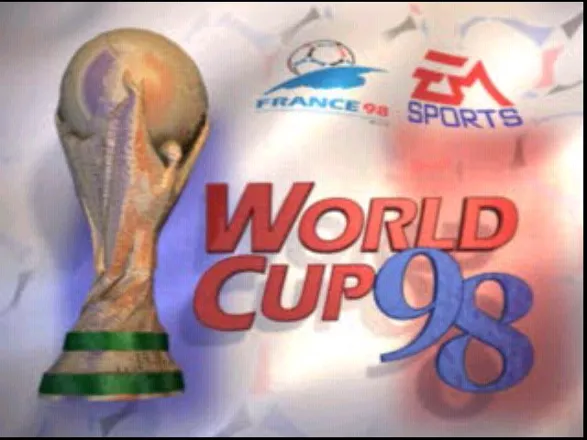
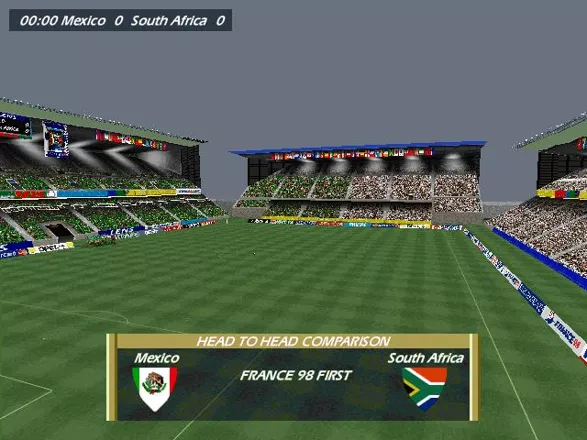
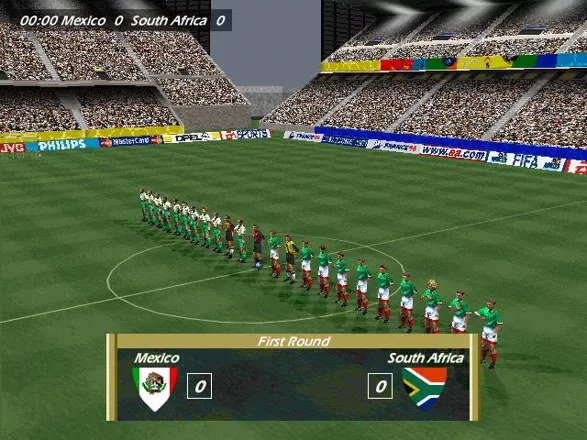
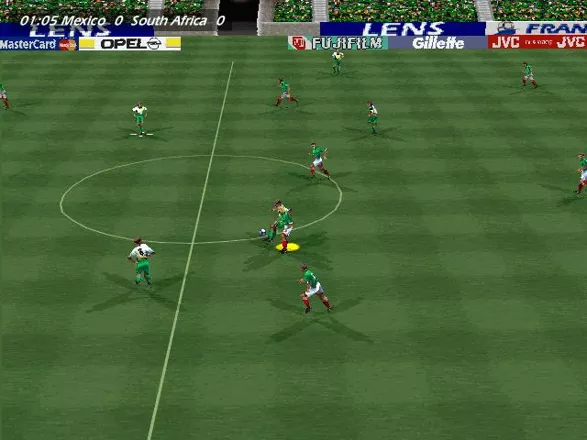
The licensed game of the 1998 Football World Cup held in France from June 10 to July 12 and the first World Cup licensed game distributed and developed by Electronic Arts features a tweaked FIFA 98 engine, with all 10 stadiums accurately designed and all 32 teams (plus 8 teams that failed to qualify but still deemed too important to leave out) featuring real names and close "look-a-like" kits. Changes done to the 3D engine feature include on the fly in-game management with better player positioning AI (including the goalkeeper), and faster gameplay. An editor to change all player information is included, which affects simulated data: the team with higher ratings has a better chance of progressing through the next stage regardless if it is Brazil or China.
It's possible to play with the groups as determined by the real draw, randomize or customize them to the players' likings, mixing both qualified and additional teams. Once the player wins a trophy, the first of the Classics matches is unlocked. These are eight final matches in the competition's history which are unlocked as the player beats them one by one. Friendlies, training matches and practice penalty shootouts close the modes available.
Spellings
- 世界杯: 决战法兰西 - Chinese spelling (simplified)
Groups +
Screenshots
Promos
Credits (Windows version)
220 People (170 developers, 50 thanks) · View all
| Executive Producer | |
| Director, Product Development | |
| Art Director | |
| Producer | |
| Franchise Development Director | |
| Franchise Associate Producer | |
| Assistant Producer | |
| Development Director | |
| Franchise Engineering Architect | |
| Franchise Art Lead | |
| Lead Programmer | |
| Programming | |
| Artists | |
| Core Production | |
| [ full credits ] | |
Reviews
Critics
Average score: 88% (based on 32 ratings)
Players
Average score: 3.5 out of 5 (based on 42 ratings with 2 reviews)
The Good
It's not far from the truth to say I'm not a sport fan and that sport games I have in my collection could be count on one hand. But, every now and then in a decade I get sting by a bee that claims otherwise and I go nutz on some sport game. Once upon a time, it was this game's turn to take all my time. The moment I saw it I was literally blown away as to how amazing it looks, and how the entire feeling t creates barely variates from watching live tv football match.
The roots of my football games don't go that wide as I've only ever really played two other soccer games, Manchester United Europe and Sensible World of Soccer. The latter was just for fun, but the first one here is what showed me the potential of football on a computer screen. It was brilliant in every way, plus I could play it with up to three other friends on a same computer. Two would control players, and two goalkeepers. Bah, they just don't make games like that anymore :(
Game was simple to play, yet not as easy to score a goal as in the forementioned classics. So, the basic controls would be kick, pass, shoot, roll, and a few other regulars, but that's about it. There's more up to the strategy then mysterious strikes from the center that will score you a goal. Then again, once you're in a zone... figured the tactic, there's noone to stop you but the higher level of difficulty.
Probably the newest and most surprising thing to me that I never encountered before was the spectator. It was like (the two of them were I believe) he knew what you missed, from where, and what your attempt might be. It was really great feeling playing football matches here, on any stadium (which presented a small opening animation to each of them), the atmosphere was sportish, and the crows was a blaze. Every score and miss reflected on the fans cheering, and yellow and red cards are dealt handful. It was a match after match, until you triumphed over the others and won the trophy for your country. This game leaves a long will to be surpassed.
The Bad
Nowadays this does seem old and faces of the players aren't even recognizable, but believe me, back then it did look impressive. This is simple game that lets you play your way to becoming the world champ, and that's that. There's nothing wrong in having a little simplicity once in a while.
The Bottom Line
You think France shouldn't have won the cup and perhaps paid their way into victory? You think the ladder should've been different and players should be rearranged? You think your country should've been victorious? No need to cry me a river any more, get this game and prove your thoughts. But be aware and don't get FIFA 98 by accident.
Windows · by MAT (240995) · 2012
The Good
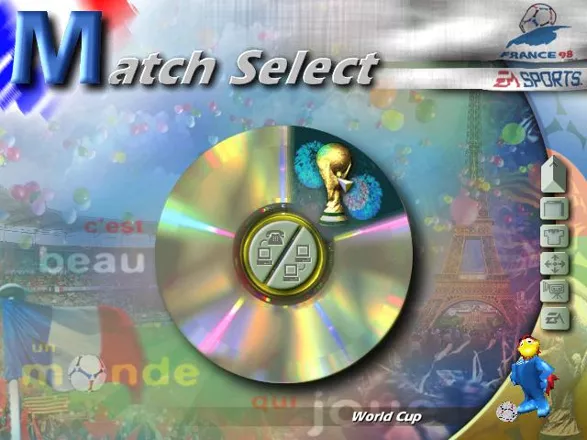
Immersion. That's a word that was absent in the previous games using either a FIFA or UEFA tournament license. Everything was done to give the player the feeling of "being there", from the perfectly executed stadiums, the pre-match FMVs displaying the city where the game was to be played, the competition status screen with a rotating miniature of the stadium while Lineker is giving his insight on the stages... It was the first and last to give such a level of immersion.
Graphics were of the highest quality in 1998, and comparing to FIFA 98, released months later, show some great improvements. Better 3D card support (which results in some smooth colours all-around), individual kits for teams (and based on the real kits used, too), perfectly recognizable stadiums, well animated players and an excellent front-end are all improvements over the already finely produced FIFA 98.
Sound/music also does not fail the grade. In the sound department the game manages to have terrific commentary, composed by four commentators (Lineker, Motson, Lynam, Hoddle and even a trivia-filled Kenneth Wolstenholme for classic matches), the crowd sounds are equally good and the typical in-game sounds are pretty much what was required. Music is yet another sytong point in the game, and helped to popularize the theme track (Chumbawamba's Thubthumping) as a football tune.
Finally, gameplay. What was perhaps the strongest point of FIFA 98 required only minor tweaks to be even more enjoyable. Some of the tricks were changed, but the core of gameplay is still there. One of the most impressive features is how even the most simple ball tricks can send a defender to his knees if chosen at the right place and time. It's possible to score from most situations, including corners, freekicks, crosses, feinting the goalkeeper, blast outside the area, and so on. Team management is also important, and adjusting the attacking bias and aggressiveness do make a difference.
The game also features an editor that allows to change the game completely. For instance, a team with high skills but low endurance will suffer ahead in the tournament as fatigue starts wearing down the players or bringing up a lower team the top contenders by editing the players up and vice versa.
The Bad
Like I've said, the game is almost flawless, thanks to the base game and the full use of the license, instead of just plastering the logo and the cover and use real player names. There are only three things that can be pointed out:first, faces are poor, second, the classics mode could have included all players and finals since 1930 instead of just eight and replays of goals scored in overtime cut before entering the goal, which is a bit of a letdown when you have in mind to pass them to streaming video.
The Bottom Line
While EA is criticized now for doing little with their franchises and licenses, this game comes from a time where EA was leading in this genre. No other game before and after made such a good use of a license, and considering it was developed in the relatively little time between the release of FIFA 98 and a usable date (around May), it just makes the game look even more impressive. While none of the aspects (except presentation) can be a match to today's modern offerings, the game still remains a solid, entertaining title, and provides a good insight to the 1998 World Cup.
Windows · by Luis Silva (13443) · 2006
Trivia
Cup Classics
The Cup Classics from 1966 and before are presented in black & white, and feature the old style ball (made of leather, stops like a dead weight, etc.) which behaves differently from the modern one. The two Cup Classics from the 30's (1930 and 1938) have an old film quality. The dress and hairstyles of the different eras are accurately portrayed (sideburns in the 60's, short hair in the 50's, very short shorts in the 70's, long shorts in the 50's, etc.). However, there are some inaccuracies: * The football design, adidas Tricolor, used in reality only during the 1998 World Cup, is used in all classic matches from 1970 onwards (that is all classic mode matches shown in colour). * The Golden Goal rule, used in real life for the first and only time in the 1998 World Cup is used for all World Cup Classics matches in the game. * The penalty shootout introduced in 1970 can be used to decide any of the World Cup Classics matches in the game. * The Yellow and Red cards, used in real life first during the 1970 World Cup, are used for all games in this mode. * The cards are shown in colour during black and white/sepia matches. * Captions are shown in faded colour during black and white/sepia matches.
References
During penalty shootouts, if the player scores one of the possible commentary strings is "That's how we score'm, John", said by Chris Waddle. The same Chris Waddle that blasted his shootout spot kick high into the stands in the WC'90 semi-finals against Germany, which ended up in a tearful defeat for the British side. Germany went to win the tournament 1-0 against Argentina, and Italy beat England 2-1 for the third spot.
References to the game
The PlayStation version of the game appeared in the music video for "Vatreni zmajevi" by Croatian musician Ante Cash in 2014.
Awards
- Computer Gaming World
- April 1999 (Issue #177) – Best Sports Game of the Year (together with FIFA 98: Road to World Cup and FIFA 99)
Information also contributed by A_J and Luis Silva
Analytics
Upgrade to MobyPro to view research rankings!
Related Games
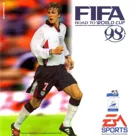
Released 1997 on Windows, PlayStation, Nintendo 64...
Released 1998 on Windows
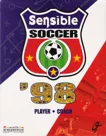
Released 1997 on Windows
Released 1998 on Neo Geo Pocket, 1999 on Neo Geo Pocket Color
Released 1997 on Game Boy
Released 1998 on Neo Geo Pocket
Released 1998 on Nintendo 64
Released 1998 on Windows, PlayStation, SEGA Saturn
Released 1997 on Genesis
Identifiers +
Contribute
Are you familiar with this game? Help document and preserve this entry in video game history! If your contribution is approved, you will earn points and be credited as a contributor.
Contributors to this Entry
Game added by Raphael.
Nintendo 64 added by Kartanym. PlayStation added by will.i.am.
Additional contributors: Matthew Bailey, VGM Maniac, Kohler 86, CaesarZX, Patrick Bregger, Plok, Hipolito Pichardo.
Game added October 26, 1999. Last modified March 7, 2024.