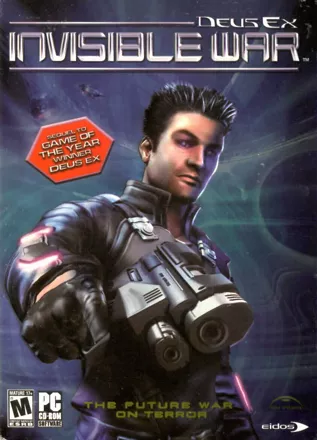
Deus Ex: Invisible War
-
 Eidos Collector Pack
(2008)
Eidos Collector Pack
(2008)
Description official descriptions
Twenty years have passed after the events described in Deus Ex. The actions of JC Denton have eventually led to a period of economic depression, known as "The Collapse". The world is on the brink of chaos after the dismantling of the mighty biotech corporations, and multiple religious and political groups lust after power.
The city of Chicago is destroyed in a devastating energy blast by unknown terrorists. Two trainees of the Tarsus Academy, Alex D and Billie Adams, are evacuated to another Tarsus-controlled facility in Seattle. Shortly thereafter the facility is attacked by members of a religious organization called the Order. Billie admits that she has been collaborating with them, implying that Tarsus may be involved in a conspiracy. It is now up to Alex to find his or her place in the new world, and ultimately shape its fate.
Deus Ex: Invisible War is a first-person shooter that retains many gameplay elements of its predecessor, such as conversations with characters, inventory management, exploration, and mixing various gameplay styles during missions. As in the original game, the style of play helps shape the game as it progresses, from how characters interact with the protagonist to the types of situations encountered. Each potential conflict can be resolved in a number of ways, through peaceful means or through violence, using stealth or a show of force. Hacking computer terminals and unlocking doors with special tools are prominently featured.
Weapons can be modified in a variety of ways, e.g. increasing their rate of fire, silencing the shots, allowing the weapon to shoot through glass, etc. Characters can once again outfit their bodies with an array of biotech parts, some of which include the ability to see through walls, disappear from radar, regenerate from critical hits, or jump forty feet in the air. Unlike the previous installment, there are no true role-playing elements in the game. The player must search for biotech canisters to install and upgrade biomods; however, no experience points are awarded for either completing missions or dealing with enemies. Inventory management has been simplified as well.
The sequel places more emphasis on decisions and different approaches to missions. From the beginning of the game the player has the freedom of performing missions for organizations and people of his or her choice. Like in the first game, several endings can be reached depending on the player's decisions.
Spellings
- 杀出重围:隐形战争 - Simplified Chinese spelling
- 駭客入侵 - Traditional Chinese spelling
Groups +
- 3D Engine: Unreal Engine 2
- Console Generation Exclusives: Xbox
- Deus Ex series
- Gameplay feature: Multiple endings
- Games with 451
- Green Pepper releases
- Middleware: Bink Video
- Middleware: FaceFX
- PC Gamer Presents games
- Physics Engine: Havok
- Protagonist: Cyborg
- Protagonist: Female (option)
- Setting: Arctic / North Pole
- Setting: City - Cairo
- Setting: City - Chicago
- Setting: City - New York
- Setting: City - Seattle
- Software Pyramide releases
- Theme: Hacking / Pseudohacking
- Theme: School
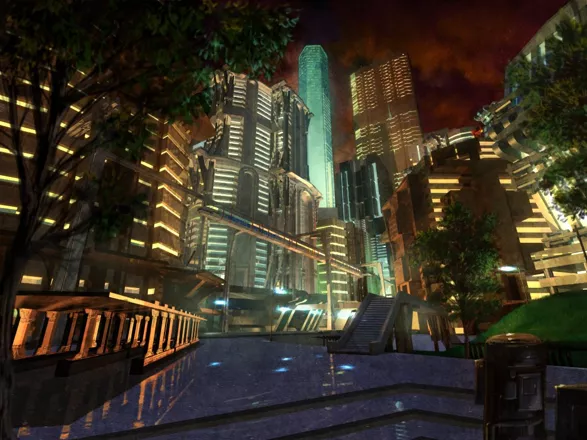
Screenshots
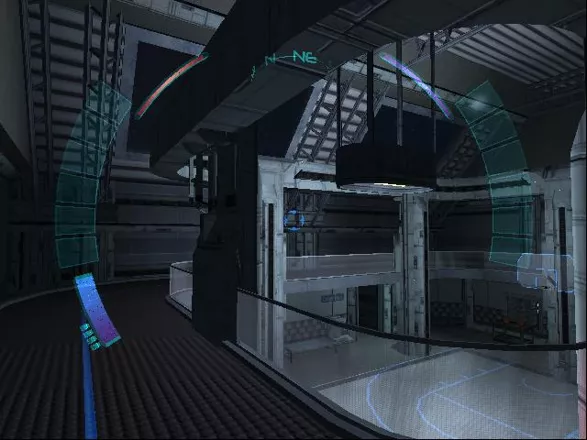
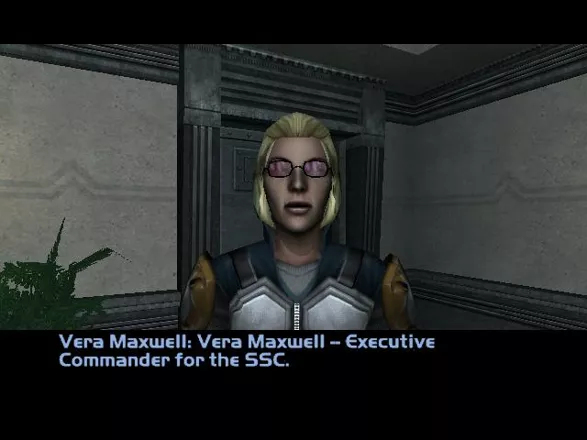
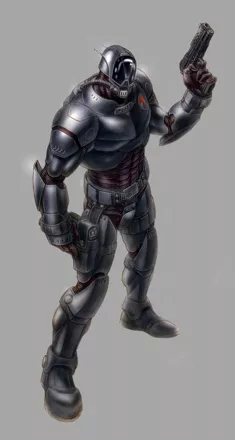
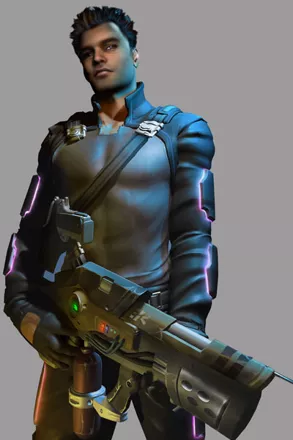
Promos
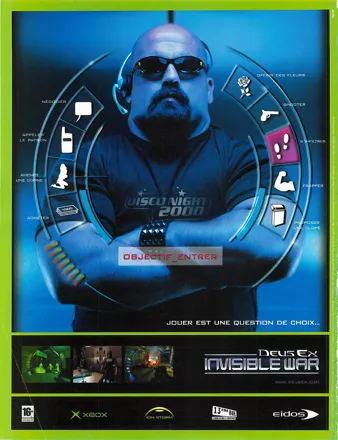
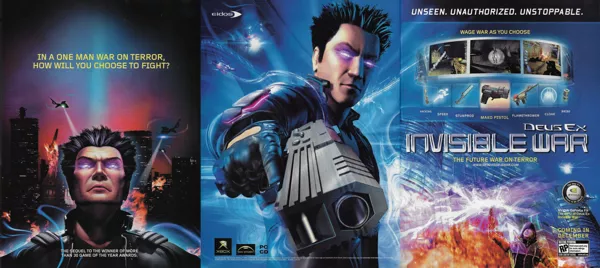
Videos
Add Trailer or Gameplay Video +1 point
See any errors or missing info for this game?
You can submit a correction, contribute trivia, add to a game group, add a related site or alternate title.
Credits (Windows version)
276 People (233 developers, 43 thanks) · View all
| Studio Director | |
| Project Director | |
| Executive Producer | |
| Producer | |
| Associate Producer | |
| Lead Programmer | |
| Programmers | |
| Additional Programming | |
| Director of Technology | |
| Lead Technology Programmer | |
| [ full credits ] | |
Reviews
Critics
Average score: 79% (based on 64 ratings)
Players
Average score: 3.4 out of 5 (based on 152 ratings with 16 reviews)
The Good
After the global Collapse, the WTO established safe enclaves for the best and brightest citizens of the world. In these enclaves commercialism flourishes. WTO troops and private sector security forces guard commercial and housing districts, while corporations have free reign to raise and educate their future employees. But all is not well. The Order Church have stepped up their anti-WTO activities. Chicago is decimated by a nanotech bomb, an Arcologist compound in Cairo is under siege, and the Panzerwerks factories are crippled by saboteurs. And lurking in the background is the revitalized Knights Templar, whose neo-luddite rhetoric has taken on religious fervor.
Deus Ex: The Invisible War begins with an Order raid on a Tarsus Academy in Seattle. The player’s character, Alex D—a Tarsus student, finds him- or herself under fire and unable to trust the WTO structure he’s been raised in. While the Order is clearly in the wrong, events suggest that Tarsus had ulterior motives regarding his education. Alex finds himself pulled between the WTO and the Order, with both sides recruiting his friends and attempting to sway his opinion. Starting in Upper Seattle, the player is quickly immersed in the gray morality that is the world of Deus Ex.
Invisible War is an action RPG presented from an FPS perspective. The game presents the player with a series of choices in terms of quests and goals. The choices are often conflicting and usually weigh a stack of credits against Alex’s code of ethics. The owner of a nightclub will want someone killed but the mark could double your money. Killing a fighting greasel might improve your gambling luck. Small choices lack the larger repercussions found in the original game, but you can cater to the several factions vying for your favor.
While much of the game can be played over the barrel of the gun, stealthy players can complete the game with few, if any, kills. Like its predecessor, Invisible War is customizable. Through the use of legal and black market biomods, players can upgrade their character, concentrating on creating a covert ops hacker or a killing machine. Basic upgrades allow for health regeneration, increased strength, and increased speed. Illegal modifications let players hack ATMs, take control of security turrets, and drain life from unconscious enemies.
Invisible War doesn’t have to be combat intensive, but there is a decent amount of weaponry to be found. Ranged weapons include the typical lethal pistols, sniper rifles, and rocket launchers. A poisoned dart boltcaster can knock out opponents from a distance. You can get up close and personal with a combat knife, energy sword, or various baton types. There is also a wide array of explosives for various user needs.
Of note, all projectile weapons draw from the same ammunition pool, but at a different rate. So you might not be able to send any more rockets flying at a Templar in full armor, but you can switch over to the pistol and fire off a few more rounds. Weapons can also be modified, but can only take two upgrades and can’t be downgraded if you change your mind.
The world of Deus Ex is still populated with interesting characters, some of whom return from the original game. The world is littered with books and datacubes, coming nowhere near Morrowind’s word count, but still filling in the gaps and explaining things like why all guns take the same ammunition. This entry has fewer locations than the original (and smaller levels), but there is still a bit of globetrotting to be done.
The Bad
Invisible War, aside from its weaknesses as a Deus Ex game, is a fun, largely open-ended excursion. Its ten hour playtime doesn’t provide enough time to develop characters or explore the storyline and players just coming to the franchise might prefer if characters just shut up rather than droning on about myriad conspiracies and organizations. Still there’s a lot to like here.
Most of what I didn’t like involved design choices. The HUD is clunky and crowded. Resembling an iris, good chunks of Alex’s peripheral vision are taken up with inventory and biomod information. You still have to enter an inventory screen to manage inventory, so it really isn’t time saving—especially since you can use the scroll wheel to move through active inventory items.
Levels look similar regardless of where they are geographically. I guess the proliferation of WTO technology is part of the problem, but I was really dying for something organic towards the game’s end.
Finally, aside from a rendered opening and four rendered endings, nothing happens outside of a game level—i.e., taking a helicopter from Cairo to Trier means clicking on a helicopter in Cairo and then magically showing up in Trier. A few transitional scenes would have been nice.
The Bottom Line
There’s an interesting conspiracy theory that Invisible War is smaller, simpler, and shorter than the original in an effort to make it more console-friendly. I’m not sure I buy it, but you have to wonder: in an age when sequels are bigger and better, why is Invisible War so scaled-down?
Let me step back, when I first played Deus Ex I was singularly unimpressed. As a first-person shooter, it was just average and lacked any sort of robust AI. As a first-person sneaker, I much preferred the Thief series. What I liked on my first play through, was the amount of character customization and the conversation options. And the fact that I had choices to make. Choices that seemed to matter.
The second time I played Deus Ex, I realized how brilliant the game was. Based on the choices your character makes, killing Anna early on or saving Paul, the game feels completely different. There’s an incredible level of branching, which I missed the first time out.
Back to Invisible War, I’m not sure that anything I did, up until the last half hour of gameplay, had any real effect. It’s that last half hour that determines which of the four endings you’ll get. Unfortunately, the previous 9-1/2 hours haven’t directed you towards any particular outcome. Are the Illuminati better than the Templars? Is the WTO’s vision of utopia more convincing than ApostleCorps’? Does any of it really matter?
Windows · by Terrence Bosky (5397) · 2005
Butchered, Bothered, and Bewildered
The Good
I consider the first Deus Ex one of the most important games ever made. Like many other fans of that Warren Spector masterpiece, I was impatiently waiting for the sequel; when I laid my hands on it, it made me shrug my shoulders more than once, until I decided it was not worth my time. However, I found myself coming back to the game in my thoughts; eventually, eight years later, my interest having been revived by Human Revolution, I gave it another chance.
All the annoying simplifications aside, the core gameplay still retains some of that special Deus Ex magic.The abundance of stuff to find brings back fond memories of a game that can become a giant scavenger hunt; even though they went over the top with that (thorough exploration rewards you with way more items than you'll ever need), it is still fun. I love collecting items, sometimes just for the sake of it, and Invisible War does satisfy that instinct somewhat.
Each level has branching paths accommodated to different styles of play. Don't want to spend multitools to disable laser beams? Maybe you could crawl through a nearby vent; but beware of spider bots. Any given area can be tackled by using different means - not necessarily by seeking out alternate routes. Tired of all this crawling? How about walking in gun-blazing, and dispatching of those giant robots with the EMP secondary fire of your mag rail? Be my guest. Think it would be too challenging? Activate a biomod that makes you invisible to robots, and quickly run past it. Every approach has its obvious advantages and disadvantages, but the bottom line is that the player can switch gears at any time, allowing for fluent gameplay. This cardinal aspect of the original Deus Ex was carried over to the sequel - though I must say that at times it felt like mechanical copying.
The world of Invisible War is fully interactive. Objects will physically react to your actions; you can move, knock down, throw, destroy, and interact with pretty much everything you see. Every single item, no matter how unimportant it is, can be picked up and put elsewhere. Moving items sometimes rewards you with a discovery of an alternate route, and throwing chairs and crates at enemies (with an appropriate biomod installed) is very cool.
The Bad
Why the hate? This is a sentence I've encountered on more than one website dedicated to the series. Many fans of the original Deus Ex loathe Invisible War; while I do not quite share this sentiment, I can certainly see where the hate comes from.
It's all been discussed many times before: removal of role-playing elements, unified ammo, dumbed-down interface, claustrophobic hubs. Side quests are always great, but the player needs to be rewarded for completing them. Without experience points, money would be the only reward; however, money is useless in the game. You cannot buy anything except food, and you don't need it. Even if you could buy other items, you wouldn't need to: everything is plentiful. Biomod canisters, in particular, are as common as bread loaves. I'm actually glad they removed shops because those would have made the game even easier. But of course it would have been better if they balanced all this without cutting out anything. And of course, there is the console habit of imposing limitations on everything.
Unified ammo - there is no way around it, it's not a good idea. Yes, I found myself rejoicing when I realized I will never run out of sniper rifle ammo. But that ruined the whole "you must survive with whatever little you have" aspect of the game; it went contrary to the concept of using different means to solve problems.
The interface bothered me enormously until I realized I could turn off the item display in the HUD by making it completely opaque. Wandering around in cities that consisted of a few narrow corridors was even less agreeable. Seriously: no city feels like one; in some places the cramped design borders on ridiculous, literally squeezing you into straight paths you can not deviate from. Add to that the painful loading times: minuscule locations are separated from each other by loading screens announced with an ironic "do you want to travel to..." greeting. Travel? You call opening a door and stepping through it traveling?
There was also something less tangible - a certain aspect of design and presentation that kept bothering me. A feeble, but constant unpleasant feeling relentlessly accompanied my playing sessions. I disliked the game's cold, calculated nature. It is as if somebody took some cool aspects from the first Deus Ex and carefully combined them together without infusing them with passion. I could never shake off the impression of artificial, deliberate planning.
Invisible War did nothing to correct the flaws of the original game. They bothered me more in the sequel than they did in the predecessor: three years have passed, and the second game lost a lot of what made the first one great, so I expected that they will at least address the weaker aspects of the original. Bad voice acting and moronic AI are still there. Hostile areas still tend to be monotonous and abstract.
The Bottom Line
Invisible War is a curious product. It's a terrible sequel, but I wouldn't call it a bad game. Even in its butchered, mutilated state, Deus Ex manages to elevate itself above the crowd.
Another reviewer passed the following verdict on Invisible War: "it's by far not as good as the first game, but it's still better than a lot of that crap out there". I think there is much truth in this statement.
Windows · by Unicorn Lynx (181775) · 2017
The Good
Deus Ex (the original) is one of my top five games of all time. It's everything I want in a game: first person view, RPG elements, a great story, great characters, great weapons and large, well designed levels. Deus Ex: Invisible War still has some few good things left, like interesting weapons and a first person view. I liked that. Unfortunately there's not much else left to like about it, as I'll explain in the next paragraph.
The Bad
There's so many dumb decisions and failed motives baked into this game, I hardly know where to start. First of all: there are no RPG elements left in the game. They're all gone. Augmentations turned into biomods that are extremely easy to max out. Most players did it within the second level of the game. The levels are small, cramped, uninteresting and plain ugly. The loading times between levels (and there are a LOT of loading going on) are ridiculously long. The performance of the 3D engine is abysmal. Even a system with 9800 XT and 3000+ Mhz CPU can't make it run smoothly above 800x600.
The AI on the NPC:s is so unbelievably dumb it's not even funny. You can stand 2 feet away from them and throw barrels in their heads and they won't react. Another extremely stupid decision made by Ion Storm was the unified ammo. All weapons in the game uses the same ammo! How's that for strategic planning?
Healer bots now heal you automatically and they're everywhere. You get tons of money but no shops. The biomods are almost all automatic so you don't need to worry about them. The weapon are still modifiable (although you no longer have any skills so you're a master sniper from the start) but only by 2 different weapon mods. Both of which are useless.
The worst thing about this game, though, is that it was clearly made for the Xbox. It runs GREAT on that 733 Mhz Geforce 3 machine, but almost refuses to run on my 2800 Mhz Geforce 4 Ti 4600 PC. Nice optimizations, Ion Storm. Not only that, but most of the settings in the PC version of the game are still Xbox optimized! Even the ingame-UI was accidentally left in Xbox-mode. The dialogue text is optimized for TV-screens. Nowhere in the game do you need a mouse pointer anymore, to make it easy for the Xbox people.
The sad thing is I really wanted to love this game, I tried really hard to at least like it, but it's impossible. It's such a blatant sellout to the big Micro$oft machine I can't even stand to look at it any longer.
The Bottom Line
If you want an extremely simple, short game that can't decide if it wants to be a bad FPS or a bad adventure game, then this is what you want. But you got to love long loading times, stupefied gameplay, awful performance and lots of bugs to be able to enjoy this title fully.
Windows · by Mattias Kreku (413) · 2003
Discussion
| Subject | By | Date |
|---|---|---|
| It's not that bad! | Unicorn Lynx (181775) | Sep 15, 2011 |
| Screenshots | Cantillon (77202) | Sep 8, 2011 |
| Dynamic Lighting | St. Martyne (3648) | Nov 15, 2008 |
Trivia
Basketball
Continuing the Warren Spector tradition, Invisible War features a basketball court. It's right at the beginning of the game and there's no missing it; one of your mandatory objectives will send you through there.
Engine
Ion Storm licensed the Unreal engine and heavily modified it for this game. Its a inhouse engine with a tiny bit of Epic's Unreal code left in. It is said that the engine programmer left mid-development with a largely undocumented code which caused the game's numerous technical problems.
Music
In order to bring popstar NG Resonance's music to life, Eidos licensed a few tracks from the industrial/techno band "Kidney Thieves". Said tracks can be found in their Trickstereprocess album. The original soundtrack for the game on the other hand, can be downloaded for free on Eidos's site.
References
The coffee shops, Pequod's, and QueeQueg's are from Moby Dick. The Pequod, was the name of the ship. QueeQueg is the Indian harpooner.* In the abandoned curio shop over the 9 World Taverns, you can find a book containing text on the care and cleaning of Ohio State Bobbleheads. Chris Carollo, the lead programmer for Invisible War is an Ohio State alumni. * The Tarsus Academy shares a name with the city that was the birthplace of Paul, the apostle. Paul Denton acts as the apostle for J.C. Denton.
Awards
- 4Players
- 2004 – Best Console Story of the Year
- GameSpy
- 2003 – #7 Game of the Year
- 2003 – #3 Xbox Game of the Year
- 2003 – #5 PC Game of the Year
- GameStar (Germany)
- Issue 04/2009 - One of the "10 Most Terrible Sequels" (It is a good game in its own right but it changes everything which made Deus Ex big for the worse, e.g. exciting story, clever level design, RPG elements and freedom of decision.)
Information also contributed by MasterMegid, Scott Monster and Zovni
Analytics
Upgrade to MobyPro to view research rankings!
Related Games
Released 2000 on Windows, Macintosh, PlayStation 2

Released 2011 on Windows, Xbox 360, PlayStation 3...
Released 2001 on Windows, 2011 on OnLive

Released 2012 on Windows, Macintosh
Released 2011 on PlayStation 3, Xbox 360, Windows

Released 2011 on Windows, Xbox 360, PlayStation 3

Released 2017 on Windows, Linux, Macintosh...

Released 2003 on Windows
Released 2005 on Windows, 2017 on iPad, Android
Related Sites +
-
Deus Ex 2
Official Web Site -
Deus Ex: Invisible War Post-Mortem
Warren Spector and Harvey Smith speak about the development and shortcomings of Deus Ex: Invisible War (Youtube) -
Hi-Res Textures for Deus Ex: Invisible War
Download a pack containing hi-res replacement textures for the game. -
Kidney Thieves official site
Site of the industrial/techno band Kidney Thieves, who contributed to Invisible War's soundtrack.
Identifiers +
Contribute
Are you familiar with this game? Help document and preserve this entry in video game history! If your contribution is approved, you will earn points and be credited as a contributor.
Contributors to this Entry
Game added by Jeanne.
Xbox added by Jason Walker.
Additional contributors: xroox, Zovni, Unicorn Lynx, Shoddyan, Paulus18950, Patrick Bregger.
Game added December 6, 2003. Last modified March 19, 2024.