Sid Meier's Alpha Centauri
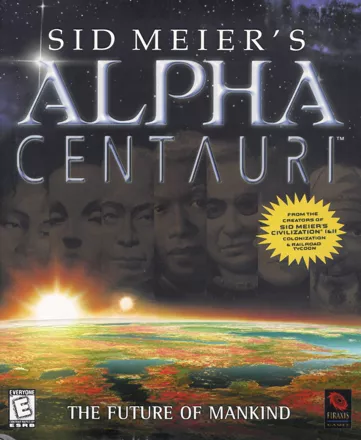
-
 Sid Meier's Alien Crossfire
(1999)
Sid Meier's Alien Crossfire
(1999)
-
 Electronic Arts Top Ten: Red
(2002)
Electronic Arts Top Ten: Red
(2002) -
 Sid Meier's Alpha Centauri: Planetary Pack
(2000)
Sid Meier's Alpha Centauri: Planetary Pack
(2000) - The Biggest Names the Best Games 3 (2000)
-
 The Conqueror's Collection
(2004)
The Conqueror's Collection
(2004) -
 The Laptop Collection
(2003)
The Laptop Collection
(2003)
Description official descriptions
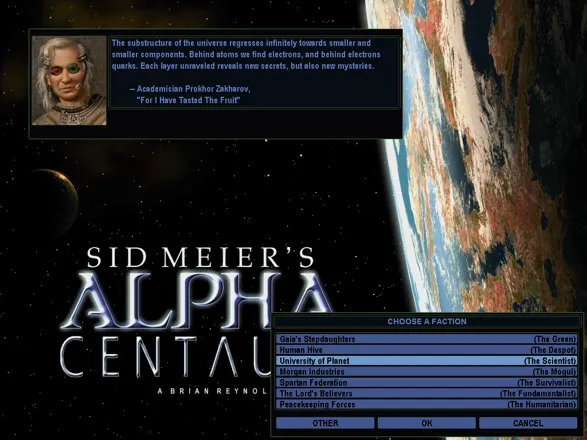
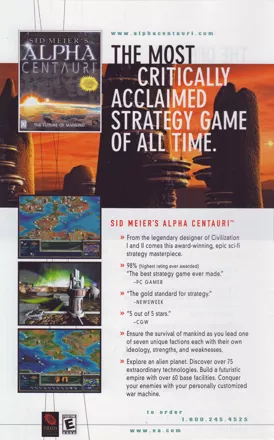
After the 20th century, humankind reaches its hand out across the stars. Seeking to escape the overcrowded chaos of Earth, the United Nations builds a single seedship, the UNS Unity, and sends her on a mission towards the Alpha Centauri star system. After a long journey in cryogenic suspension, the Unity reaches Alpha Centauri where the Captain is killed under mysterious circumstances. Suspecting the motives of one another, the officers and the crew split into 7 factions, each lead with a distinct ideology and motives that they seek to build the planet in their image...
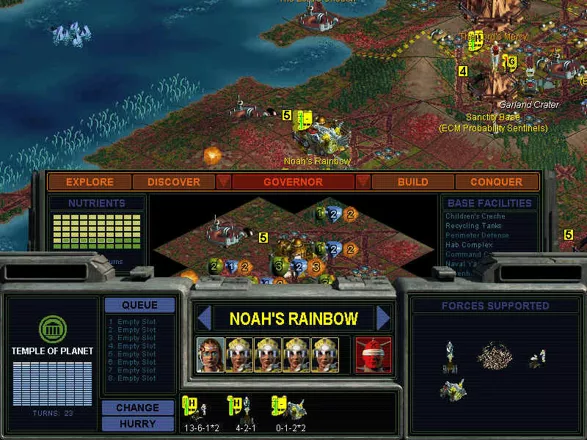
Sid Meier's Alpha Centauri is best compared to Civilization II, but features many distinct differences in gameplay and thinking. In Civilization, the objective was to evolve a society from primitive tribes, whereas Alpha Centauri starts with the landing of colony pods on a barren planet with society becoming fractured. Each faction (aka nation) receives it's own share of the Unity's resources and tech base. For the basics, bases produce nutrients, materials and energy. Nutrients are required to feed to population, Materials are used in production and energy represents the commerce effect which can be traded to players diplomatically or spent on improvements. The 7 factions each have their own agenda, which is determined in large part by the Social Engineering. This enables a faction to customize its values, earning a bonus for what it considers important and a penalty for what it doesn't. Social Engineering system are discovered through research, the same as other improvements, such as structures and units.
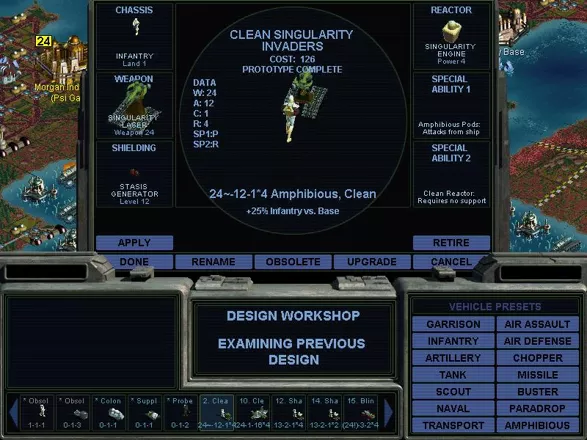
Research is divided into 4 types of technologies, which form an intertwining tree of dependencies. They are: Conquer (direct military applications), Explore (indirect technologies for units and bases), Build (direct infrastructure application) and Discovery (Science for the sake of science, indirect applications). Because of the separation, factions can focus on what they hope the intended result of their science will be, and can be changed at any time. To explore the planet, units are needed. Any unit can be customized out of known technologies; consisting of a chassis type, reactor, weapon, armor and special abilities. Each of these components has a different expense, with untested technologies having additional overhead (prototype).
Finally, Alpha Centauri is not a desolate star system. There is life on the planet, in the form of alien fungus that litters the ground and strange creatures such as mindworms. Initially hostile to all factions, this form of life holds its own secrets and effects on the world at large.
Spellings
- 半人马座 - Simplified Chinese spelling
Groups +
- EA Classics releases
- Game with creator's name
- Gameplay feature: Color-blind mode
- Gameplay feature: Fog of war
- Games made into books
- Games made into comics
- Games that include map/level editor
- Games with randomly generated environments
- Live action cut-scenes
- Protagonist: Female (option)
- Sid Meier's Alpha Centauri series
- Sid Meier's Civilization series
- Sid Meier's licensees
- Visual technique / style: Voxel graphics
Screenshots
Promos
Videos
Add Trailer or Gameplay Video +1 point
See any errors or missing info for this game?
You can submit a correction, contribute trivia, add to a game group, add a related site or alternate title.
Credits (Windows version)
148 People (145 developers, 3 thanks) · View all
| Lead Design | |
| Design | |
| Programming | |
| Additional Programming | |
| Music / Sound Programming | |
| Libraries / Utilities | |
| Graphics / Artwork | |
| Music | |
| Executive Producer | |
| Producer | |
| Acting / Voiceovers | |
| [ full credits ] | |
Reviews
Critics
Average score: 88% (based on 39 ratings)
Players
Average score: 3.9 out of 5 (based on 172 ratings with 16 reviews)
This is NOT Civilization. It's a whole lot damn better!
The Good
There are strategy games and there are strategy games. Alpha Centauri is the best thing that ever hit the strategy gaming world in a long time. How so? Well, I'm betting (of which I usually lose...) if your reading this review, you'd probably be well known to ol'Sid and his products, such as the acclaimed Civilization. Well, if you've played Civilization, you know the routine, build this build that until you have too many cities and they become to big and begin to die, etc.
Well, whoever made Civilization sure hell wasn't on the Alpha Centauri team. And thank the gods for that! Alpha Centauri is probably what you call "the PERFECT CIVILIZATION" (subjective opinion of course). I'll tell you why in a moment, but first I'd like to give you a description about what Alpha Centauri is all about (for those who have never played this game before).
Alpha Centauri started when Civilization ended (presumably), when you finish Civilization, well one of the endings anyway, you send a ship to outer space to conquer new worlds. Well, the blokes on Civilization (also presumably) landed on Alpha Centauri. They arrived safe and sound. Almost. Mankind always proved that they have the common sense of a warthog, and Alpha Centauri pointed that out by introducing the "Civilizations" in the game. Only, it not due to race. It based on ideology, each with multiple weaknesses and strengths. It maybe science fiction, but it sure hell was better than the real thing.
Now you have environmentalists, communists, industrialists and other ideologies of which I forgot, each have a unique way of handling problems. This can be seen from the technology tree, in a way it's similar to Master of Orion 1 & 2, except your only on one planet. Oh, you also notice that your not alone in this forsaken world. There are aliens...and they don't look friendly.
Enough said, back to the issue. What's so good about the game? Where to start... (In no particular order). The best way to compare this game is to compare it to Civilization, whom everyone adores so much (I got bored after Civ 3, same old same old...no Civ 4 please...)
Civilization had (and still I think) the worst diplomacy screen in the history of strategy games (Civ 3 got a little better). I recall in Civ 1 & 2, negotiation was not very interactive. In Alpha Centauri, the diplomacy is ALIVE! I felt as if I was playing AI with actual Intelligence! And the artificial intelligence of the computer players are really commendable. When they go to war, they really go to war! Civilization computer player always had an edge in expansion, but were mostly boring when it comes to battle. In Alpha Centauri, those guys (and girl) really know how move the muscle.
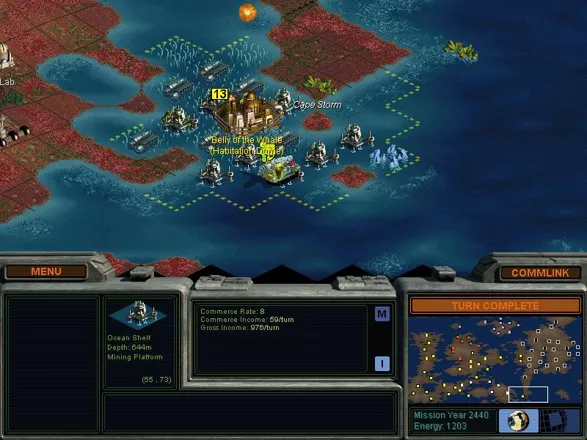
Like Civilization, every time you play a new random game, it's a totally different geographical map. But unlike Civilization, you probably wouldn't restart a couple of hundred times trying to find that "perfect" geographic location (not a desert again!). Alpha Centauri succeeded were Civilization was irritating. Geography doesn't matter. Even if when your surrounded by water, you can be as big as a city on land! What's the secret? Technology! Finally, the technology that actually makes a difference. You can even make cities on the ocean...there's no such thing as a "perfect" location in Alpha Centauri. Every place is a perfect location to build your city. There are also random events that may change the geography of the planet. One time a big volcano erupted and it was smack daddy in the middle of the map. Kinda cool actually, building cities around that hunk of molten rock.
What I like most in this game, is probably also what I liked most in Master of Orion. You can design your units. Weapons, armor, you name it, you can change it. You can make any kind of unit to fit long term or short term needs...this game was way ahead of its time...even way ahead of Civilization 3...how is that possible? Beats me.
The Bad
Well, geographical bonuses are random. Sometimes you get it, sometimes you don't. There are a lot of unique geographical terrain that don't necessary show up in each game...it's useful at the beginning of the game.
The Bottom Line
This game will never be a classic. It's still way ahead of it's time to be old...
Windows · by Indra was here (20755) · 2002
It was the time to step forwards, but...
The Good
SMAC heirs the features that made Civilization a classic, being the most important replayability: a random map makes up for that, and so does adding different factions with unique abilities; personally, mission-based titles aren't in my preferences. Diplomacy, although limited, has very well configured messages to give the feel of talking to a leader with his/her own personality; add to that agendas and aversions, and the Council, too. The gameplay in general is also a strong point: like in Civilization, found cities (bases), terraform, expand at will in a terrain with infinite variations and landscapes. The finest addition to politics is the Social Engineering, with great Role-Playing stile statistics.
Some say the technology tree is confusing due to strange descriptions: I think those add a unique sci-fi flavor: personally, I get more immersed in the futuristic atmosphere when reading "Our scientists discovered Photon-Wave Mechanics" or "Pre-Sentient Algorithms" than reading "Our scientists discovered the Photon Wall armor" or "can now build the Hunter-Seeker project".
The game is also very configurable, and multiple paths to victory enrich the gaming experience. Now, instead of having pre-made units, you can design your own, but shortly becomes evident which are the best combinations for each situation; the possibility is nice, though.
Graphics and sound aren't outstanding, but make their work, and that's enough for a strategy TBS game; it doesn't need more.
In general, SMAC is an empire-building game, and that's the feel it gives the player: of being building (or falling with) an empire through time.
The Bad
However, SMAC also heirs bad and annoying features from Civilization. And that's the matter: Civilization is a classic, with no doubt. But it was released in 1991, eight years before SMAC; and that's too much time. Many fans, I included, were disappointed by this game because hardly can be referred to as "evolutive".
First, diplomacy is still limited: instead of constructing your own proposals and counterproposals, the game forces you to take pre-defined options (what can I do when I want to demand or give 457 credits and the computer only allows me the fixed number of 300 or 150?). And diplomacy problems brings treaties and alliances problems: there's no way for a treaty to stand for long: if you're weak, the strong empires crush you; if you're strong, all other factions declare war on you even if they have no chance (apart of slave factions, of course).
Nothing to say about trade: the model is simple to death. "Tired of designing, guys?" is the question.
Developing of cities, also from Civilization, quickly becomes boring and repetitive: except on early stages of the game, it's a matter of "all buildings you can build". I think a model close to MOO1 or perhaps Ascendancy is much better. The "Talent/Drone" model, also, is too simplistic: does not include, for example, the effects of a sudden change of government (apart from varying Police indexes). What if a long-standing Democracy turns to a Fundamentalism in a turn? Will citizens remain so conformist? And so will they if the base is starving to death? And what if an obscure technocratic secret society is turning a base against its Eudaimonic government, or communists/ecologists incite uprising in a Free Market society? How can citizens stand quiet when unit after unit is destroyed in an endless war? Are soldiers mindless androids? Balancing Talents with Drones is enough to maintain peace?
But the worst of all is combat. Perhaps seems combat is not very important in an empire-building game, but is impossible to play a game without messing in several unprovoked wars (even with long-term allies; perhaps they don't know allied victory is possible). The "collateral damage" feature is annoying to say the least: I don't understand why 7 units sit while the 8th. is fighting against 1 attacker, who inflicts damage to all when winning; also, "automatic retreating" of tanks is a bad fix. Why not using a system like MoM? But even worse are the Attack/Defense stats: a battle consists of the attacker firing at the defender while the latter stays hoping its armor deflects all shots. A 12-1-1 Unit attacking a 16-4-1 Unit has all the chances of winning! Ridiculous! To make things even worse, armor values increase more slowly that weapons, making wars a matter of sending 13-1-1s. against 1-6-1s. in a base equipped with Perimeter Defense: outdoor battlefields belong to the one who attacks first. Air combat is still bad: although it's resolved comparing weapon forces, armor doesn't count. Why a land/sea unit cannot enter a square occupied by air unit?
Finally, although the AI is decent (decent, but not excellent), difficulty means more drones and ultra-cheating. The computer seems to know exactly where your units are, even without entering your datalinks or without having the Empath Guild. Do I really have the chances of success presented in the probe team operations window? No, I think. How can the computer discover Unified Field Theory and on the next turn send me a horde of marines equipped with weapon 12? He had only 150 credits to buy!
The Bottom Line
SMAC has almost all good features from Civ, and good new ones, but also has bad features from Civ (I say again: 8 years is enough time to get new and good ideas), and lacks some from Civ that were good.
Finally, even with the weak points, the game is worth a try, specially at reduced price. But i'ts far from being a true masterpiece.
Windows · by Technocrat (193) · 2002
I can't see why everyone likes this.
The Good
Ok, before I go on, please know that I own and love Civilization 2 and Civilization 3. Thank you.
When I first got this, i was excited. I had heard almost nothing bad about it, it had received PC Gamer's highest rating ever, and everyone said this was awesome. At first, I thought they were right. The graphics are improved from the original Civilization 2, and the interface seemed pretty much the same. Also, the Wonder Movies, like Civilization 2, were awesome.
The Bad
Then I began playing and realized how "un-fun" this was. I had no idea what any of the improvements or techs were. Should I research Polyphormic Encryption or Synthetic Phase Theory? Gee, the answer is obvious, isn't it? Polyphormic Encryption leads to Quantum flux which lets me modulate my phase variance, whereas Synthetic Phase Theory only allows me too create droids with upgraded logic data processors. Got all that? I didn't. You either know the techs and understand what they are, or you just bumble along, having no clue or clear direction about what you are researching except that "this tech is in the war field, and this other one is in the social field." The ability to create your own units sounds terrific, but proves to be a waste of effort. All the units that are worth any effort are already automatically made by the computer. Speaking of units, unlike in civ 2 where old, useless, antiquated units are replaced by more advanced units in the build menu, in this game, they aren't. So you either have too constantly clear out the old units, or leave them there and scroll through them all.
The Bottom Line
Basically, what you have here is Civilization 2 with poorer controls and much less accessibility. It's just too hard to get into. Civilization II on the other hand, is easy to sit down and play. You'll have to look at the manual every so often, but you can understand the basic concepts of the game such as what "archery" does.
Windows · by James Kirk (150) · 2004
Discussion
| Subject | By | Date |
|---|---|---|
| Upgrading units manually? | Xoleras (66141) | Aug 2, 2007 |
Trivia
1001 Video Games
Sid Meier's Alpha Centauri appears in the book 1001 Video Games You Must Play Before You Die by General Editor Tony Mott.
Cutscenes
Most of the secret project movies contain scenes from the documentary Baraka.You can find information about Baraka at IMDB.
Development
From an interview with designer Brian Reynolds Brian Reynolds with Computer Games Magazine (June 2000):
I always wondered if my degree in Philosophy would ever come in handy for something. My favorite part of this game was developing the characters and factions, and the AI to give them divergent personalities and agendas.
I think a part of broad appeal is merely choosing the right topic, and certainly compared to Civilization II, science-fiction was a lot harder, and gave the game more of an esoteric feel. Everybody knows what the wheel is, everyone knows what mathematics is, but linear mathematics? Particle accelerators?...It's even worse when you get into things you kind of made up.
Plasma bomb
The "planet buster" of the first-generation model, is listed in the game manual as technically called the Mark 714 plasma bomb, a single warhead delivered by a ballistic missile that locks onto its target by the signature of charged particles coming from it. The active kill radius, or the radius in which everything and everyone would be immediately destroyed (as opposed to people killed eventually by the side effects) is listed as 2,000 kilometers -- about 1,240 miles. The yield of the first-generation "planet buster" is said to be equivalent to 296 gigatons of TNT.
Here is what would happen if a bomb one ten-thousandth as powerful as that were detonated in a groundburst upon New York City:
There would be an overpressure of 15 pounds per square inch out to about five miles, or as far as the Receiving Reservoir at Central Park, Manhattan, and even reinforced concrete structures such as skyscrapers would be obliterated. Most water would be vaporized. No one would survive there. The surface of the land in that area would be melted to resemble black glass.
Smaller concrete structures would be destroyed as far as about six miles away.
In a doughnut shape covering the area between seven and nine miles away, all houses and other small buildings would be destroyed. Towards the outside, wreckage would remain.
Windows would be shattered as far out as about sixty miles away, from Scarsdale in the north to Keansburg in the south.
The above information about blast radii is from the HYDESim High Yield Detonation Effects Simulato.
Premise
As people who play Civilization know, at the end, one of the ways to win the game is get the expedition to Alpha Centauri first. So it was no coincidence that Sid's next game is Alpha Centauri.
Reception
As of August 2000, Alpha Centauri was PC Gamer's highest rated game ever with a score of 98%. Prior to the review this honor belonged to Sid Meier's Civilization II which had a score of 97%. In the December 2004 issue of PC Gamer, Alpha Centauri's "highest-rated" title was lowered to a mere tie when Half-Life 2 received a 98%.
Awards
- Academy of Interactive Arts and Sciences
- 1999 - Strategy Game of the Year
- Denver Post
- 1999 - Best Game of the Year
- Gamespot
- 1999 - Turn-based Game of the Year
- GameStar (Germany)
- Issue 12/1999 - #44 in the "100 Most Important PC Games of the Nineties" ranking
- Origin Awards
- 1999 - Best Computer Strategy Game
- PC Gamer
- 1999 - Turn-based Game of the Year,
- April 2000 - #16 in the "All-Time Top 50 Games Poll"
- Toronto Sun
- 1999 - Best Game of the Year
Information also contributed by 88 49, Chris Martin, Indra was here, Kasey Chang, mulayim; PCGamer77 and Zack Green
Analytics
Upgrade to MobyPro to view research rankings!
Related Games
Released 2000 on Windows, Linux, 2002 on Macintosh
Released 1999 on Windows, 2000 on Macintosh

Released 2011 on Windows
Released 2010 on Windows, Xbox 360, PlayStation 3...
Released 2014 on Nintendo 3DS
Released 2003 on Windows

Released 2014 on Windows
Released 2002 on Game Boy Advance

Released 2011 on Windows
Related Sites +
-
Alpha Centauri 2
single-player and multiplayer resources: game guides, game of the month, modding resources, MP ladder, all patches (official and unofficial), mirror of the AC official site (no longer online), downloads, articles, fan-fiction, fan art, links. -
aliencrossfire.civ3.de
German fansite for Alpha Centauri and its add-on; it offers background story, tips & tricks, scenarios, etc.
Identifiers +
Contribute
Are you familiar with this game? Help document and preserve this entry in video game history! If your contribution is approved, you will earn points and be credited as a contributor.
Contributors to this Entry
Game added by Brian Hirt.
Macintosh added by Corn Popper.
Additional contributors: PCGamer77, Kalirion, Rebound Boy, Technocrat, Shoddyan, CaesarZX, Patrick Bregger, sisko, FatherJack.
Game added March 1, 1999. Last modified March 31, 2024.