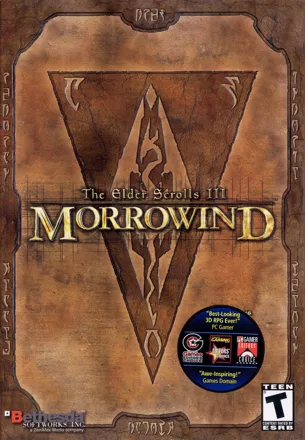
The Elder Scrolls III: Morrowind
-
 Gold Games 7
(2003)
Gold Games 7
(2003) -
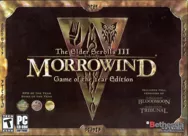 The Elder Scrolls III: Morrowind - Game of the Year Edition
(2003)
The Elder Scrolls III: Morrowind - Game of the Year Edition
(2003) - Ubi Soft Games Pack (2002)
Description official descriptions
Freed by the decree of Uriel Septim VII, the Emperor of Tamriel, a lone prisoner is transported to the province of Morrowind. It seems that the strange dreams this prisoner has been having lately may have a connection to equally strange events occurring there. The protagonist is given a simple assignment: join the Blades, a secret organization whose goal is to protect the safety of the Emperor. This leads to a discovery of an ancient prophecy and an evil scheme concocted by a powerful deity whom the protagonist alone is able to stop.
Conceived in the tradition of the Elder Scrolls series, Morrowind is a fantasy role-playing game with a vast world open for exploration. After being released from a prison ship at the shores of the island Vvardenfell, the protagonist may do more or less what he or she wants: follow the main quest and solve the mystery of an ancient prophecy, join any of roughly a dozen guilds and rise in their hierarchy by performing duties, or simply explore the gigantic island with its stylistically diverse cities, hundreds of dungeons and tombs, ancient ruins and mighty fortresses.
Morrowind uses a two-stage skill system. The hero’s primary stats (strength etc.) increase with each level gained, while secondary abilities improve by use – for example, the more often the character jumps, the more proficient he or she becomes in the Acrobatics skill, etc. The action-oriented fights are simple exchanges of strikes or spells, until one combatant dies. The enemy's hit points and condition were not originally shown; however, at the request of customers a health bar was added for enemies as part of the first upgrade patch.
The protagonist's race and gender, but also his or her reputation influence the reactions of NPCs. If a character’s sympathy for the hero is low (rated on a scale from 1 to 100), he might refuse to answer questions; if it is high, the player will get more detailed information and better bargains in shops. Most quests involving other persons can be solved by persuasion, pick-pocketing, or simply by force.
The game's NDL 3D game engine is powerful in drawing wide, detailed outdoor landscapes as well as complex indoor environments. Transitions are not fluent; houses and dungeons must be loaded upon entering.
Spellings
- 上古卷轴III:晨风 - Simplified Chinese spelling
- 上古捲軸 III:魔捲晨風 - Traditional Chinese spelling
Groups +
- Animals: Cats
- Console Generation Exclusives: Xbox
- Covermount: Fullgames
- Elder Scrolls series
- Fantasy creatures: Dwarves
- Fantasy creatures: Elves
- Fantasy creatures: Orcs
- Gameplay feature: Alchemy
- Gameplay feature: Burden / Encumbrance
- Gameplay feature: Character development - Repetition
- Gameplay feature: Drowning
- Gameplay feature: Equipment quick slots
- Gameplay feature: Hunting
- Gameplay feature: Journal
- Gameplay feature: Paper doll inventory
- Middleware: Bink Video
- Middleware: Gamebryo / Lightspeed / NetImmerse
- PC Gamer Presents games
- Physical Bonus Content: World Map
- Protagonist: Female (option)
- Software Pyramide releases
- Technology: amBX
- Ubisoft eXclusive releases
- Xbox Classics releases
- Xbox Platinum Hits releases
Screenshots
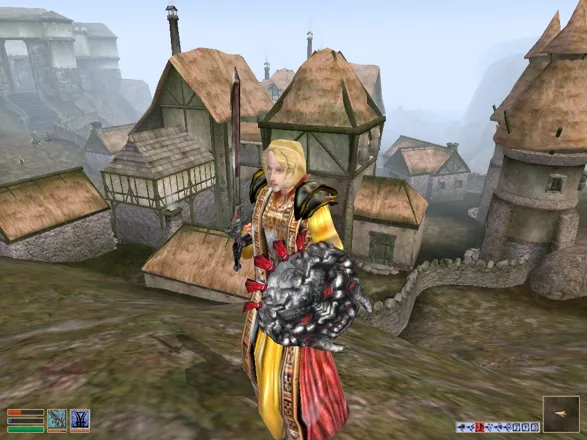
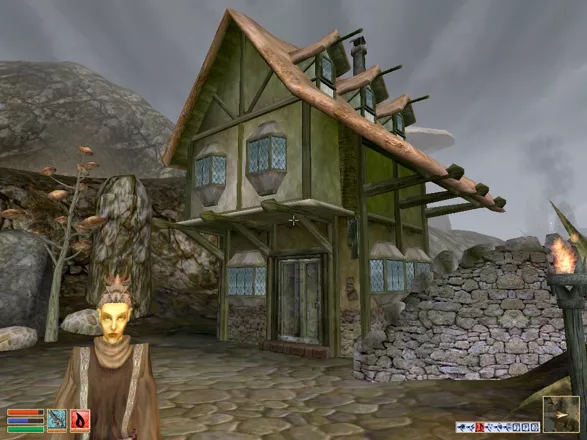
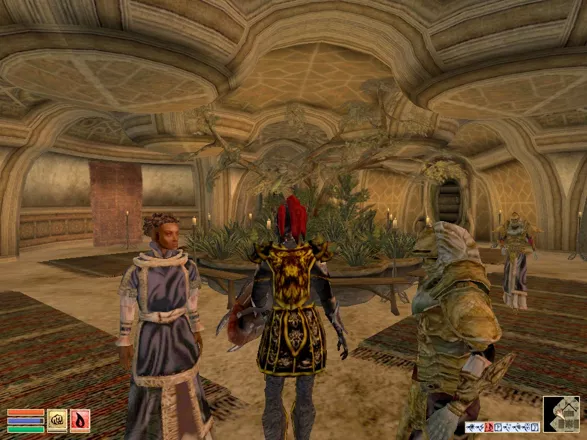
Promos
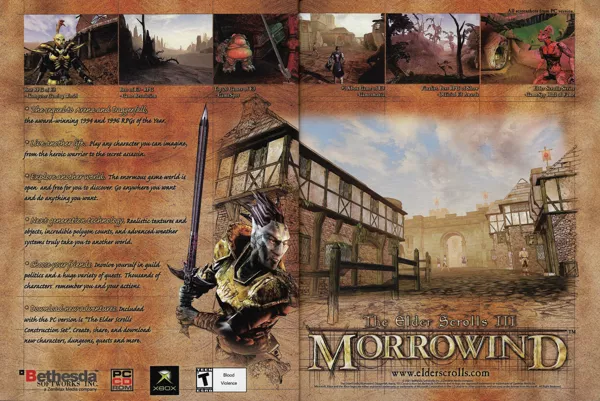
Videos
Add Trailer or Gameplay Video +1 point
See any errors or missing info for this game?
You can submit a correction, contribute trivia, add to a game group, add a related site or alternate title.
Credits (Windows version)
118 People (80 developers, 38 thanks) · View all
| Project Leader | |
| Lead Designer | |
| Lead Programmer | |
| Lead XBox Programmer | |
| Lead Artist | |
| Lead Character Artist | |
| Programming | |
| Additional Programming | |
| World Art & Building | |
| [ full credits ] | |
Reviews
Critics
Average score: 89% (based on 83 ratings)
Players
Average score: 4.0 out of 5 (based on 285 ratings with 23 reviews)
The Good
This game is BIG. It's graphics are BEST. There tons of activities, tons of possibilities and tons of stuff to collect. You can always play it again and again and choose different paths, its almost impossible to get bored. The music is perfect
The Bad
When I first read the review of Morrowind in a local computer zine, I was only thinking about one thing: I NEED THAT GAME. It was in Summer 2002, and I even couldn't imagine that my dream would come true. My PC was Pentium 166, so I figured it'll take years to get a new PC (I didn't have any money). But in February 2003, my dreams came true: I bought a normal, 1700MHz PC. By that time I had forgotten about Morrowind and one day I started reading about it again and went out and bought the game. When I was coming home from the shop I already imagined it: my char wondering around Morrowind, slaying stuff. But when I installed it, and started the game, I was disappointed. Why you ask?
The game itself is good. REAL good. BUT. All the NPCs are just standing there. They aren't doing anything. Even the badguys aren't lurking around (except wild "animals"), they are just standing there and waiting for you. When I first saw Syena Need (sorry I don't remember the exact name but It's the first town you see in Morrowind) I thought those people were zombies because all they did was walked around and said "Make it quick outlander, I havent got much time". Why are they so boring? Why Bethseda was working on Morrowind for 6 years and didn't make NPCs more active?!?!! Even Ultima 9 has that! That is the worst part of this game.
The Bottom Line
Although it has it's setbacks, this game is good. It has excellent graphics and sound and a lot of activities to do. Buy it!
Windows · by Sir Freeman (1) · 2003
A beautiful and rich game setting stunted by inexcusable game design flaws.
The Good
The best parts of Morrowind are the graphics and the exploration.
The graphics are extremely well done, especially the water effects. Water looks like you could actually drink it instead of appearing (as it does in most games) as a translucent blue mess. Even more amazing are the effects when your character walks through water or when rain splashes into the water.
The other part of Morrowind that is done well is the questing and exploration aspects of the game. The game is very large and detailed, so much so that I have played through the beginning parts of the game three or four times and I haven't explored even half of that area, let alone the other 90% of continent and its islands. There are numerous factions and quests you can do for those factions to gain prestige and move the plot of the game along, but you can also ignore quests completely and just wander around looking for trouble.
Another trivial, but often overlooked detail in other games (cough Wizardry 8 cough) that I liked was that monsters almost always have the loot you expect them to have, not some randomly-generated junk. So if you slay a skeleton warrior that was chopping you up with a big battle axe, you will find Bonemeal and a battle axe on his corpse.
The Bad
There are almost too many things that I didn't like about this game to list. None of them make the game unplayable, but after playing the game for about 15 hours you wonder why they spent so much time on the water effects and so little time balancing the skills, making the interface easier to use, giving the characters personality, and giving good feedback to the player in combat.
The character-building tools are fun to use, and it is great to have the flexibility to make the character you want, but ultimately, the flexibility is illusionary -- there are only a few different types of character builds, and since you can buy training for cash, you can get good in skills even if you didn't specialize in them once you raise enough money. There is also almost no reason to specialize in Stealth because you can get all of the perks of the Stealth abilities by casting spells. Sure a thief can sneak and pick locks, but there are cheap, reliable spells that replace his abilities and they are easier to come by than a high Security skill and a pair of master lock picks. Why even bother with sneaking when you can just make yourself invisible? I had some fun with the thief I made until I tried out a mage build and found that I could steal 90% of the stuff that the thief could without specializing as a thief. I was never able to successfully backstab, even with weapon raised and the "sneak" icon clearly showing that I wasn't detected. So much for the thief builds.
So that gives you the choice between fighters and mages or a combination of the two. So now your only character-building choices are picking which spell schools and weapon types you want as Major skills and which you want as minor skills. The spells are fun to use, but are awkward to select even with the quick keys. The worst aspect of spells is that there is no obvious way to remove obsolete spells from your spellbook as you get or design better versions of them. So if you can't fit all your favorite spells on the quick menu (I couldn't and I only had 4 schools of magic) you have to bring up the spellbook menu and search through the list for it which is tedious to say the least.
Combat is poorly implemented. First of all, there is absolutely no feedback on how damaged a foe is, so you have no idea how close you are to killing your enemies, which eliminates a lot of combat strategy. Second, combat is even more of a click-fest than in Diablo 2, without the fun of having all those cool special attacks. Your only attack options are spells and melee. There are three types of melee attacks: slash, thrust, and chop, which would seem to give you some strategic options. Unfortunately, you have to do some really awkward gyrations with the controls to select between the different attacks, and it doesn't matter anyway because all weapons have one kind of attack that does more damage than the others, so why bother using any of the others? There is a game option to "always use best attack" that keeps you from having to jiggle as you clash swords. Why didn't they just remove the options altogether since there is never a reason not to use the best attack? Finally, it was obvious that Hand-to-Hand combat with fists was an afterthought, as it requires so many punches to KO even a lowly rat that you will wear out your index finger and your patience before becoming the Karate Kid of Morrowind. Also, for no reason at all, you can't use the Block skill with unarmed combat which would seem to be a natural fit for that skill.
A final problem with character development is that the Enchant skill is way too powerful. As long as you have the Soul Gems (and are willing to restore a lot of saved games or spend lots of money to raise your Enchant skill) you can put any spell effects, from paralyze to life leech, on an item, the only limitation being that you have the spell effect in your spellbook, even if you can't cast it reliably or don't have enough mana to cast it! So you can run around with your Staff of Paralyzation and Life leech and mow down monsters at your leisure. It would be much more interesting if the abilities on the item were based on the creature you had trapped in the Soul Gem. But of course Bethesda couldn't put something that interesting in the game, they had to make it generic.
Dungeon-delving and questing is a fun part of the game, but the price you pay is a rather disjointed gameplay as you wait for new scenes to load even if you are only visiting the local Inn to get a good night's sleep. The developers really should have toned down the graphics a little so they could have made the game transitions smoother. They should have done seamless transitions like Dungeon Siege, especially since it is only a single-player game! The other problem with their zoning is that creatures can't follow you in and out of zones. So if you are getting your butt kicked by a bunch of bandits and you have enough speed you can just turn around and run out the door to their cave (that's right...ALL of the caves in Morrowind have doors!) for an easy retreat.
The interface is pretty good, but there are a lot of things that require too many clicks and drags to accomplish simple tasks like inventory management. The inventory system is difficult to use and forces you to click and drag items too many times. It would be a lot more convenient to have a text view of many items, especially alchemical ingredients and potions, which all look alike after a while. I hate having to mouse over every scrap of hide or piece of plant that I have in order to find the right ingredients for my potion. I also wished that I could load two different types of arrows into one quiver so that I wouldn't have to reload during combat.
My final gripe is that none of the characters in the game are very interesting. I wasn't expecting the level of characterization of Morte in Planescape: Torment, but I was expecting at least a little more dialogue options than only being able to ask about quests, rumors, and what they do for a living. The worst part of the dialogue options is that most characters respond in exactly the same way. So if you ask any fighter about his job, he will respond with a lengthy paragraph that sounds like a resume submitted to the local fighters' guild. Yawn.
Some characters will join you as companions, but don't expect them to be very interesting or even very helpful in combat. Your companions always blindly charge anything that appears hostile, even if they are obviously overmatched. Even worse, they often charge into the path of your spells or arrows, and then take their stupidity out on your hide. After a while I just started killing anyone that wanted to join me so they wouldn't get in the way. After all, they still carry the reward money or item they were going to give you for doing whatever errand they wanted you to do.
The Bottom Line
Morrowind is a large, beautiful, open-ended RPG that allows you to custom build your character, spells, and magic items from components. Unfortunately, the good ideas in the game are overshadowed by a ton of poor game design choices that make the game a lot less fun and a lot more tedious than it should be. Perhaps the Mod community will be able to use the bundled construction kit to solve some of Morrowind's worst problems, but many of them are so embedded in the design of the game that I doubt anything but a huge gameplay and interface patch by Bethesda would solve the problems.
The game is still worth trying, but I would wait until it is $15 in the bargain bin and good Mods start coming out before shelling out money for it. If you did pay full price, you can at least console yourself about your bad gaming investment by looking at the cool water effects.
Windows · by Droog (460) · 2002
The third installment in the ES series is, like its predecessors, a flawed masterpiece.
The Good
Morrowind is a truly excellent title. I've been a fan of the Elder Scrolls for a long time, so I had been following the game's development for years before its release, and I was shaking with excitement when I inserted the disk into my CD-ROM drive for the first time, praying that my system stats-- which were barely over what the game required-- would make it, and a small, rebel part of my brain (the part that could admit that there was a possibility Morrowind might be a disappointing game) was praying I wouldn't be disappointed.
I wasn't.
The game begins on a prison ship, as you may well know. You are smoothly introduced to the basic controls and interface as you design your character. The choice of races is slightly more expanded from the prequel, Daggerfall, to add Orcs (who are no longer considered vicious barbarians by all the other races) and Imperials. As in all the ES games, you have complete freedom in designing your character. No newbie to RPGs, I built myself a custom character and jumped right into the game. Beware, Morrowind World.
The graphics are stunning in Morrowind; everything, from tables to rocks, is modeled with great attention to detail. I was shocked when I turned wireframe on for the first time and really grasped the complexity of the 3d models they use. I've never seen so many polygons in an RPG before.
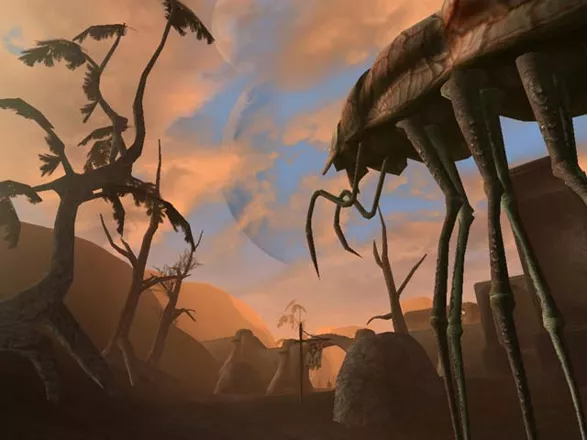
The sky is a real treat, and, in my opinion, the very best part of the graphics. Clouds float gently across the sky, slowing growing denser, until a steady rain begins to pour; then they part, the sun peeks out, and you have a few more hours of light before it sets... ahh, the sunset. And then the night! You can even spot constellations in the sky around the large twin moons of Nirn (The World). You have never seen such a wonderfully detailed sky before.
The creatures were well modeled and not disappointing at all, especially as you meet higher level ones. I just love how the Dremoras look. And-- thank you Bethesda-- there are no spiders in the game. +5 to gameplay on a 1-5 scale for that ;-).
The world itself is quite different from Daggerfall. It's not the same massive scope twice as big as the UK; no, it's more like, say, two miles. But unlike Daggerfall, none of this is stock terrain. Every bit of land has been custom designed, from the plants-- that you can pick-- to the creatures and the dungeons. There are around 300 dungeons to explore and 15 towns; this may sound like very little, but I have had characters get very far in this game, and they have barely scratched the surface of the world you are allowed to explore.
The NPCs are unique, too; all 3000 of them. They will each have an individual opinion of you, each have different things to discuss; you can also bribe and 'admire' them if you want to get on their good side, or taunt them if you want a fight without getting in trouble with the authorities.
The whole world is wonderfully set up and it's such a relief to have the world so ALIVE around you, such a sharp contrast to Daggerfall's everyone-comes-from-a-cookie-cutter-ness.
The game is packed with extra 'little' features, like making your own spells and trapping souls and enchanting items-- doing it yourself or having others do it for you, you choose. There are a collection of guilds to join; there are some unique to Morrowind, like the Morag Tong, and then the typical Fighters, Mages, and Thieves guilds. The quests in Morrowind are unique; you'll never be told to do the same thing twice. Side-quests included, I'd estimate there were something like 200 of them, but that is a very low estimate.
There are also three Great Houses in the game you have to join at one point or another. The conflicts between them, and the foreign Mages, Fighters and Thieves guilds, grow more obvious as you learn more about Morrowind. The whole place is veritably seething with intrigue, but if you think guild conflicts are all there is, you've got a lot to learn. Along the way, you'll find out about the (generally) hated Daedra and the Tribunal of gods, and about a prophecy that is changing the world.
The sound in the game was a bit of a disappointment for me. Each creature has 3 sounds and that's it, and some are even re-used for other creatures. This felt very cheap. NPC dialogue lines, however, are very well recorded and there are a large number of lines per Race/Sex combination.
The music is wonderful. There are only about 40 minutes of it, but it'll take your breath away the first time you hear the title theme. It grows a bit redundant, but you can add in your own fantasy themed music easily if you want too.
Then there is the Construction Set, the tool with which the entire world was made. You can make mods of all types with it-- change walk speeds, make new armor, raise a whole island, or even change the world completely. The CS deserves a review by itself, really. It's the best game editing tool I have seen-- beats the NwN toolset flat, in case you were wondering.
The Bad
The NPC models were a bit of a disappointment. The graphics system had to manage NPCs so that different armor could fit over any body part, so the game had to use a clunky limb system. This isn't too bad normally, but it does look a bit blocky and subtracts from the realism.
The game isn't balanced too well. Good items are too easy to find early on. But then again, how could it be balanced perfectly, in a game where any class could go any place at any time?
Is that all? No, not really. That's not enough to call Morrowind a 'flawed masterpiece'. But there is something else about the game. It's hard to explain.
But, after playing for a while and then going back to another game for a bit, you'll realize how bland Morrowind's textures are. It's like every single texture was taken and had the contrast lowered half way to black and white; everything is nearly in shades of gray. Except the sky! You don't notice it right away, but it can really bug you after a while.
It's only part of the full effect, however. Added is the fact that you start the game as a stranger in a strange land; the world around you is alien and very dry. The burned lands that have been ruined by the Fire Mountain take up 3/4 of the whole island. After a while, you'll find yourself yearning for verdant forests, lush fields-- something that feels ALIVE! That is my main complaint with the game. It really does begin to trouble you after playing it for a while.
The Bottom Line
Morrowind is a great game. The one large flaw and other, very small ones do not ruin it; they might have destroyed a smaller game, but Morrowind is so massive, with so many amazing features and so many hours of gameplay, that it still comes across as a brilliant game. It's one that I think every gamer should get, especially those who enjoy RPGs. It really revolutionizes the genre. 'Flawed Masterpiece' just about sums it up!
Windows · by ShadowShrike (277) · 2004
Discussion
| Subject | By | Date |
|---|---|---|
| Add Game Group | karnak1 (22) | Dec 24, 2012 |
| Morrowind vs. Oblivion | Unicorn Lynx (181775) | Jul 26, 2007 |
Trivia
1001 Video Games
The Elder Scrolls III: Morrowind appears in the book 1001 Video Games You Must Play Before You Die by General Editor Tony Mott.
Content
Morrowind is told to include 3244 NPCs, 316.042 hand placed objects, 480 billion possible characters to create and play, 150 billion spells by using spellmaking in the game, and six full sized novels worth of text.
Creature differences
Some monsters and creatures went through drastic visual changes from Daggerfall and Battlespire to Morrowind. First, the type of khajiit are the same as those presented in Redguard, while the Dremora were turned from fair-skinned, horned demons to black and red-skinned demons. Harpies were replaced with (visually at least) Winged Twilights, and other monsters such as the slaughterfish, orcs and others remain much the same, though much better looking in true 3D.
Graphics
Ever wonder why Morrowind can run at such a slow FPS sometimes and why the game is notorious for making even expensive, fast systems (as of 2004) seem slow? The answer is simple; polygons. While playing the game you'll encounter vast areas full of people, objects and architecture. All these are made from polygons and require the videocard to process them. Morrowind has possibly the heaviest counts of polygons in a single video game, most likely surpassing every game before it and still with a vast number more than contemporary games.
References
There is a single daedric crescent from Battlespire hidden in Morrowind, but getting to it requires some work and initiative (it isn't a part of any main or faction quest), or access to a hint guide.
Awards
- 4Players
- 2002 – #9 Best PC Game of the Year (Readers' Vote)
- Computer Games Magazine
- March 2003 (Issue #148) - #3 overall in the "10 Best Games of 2002" list
- Computer Gaming World
- April 2003 (Issue #225) – RPG of the Year
- GameSpy
- 2002 - PC RPG of the Year
- 2011 – #14 Top PC Game of the 2000s
- RPG Vault
- 2002 - Game of the Year
- 2002 - Role-Playing Game of the Year
Information also contributed by calavera, Jason Musgrave, ShadowStrike and WildKard
Analytics
Upgrade to MobyPro to view research rankings!
Related Games
Released 2006 on Windows, Xbox 360, 2007 on PlayStation 3...
Released 2003 on Windows
Released 2002 on Windows
Released 2002 on Windows

Released 2018 on Windows, Nintendo Switch, 2020 on PlayStation 4
Released 2003 on Windows, Xbox, 2021 on Windows Apps
Released 2017 on Windows, PlayStation 4, Xbox One
Released 1996 on SEGA Saturn, 2005 on PlayStation 2
Released 1993 on Arcade, SNES, 2020 on Nintendo Switch
Related Sites +
-
Baldurdash
Kevin Dorner's site has bug fixes for Morrowind -
Elder Scrolls III: Morrowind
The official homepage of Elder Scrolls III: Morrowind. Contains general information, downloads, art, and plug-ins. -
Hints for Morrowind
Need just a few clues about Morrowind? These question and answer hints provide nudges before the final solutions are revealed. -
Morroblivion
A free mod that brings Morrowind into Oblivion by converting the game files. -
Morrowind Summit
A Morrowind fan site containing vast amounts of information about the land of Morrowind and how to create your own Morrowind adventures. -
Morrowind at RPGDot
Contains news, information, and downloads for Elder Scrolls III: Morrowind. -
Telesphoros' List o' Mods
One man's opinion of the ESSENTIAL fan-made enhancements (mods) to the Morrowind world. -
The Elder Scrolls III: Morrowind - FAQs & Guides
A multitude of walkthroughs, faqs, maps, text files on Morrowind. -
Wikipedia: The Elder Scrolls III: Morrowind
Article about the game in the open encyclopedia -
Wiwiland
French modding community with a lot of exclusive mods.
Identifiers +
Contribute
Are you familiar with this game? Help document and preserve this entry in video game history! If your contribution is approved, you will earn points and be credited as a contributor.
Contributors to this Entry
Game added by NeoMoose.
Xbox One added by Kennyannydenny. Xbox Cloud Gaming added by Sciere.
Additional contributors: PCGamer77, -Chris, Unicorn Lynx, Jeanne, OFoglada, Shoddyan, Sciere, Aubustou, Paulus18950, Patrick Bregger, FatherJack, Kennyannydenny.
Game added May 10, 2002. Last modified April 19, 2024.