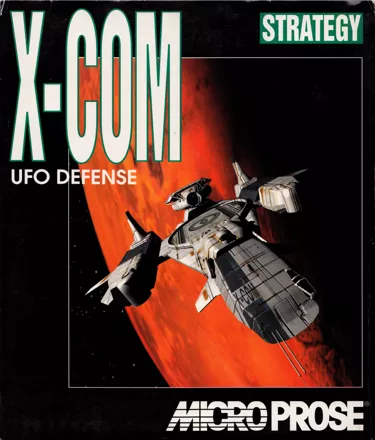
X-COM: UFO Defense
-
 2K Huge Game Pack
(2009)
2K Huge Game Pack
(2009) -
 Power, Corruption & Lies
(1995)
Power, Corruption & Lies
(1995) -
 Telstar Double Value Games: Syndicate + UFO Enemy Unknown
(1995)
Telstar Double Value Games: Syndicate + UFO Enemy Unknown
(1995) -
 UFO: Enemy Unknown / X-COM: Terror from the Deep
(1997)
UFO: Enemy Unknown / X-COM: Terror from the Deep
(1997) -
 Ultimate Strategy Archives
(1999)
Ultimate Strategy Archives
(1999) -
 X-COM Collection
(1999)
X-COM Collection
(1999) -
 X-COM: Collector's Edition
(1998)
X-COM: Collector's Edition
(1998) -
 X-COM: Complete Pack
(2008)
X-COM: Complete Pack
(2008) -
 X-COM: Unknown Terror
(1996)
X-COM: Unknown Terror
(1996)
Description official descriptions
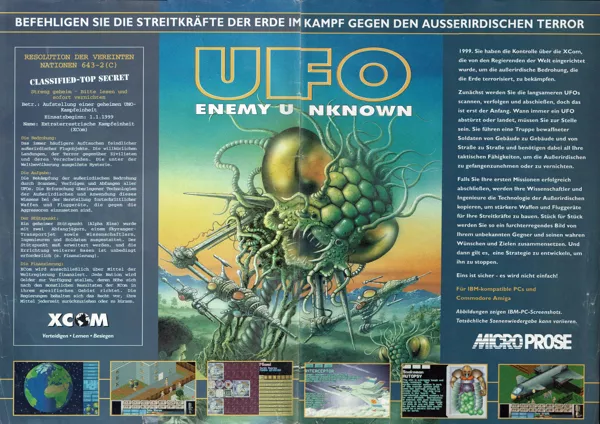
In the year 1998, the amount of reports of UFO sightings has been drastically increased. Stories about abductions and alien attacks became more and more widespread. Finally, after various nations of the world have failed to intercept the UFOs, their representatives met in a conference of global importance in Geneva, Switzerland. It was eventually decided to organize a secret paramilitary group, dubbed Extraterrestrial Combat Unit (X-COM). Starting with one base, two fighters, one transport, and a few soldiers, X-COM must locate the aliens, learn about their origins and technology, find out where their base is, and destroy it.
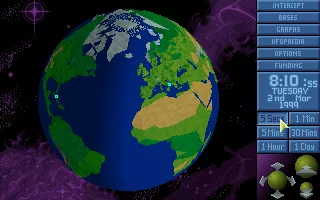
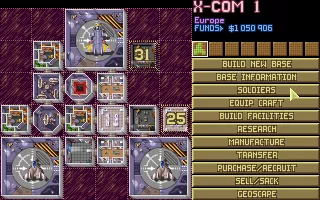
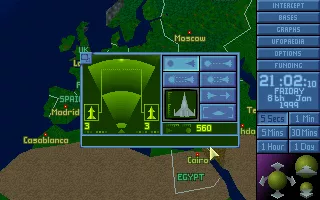
X-COM: UFO Defense is a strategy game featuring separate but interlinked elements. On the strategic side, called GeoScape, you get a rotating view of the globe, where you see all visible UFOs (those that are within your detection range) as well as major cities and your base(s). You order movements from here, such as sending out fighters to intercept UFOs, transports with soldiers to assault/recover UFOs, and perhaps assaults on alien bases (if you find any). You also control your research, as you must invent better weapons (the Terran weapons are just no match against the alien weapons) quickly, not to mention all the other cool tech you can recover from the aliens. You also need to control your budget, as you can't afford to overextend your reach. Researchers need to be paid, engineers (who build the new toys) need to be paid, base(s) need to be be built/expanded, planes need to be bought/maintained, supplies need to be replenished, and so on.
You can earn money by selling unneeded stuff, and you receive funding from the nations of the world; however, a nation can decrease its funding if it decides you aren't operating efficiently enough within its region. It's even possible that a nation gets so fed up with you that it signs a pact with the aliens and ceases funding altogether.
Once you join a ground battle, the game switches to Battlescape, which is an isometric view of the battlefield with realistic line-of-sight calculations and turn-based combat. Your mission is usually extermination of all aliens on the battlefield, though if you can capture a few it would surely help your research efforts. If you win, you also recover any alien artifacts left on the field, which can then be researched.
In combat, each of your soldiers has a specific number of Time Units. Doing anything (moving, shooting, turning around, rearranging objects in the inventory etc.) costs a number of TUs. Once a soldier is out of TUs, he cannot act any more this turn (he gets all his TUs back on the next turn, though).
Spellings
- X-COM 未知なる侵略者 - Japanese spelling
Groups +
- Console Generation Exclusives: PlayStation
- Gameplay feature: Squad management
- Games made into books
- Games with manual lookup copy protection
- Powerplus releases
- Setting: 1990s
- Setting: Earth's orbit
- Setting: Future now past
- Setting: Mars
- Setting: Space station / Spaceship
- Video games turned into board / card games
- X-COM series
Screenshots
Promos



Credits (DOS version)
24 People (22 developers, 2 thanks) · View all
| Design | |
| Programming | |
| Graphics / Artwork | |
| Music | |
| Sound | |
| Packaging | |
| Documentation | |
| Producer | |
| Project Manager | |
| Quality Assurance | |
| Special Thanks To | |
| Publishers | |
| [ full credits ] | |
Reviews
Critics
Average score: 86% (based on 45 ratings)
Players
Average score: 4.0 out of 5 (based on 380 ratings with 26 reviews)
The Good
X-COM: UFO Defense has quite a bit of complexity for a game of its age. You have to manage a worldwide organization from its budget, on down to each individual soldier in tactical combat. And while there is a lot to keep track of, the interface is very straightforward if a little unwieldy.
Managing the organization as a whole involves keeping track of funding, base construction, personnel management, and research/manufacture. This is all taken care of from the Geoscape screen. There is a wealth of information in the UFOpeadia, once you do research of course. Keeping track of you budget can be hard, what with paying salaries, maintenance costs, and vehicle leases. This can be counteracted by selling your newly captured equipment, just remember to keep some for research purposes. The management portion can get a little tedious, but it is only half of the game.
The tactical portion is really detailed for a six-year-old game. Squad tactics are important because any soldier left without backup will probably die. Once you arrive at the battle location, you must disembark from your transport and commence the alien hunt (here sectoid,sectoid,sectoid...). Depending on the alien mission, you might have to try saving as many humans as you can, which can get difficult depending on the alians present. The game tracks damage to the environment (gee sarge, that wall just got in the way!), and imposes line-of-sight rules (what you can't see,can and will hurt you). Tactical is my favorite part of the game, though it can take some time.
The Bad
I do have a few gripes about the game, such as difficulty. Even on the easiest setting, X-COM can be very hard to get started in. I tried the hardest setting once. I lasted a months worth of game time. While the tactical is my favorite part of the game, it has its issues. The environment damage makes getting through buildings to the aliens fun, but I don't understand how the rest of the building stays floating when the ground floor is blown completely away. And the line-of-sight rules can be a little screwy sometimes. There have been times when I could see the aliens, but could not shoot them (if I stick my head any farther around the corner, it'll get blown off!).
Chrysalids. #!&% Enough said.
The Bottom Line
The bad ponts are really minor gripes. In all, this game is very enjoyable, and has held up very well over the years. If you like sci-fi types of strategy games, its worth a look. Some software stores still carry the UFO Defense, Terror From The Deep, Apocalypse pack for about $20-$25.
DOS · by Narf! (132) · 2000
The Good
X-Com is really like no other game. As turn-based combat games go, X-Com require a depth of planning and tactics like no other. The entire feel of the game is unqiue. It's tremendously immersive and addictive; you'll spend hours trying to keep your little soldiers alive through just a few more missions. Each new weapon you develop will make you feel so good you'll just have to run a few more missions.
Having played every combat game there is, I've never played a game that was as tense as X-Com. Directing your men around looking for the hideous aliens, there is a palpable sense of fear; when a shot rings out from a hidden alien it can make you jump right out of your chair. Killing a well-positioned alien or completing a level brings a distinct feeling of relief. Only the truly great games can evoke that sort of emotion.
The Bad
X-Com is very, very hard, often unfairly so, and requires a lot of game saves. It's possible to have an entire squad slaughtered without any realistic chance of putting up a fight; more than once, you will have half a squad killed just opening the hatch of your ship.
You can get around this by saving a lot, and you CAN learn the game and minimize casualties, but even playing really well, you'll often have your men wiped out just by virtue of being in the wrong place at the wrong time.
The Bottom Line
A classic, innovative, and thus far unmatched landmark in PC gaming.
DOS · by Rick Jones (96) · 2001
The Good
X-Com is one of those rare games that gets just about everything right. I've always thought this was one of the best games I ever played for the PC, but recently began wondering if nostalgia was simply making it out to be more than it was. I've been playing it recently for a week straight, and have quickly come to the conclusion that this IS my all-time favorite PC game. I will tell you why:
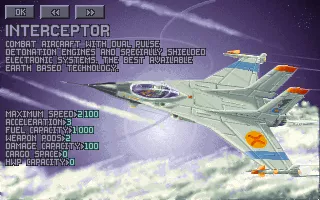
The game combines both a strategic and tactical game in one. Both are equally complex and important, and FUN in their own right. As a strategy gamer, running the operations of my X-Com bases is pure delight. One portion of the game is ran from the Geoscape. This is a real-time view of Earth from outer space. It shows locations of your X-com bases, major cities, detected UFO's, crashed/landed UFO's, alien bases and cities being terrorized. Some things, such as Alien bases, you need to find before they appear. Once a UFO is detected, you send out your interceptors to shoot it down. Once it's shot down, you then send out your Skyranger filled with X-Com operatives to secure the landing site. This is where the game turns into the tactical portion of the game.
At the start of the battle, all your X-Com operatives are inside the Skyranger which has just landed at the crash site. As you exit, you may or may not run into aliens in the vicinity. Eventually, you will, and this is where your soldiers take the fight to the aliens. Most of the game you will be behind the aliens in technology, so will need to use a lot of tactics and heavy firepower (grenades, rockets, etc) and some luck to fight the alien menace. As you win fights and secure alien crash sites, ALL their technology is captured and taken back to your X-Com base. From there, you can assign scientists to research ANYTHING. Alien corpses, live aliens, alien rifles, grenades, UFO power sources, UFO navigations, etc. Everything researched has value, whether it's tangible or just information. Do you research alien plasma rifles so your troops have better weapons, or UFO craft equipment so your fighters can shoot down bigger UFO's? You'll constantly be making these decisions throughout most of the game. The research and discovery aspect of this game, especially the first time playing it, makes X-Com one of those games where you catch yourself saying, "I'll go to bed once I researched...".
Then once a new weapon is researched, for example, you get to actually use it in the tactical combat. In X-Com you are always progressing, and seeing the benefit of this progression in actual gameplay is a real joy. Throwing your first alien grenade and seeing it do much more damage than your own grenades, or seeing a soldier survive multiple hits because of some new armor he donned due to the research you've done is great!
The tactical portion of the game is almost like an RPG. You hire new soldiers from your base screen, in the strategic portion of the game. Each soldier has about 8 statistics that can increase the more missions he/she goes on, and how many aliens they kill. They not only gain skills (Like accuracy and strength), but also rank. What happens to soldiers in a tactical fight is how their skills raise. So if you load a soldier up with a ton of equipment each mission, their strength increases, allowing them to do more with more weight. If they fire a lot, and kill aliens, their accuracy increases. The detail is amazing! Each soldier has a first and last name, so soldiers who survive a lot of missions you'll begin to get attached to. You'll see someone like Alan Davies, and remember some of the heroic missions he went on where he barely escaped death and killed the last three aliens with a well placed grenade. Then, unfortunately, some day he'll die and you won't be losing a generic soldier. You'll be losing a veteran who you grew accustomed to and counted on to be the leader on every excursion. Now you have to get a replacement who may panic the minute a friend dies next to him.
The tactical combat, even though the graphics are dated, are still very atmospheric and creepy even to this day!! Especially if you haven't played the game before, the first time one of your soldiers turns a corner or enters a new room and sees an alien for the first time your heart will jump. "What the hell is THAT thing??" you'll ask, and notice the soldier that just saw the alien doesn't have enough turn points left to fire at him. The detail in the tactical combat is amazing. Objects can block weapon fire, smoke and objects can block line of sight, smoke can knock aliens/humans unconcious, explosions can rip holes into the sides of buildings, etc. Each weapon/item has a lot of uses as well. Equip a motion detector, and you can see movement 'blips' around that soldier. Use a medikit on a soldier, and you can use three different things: Painkiller, Stimulate or Heal. Different body parts can be injured to, so you choose the body part and heal it. I can go on and on about the level of detail of this game, but these are just some examples!
The game is highly addictive, and is rightly seated in gamers' minds as one of (if not THE) best PC game of all time. Play it for yourself and find out. Even for being so old, the gameplay is still golden!
The Bad
While X-Com has gameplay second to none, anyone worth their salt can tell you it has its problems as well. Graphics are old, but they don't affect gameplay. There are plenty of crashes in X-Com, even the Collectors Edition, and especially so now on WinXP. You have to save quite often, but the game is SO good, this will become second nature, and getting back into a game takes a matter of seconds. the only time you'll get pissed about this is if you had forgotten to save in a long time, or after a very long and important battle that you had won. An auto-save feature would be nice!!
Equipping your soldiers before each battle is also a big hassle. It would have been terribly useful if you could assign equipment loads that were automatically saved, so your soldiers would be equipped properly before each battle. For example, some soldiers I designate as (Hvy), which I typically give the heavier loadouts too (Rocket launcher + rockets, medikit, extra grenades, etc). It'd have been very useful if they started with that loadout at the start of each mission. Instead, you have to manually load each soldier every time. A nagging issue that you never truly get used to.
Lots of general bugs, such as loading a saved game that was in tactical combat and had proximity mines down. They are now gone and useless once you loaded the game.
Some weapons/research aren't very useful, such as most HWP's as they die in a few shots and are very expensive, and pistols.
The difficulty can sometimes be very frustrating, especially to casual players. Aliens are generally very accurate, and in the early to mid game you will experience a lot of casualties, even if you win a fight. Especially terror missions! Another thing that is frustrating, especially on terror missions, is that you can sometimes barely get off your Skyranger before half or most of your squad is killed. You get half your guys off, four aliens are waiting right outside, and either blast them all before they can get a shot off or just throw a grenade there and annihilate your entire team. Would have probably been smart for the X-Com team to land a 'wee' bit away from the terror site and then work their way to it.
There's other problems, and annoyances with X-Com that I can't fully document here. They are experienced after heavily playing the game (which most people will!), but ultimately NONE of these problems will deter you from playing it. X-Com proves to the current industry you don't need high production values to make a classic game. Even with the dated graphics, sound, music(which is actually still kinda creepy!) and bugs this game is a shining achievement in gameplay!
The Bottom Line
X-Com is a strategic and tactical game where you defend earth from an alien invasion. You control everything about X-Com, from purchasing weapons and equipment, building new base facilities, intercepting UFO's, researching alien technology, manufacturing new equipment, investigating crash sites and ultimately finding a way to eliminate the alien invasion once and for all!
DOS · by Tim Scott (6) · 2005
Discussion
| Subject | By | Date |
|---|---|---|
| in between ranks | MerlynKing | Jan 25, 2019 |
| The original X-COM was cancelled, but development continued in secret | Freeman (65099) | Apr 27, 2017 |
| Uh, shouldn't the title be UFO: Enemy Unknown...? | Simoneer (29) | Oct 8, 2010 |
Trivia
1001 Video Games
UFO: Enemy Unknown appears in the book 1001 Video Games You Must Play Before You Die by General Editor Tony Mott.
Difficulty Level Bug
DOS version of the game has a bug in the difficulty settings. Regardless of which difficulty level you choose, you always start at the easiest level. Surprisingly, the official patch of the game does not correct this problem. However, there is an unofficial patch available for solving this issue. Problem is also solved in The Collectors Edition Windows port (also commonly known as UFO Gold or CE).
The game contains many different other bugs. All of them are gathered on UFOPaedia.
Cancelled successor
A new version of the X-COM series dubbed X-COM: Genesis, focusing on some of the gameplay features found in the original, was in production at Hasbro/Microprose in 1999. The project was cut during mass-layoffs for the company.
CD-ROM version
The CD version may include a partial install version and a full install version, depending on which CD you got. The partial install version leaves some datafiles on the CD to save disk space. However, the "full install" version is also on the CD in the HARDDISK directory.
The CD version of the game for DOS was not different from the original floppy one. However it contained animated introduction (the very same which was later used in Amiga CD32 version and (from the Playstation version) and the executable file was patched and some bugs were eliminated.
Creation
Jullian Gollop, designer of X-COM: UFO Defence tells how X-COM was created (taken from the Mythos Games web site):
We showed a demo of ‘Laser Squad 2’ on the Atari ST to Microprose in 1991. The idea was to produce a sequel to ‘Laser Squad’ but with much neater graphics using an isometric style very similar to Populous. They liked what we had done so far, but they explained that they wanted a ‘big’ game. I said "what do you mean by ‘big’" and they said "well, you know – BIG". They also said that it had to be set on earth, like Civilisation or Railroad Tycoon, because people could relate to it much more. So we went away, scratched our heads and thought about it. Then we came up with the idea of adding on a grand strategic element to the game, very firmly set on earth, in which the player managed an organisation that defended the planet against UFO incursions. I bought quite a few books on UFOs for research purposes so that we could give the game an even more ‘authentic’ basis.
The project started reasonably well with myself and Nick designing and programming, while the art was to be done by John Reitze and martin Smillie at MicroProse. Soon we had some problems because Microprose did not understand our game design and they asked for clarification. Several documents later we were not much better off and I had wasted a lot of time. Certain creature types were removed, including the ‘Men In Black’ and others added. Then the whole project was nearly axed when MicroProse made some cutbacks due to financial difficulties. Everything proceeded reasonably smoothly for a while until Spectrum Holobyte acquired Bill Stealey’s shares in the company. Our producer was made redundant and the game was nearly axed again. Finally we had to spend a couple of months working very long hours at MicroProse in Chipping Sodbury to get the game finished by the end of March in 1994.
Element 115
Ten years after the game was released, a real element 115 was discovered. Unfortunately, it wasn't named elerium like in the game, but ununpentium.
GeForce problems
GeForce owners have probably encountered display problems that render the game unplayable. This can be fixed though; go to the Windows Control Panel and the DirectX settings. Switch off DirectDraw hardware acceleration and the game should work fine.
Don't forget to switch acceleration back on afterwards, though.
Geoscape
The game is actually Geoscape, the rotating globe and resource management, generating the battlefield conditions for BattleScape, where you conduct tactical combat against the aliens. If you press Ctrl-C (as suggested by the hint "level skip") while in BattleScape, you interrupt the BattleScape program, preventing it from writing the "results" file. Thus you will get the same result as your previous battle. This is a result of the developement history (see the other trivia entries), whereas MicroProse decided that the tactical combat is not enough to be a game in itself, and asked Mythos to write a strategy game around it.
Influence
The game is heavy influenced from the TV series UFO . It's about a secret UFO defense base which sends out military aircrafts to shoot down UFOs, sending out squads to seek the wreckage and kill or catch aliens to analyze them.
Multiplayer Workaround
You can actually play "multiplayer" X-COM long before e-mail X-COM... By using sort of a "hack". As the game actually plays through turn by turn on both sides, it is actually possible to take the saved file right at the end of a turn, edit a pointer, and play the "other side" using the engine. And if you exchange files back and forth, you can have a multiplayer game.
http://www.tacticalplanet.com/dl/dl.asp?xcom/multip.zip
Novel
A novelization of the game was published through the Proteus imprint of Prima Publishing. It written by Diane Duane and first published in December of 1995.
Patches
The last offical patch changed the sound effects of the game. Many people didn't like the new sounds.
V1.4 patch removed the document check copy protection.
Releases
A complete version of X-COM is available on Classic Games Collection CD featured with the July 2000 issue of PC Gamer Magazine. - There was a "Limited Edition" of UFO: Enemy Unknown for the Amiga CD32 that included a Microprose travel alarm clock.
Technology
X-COM: UFO Defense is one of the few 256-color DOS games to implement dynamic lightning. By using 16 shades of 16 different hues (16 x 16 = 256) as the palette, artists could create isometric tiles whose colors can be gradually changed simply by incrementing each tile's palette entries by 1, 2 and so on. In this way, the same tiles can be shown darker and darker simultaneously on the screen.
Awards
- Amiga Joker
- Issue 02/1995 – #2 Best Strategical in 1994 (Readers' Vote)
- Issue 02/1996 – Readers' Special Award for 1995
- Computer Gaming World
- May 1995 (Issue #130) – Game of the Year
- May 1995 (Issue #130) – Strategy Game of the Year
- July 1996 (Issue #144) – Introduced into the Hall of Fame
- November 1996 (15th anniversary Issue) - #22 on the "150 Best Games of All Time" list
- November 1996 (15th anniversary issue) –#1 Top Sleeper Of All Time
- March 2001 (Issue #200) - #3 Best Game of All Time (Editors' Choice)
- March 2001 (Issue #200) - #10 Best Game of All Time (Readers' Choice)
- Electronic Gaming Monthly
- January 1996 (Issue 78) – Game of the Month (Playstation version)
- GameSpy
- 2001 – #35 Top Game of All Time
- GameStar (Germany)
- Issue 12/1999 - #73 in the "100 Most Important PC Games of the Nineties" ranking
- IGN
- March 2007 - #1 PC Game of All Time
- PC Gamer
- April 2000 - #15 on the "All-Time Top 50 Games" poll
- October 2001 - #3 on the "Top 50 of All Time" list
- April 2005 - #8 on the "50 Best Games of All Time" list
- Power Play
- Issue 02/1995 – Best Genre Mix in 1994
Information also contributed by Adam Baratz, Andrew Grasmeder, Der.Archivar, Entorphane, Kasey Chang, Lord FlatHead, Heikki Sairanen, Martin Smith, PCGamer77, Pseudo_Intellectual, robotriot, Rola, rstevenson, ZuljinRaynor
Analytics
Upgrade to MobyPro to view research rankings!
Related Games
Released 1999 on Windows
Released 2008 on DOS, Windows
Released 1995 on DOS, 1996 on PlayStation, Windows

Released 2001 on Windows
Released 2002 on Windows
Released 1979 on Dedicated handheld
Released 2012 on Windows, 2012 on Xbox 360, 2014 on Linux...

Released 2014 on Linux, Windows, Macintosh
Released 2008 on Windows, 2009 on Macintosh, 2013 on Linux
Related Sites +
-
OpenXcom
An open-source clone requiring resources from the original game. -
UFOpeadia
A whole wiki-based Database containing nearly everything one wanted to know about the game and beyond... -
X-COM Tactical Command
X-COM Tactical Command has an excellent range of content, now including information on hexediting UFO's files, as well as strategy guides and more. -
XCOMUTIL Homepage
The homepage for Scott T. Jones' fantastic XCOMUTIL utility: Re-vitalise and expand your X-COM game! :) -
XCommand
One of the most popular fan-sites for the X-COM series. -
XCommand
XCommand features various files for editing UFO, as well as strategic aids and the full contents of the UFOPedia. -
devisraad.com - X-COM Page
Download complete sets of new alien spacecraft, for X-COM: UFO Defense and X-COM: Terror From The Deep.
Identifiers +
Contribute
Are you familiar with this game? Help document and preserve this entry in video game history! If your contribution is approved, you will earn points and be credited as a contributor.
Contributors to this Entry
Game added by IJan.
Windows added by Shoddyan. Amiga added by Rebound Boy. Amiga CD32 added by Martin Smith. PlayStation added by Adam Baratz.
Additional contributors: xroox, Kate Jones, Kasey Chang, Josh Day, //dbz:, Alaka, Игги Друге, 88 49, BostonGeorge, Patrick Bregger, mailmanppa, Rwolf, FatherJack, Evolyzer.
Game added December 4, 1999. Last modified April 1, 2024.