Ultima VII: The Black Gate
-
 Ultima VII: Forge of Virtue
(1992)
Ultima VII: Forge of Virtue
(1992)
-
 Ultima: The Black Gate
(1994)
Ultima: The Black Gate
(1994)
-
 EA Compilation
(1994)
EA Compilation
(1994) -
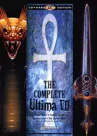 The Complete Ultima VII
(1994)
The Complete Ultima VII
(1994) -
 Ultima Collection
(1997)
Ultima Collection
(1997) -
 Ultima Complete
(2002)
Ultima Complete
(2002)
Description official descriptions
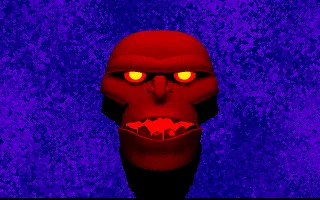
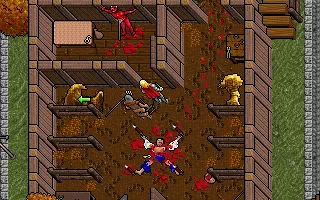
The Avatar sees a strange message on his computer screen. An unknown being who calls himself the Guardian claims that Britannia has entered a true age of enlightenment, and soon everyone, including the Avatar himself, shall bow before the new lord. At this moment, a moongate materializes, and the Avatar steps through it into Britannia. He emerges in the city of Trinsic, where his old friend Iolo tells him that two hundred years have passed since his last visit. A horrible ritualistic murder has just occurred - the body of the local blacksmith was found in the stables. The Avatar learns that a new organization known as the Fellowship has been recruiting more and more followers recently. The champion of Britannia must solve the murder and find out about the Fellowship's true purpose, while still pursued by the ominous warnings of the mysterious Guardian.
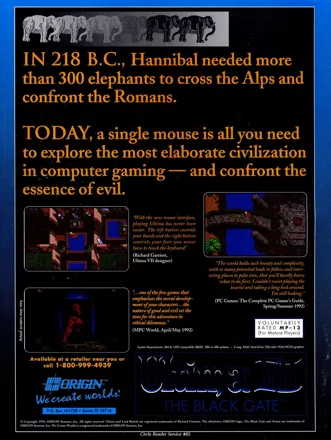
Ultima VII: The Black Gate features revamped graphics and controls. The traditional Ultima top-down view of the world now fills the entire screen, with other informational windows overlaid on top of it only when necessary. Both world interaction and dialogue are fully mouse-controlled. Objects can be physically interacted with by dragging them with the mouse. Objects can also be stacked upon each other, and some puzzles are based on this feature. Equipment screen utilizes a "paper doll" concept: equipped items are graphically displayed on the character. It is also possible to physically manipulate inventory items, arranging them within bags and other containers.
The tactical combat system of previous Ultima games has been replaced with a real-time system where only general strategies can be set and party members fight automatically, the player taking control of the Avatar alone. Combat pauses when the player accesses the inventory. Leveling up system is similar to the previous games, the Avatar's parameters increasing automatically once a sufficient amount of experience points has been accumulated. The Avatar and his companions must regularly eat in order to stay alive.
The game's world is vast, populated by many non-playable characters with their own schedules. There are more extensive dialogue trees and individual conversation topics compared to the series' previous installments. As in the earlier Ultima games, the player is free to explore Britannia from the beginning of the game; certain tasks must be accomplished in a specific order to conclude the story.
Spellings
- 創世紀7:黑月之門 - Chinese spelling (traditional)
Groups +
- EA Classics releases
- Fantasy creatures: Dragons
- Fantasy creatures: Trolls
- Fantasy creatures: Unicorns
- Gameplay feature: Brothels
- Gameplay feature: Character development - Training
- Gameplay feature: Day / night cycle
- Gameplay feature: Fishing
- Gameplay feature: Hunger / Thirst
- Games with extra content copy protection
- Games with manual lookup copy protection
- Nudity
- Physical Bonus Content: World Map
- Protagonist: Female (option)
- Sound engine: AIL/Miles Sound System
- Ultima series
- Ultima universe
Screenshots

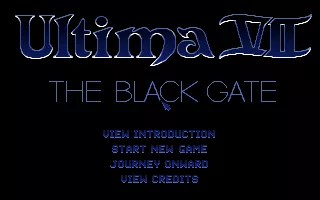
Promos
Credits (DOS version)
80 People · View all
| Design | |
| Lead Programming | |
| Programming | |
| [ full credits ] | |
Reviews
Critics
Average score: 83% (based on 13 ratings)
Players
Average score: 4.2 out of 5 (based on 98 ratings with 8 reviews)
far worse than its precessors.
The Good
A fully interactive world, lots of new items, lots of conversation, cool full-screen graphics. The last Ultima game, in a certain way - I mean: yet in Serpent Isle, you cannot go and explore wherever you want, 'cause triggered events occur, and the whole game sounds more like an arcade-adventure, with some rpg features.
The Bad
I have to say - I played Ultima 6 before playing this, and now I'll make a comparison, trying to explain why U6 is far better than U7.
What's better in U7 is quite obvious (graphics, more items and dialogues, etc.); indeed, there are many things that in U6 worked well, and in U7 don't work at all. First of them all:
1) THE ROOF - MODE. Let's say you are in a town, and you see on the screen two buildings with locked entrance doors. You open one of them, and enter the building. In U6, the new area becomes visible (the roof wears off), while the other building remains, let's say, closed. What happens in U7? You open one door, and you can see inside the second building too!!! Is the avatar supposed to have x-ray sight?? This is a very annoying thing. In the whole game, there seems to be a "roof-mode", which can be on or off. This happens not only in towns, but even in dungeons. If you can see inside one room, you can see inside everything on the screen - and that's simply ridiculous; it brings you far away from a real situation.
2) HOW CAN I ALREADY KNOW?? Conversations are very different from U6 to U7. In U6 you were supposed to type the keywords (and I liked it a lot) while talking to people. In U7, you have to choose among the main topics of conversation on the screen. Not bad, however (it was so in Times of Lore, on C64.... does anybody remember?). But there is a terrible problem. Let's say I have to find a certain item in the game - the magic orb, for instance. I ask person A about the item; he tells me that the orb is in the dark cave, and to go talking with person B to know about the cave. So, I go talking with B, I ask about the cave, and everything is ok. What happens if I go straight to B, without talking to A before? I talk to B, and the option "Dark cave" is already among the topics. How can I know of the cave at this time? And this occur ALWAYS in the game. You always get to have keywords that you shouldn't know yet. Awful.
3) THE MAIN PLOT IS OBVIOUS AND SILLY. The beginning is cool - it starts with a strange murder, and clues to find. But, since the early game, you get to know everything - you figure out who the bad guys are, what the word "black" in the title means, and really nothing in the main plot is surprising. Find out the bad guys and stop the guardian: that's all, that's silly, and you know it from the beginning (even before playing - if you read the manual carefully, you begin to suspect about the fellowship!!) . In U6 the main plot seems to be silly at the beginning (kill the gargoyles and cleanse the shrines), but it becomes more and more exciting as you proceed in the game, and the final part is really cool and surprising. You get to know what the title means, and who the false prophet is, only at 3/4 of gameplaying.
4) THE MAIN PLOT IS TOO LINEAR. Ok, as in the previous Ultimas, you can go around and live the Britannian world without caring about the main plot. But if you start following it in order to complete the game... well, you have no choice: you have to do those things in that order. And all is too obvious and easy. In U6 there are many things that you must do in order to complete the game and that you can do in any order you choose. So, if you get stuck in one of them, you can say "ok, let's do something else, and come back later". In U7, the only thing you can say is "I'm stuck here".
5) HOW CAN I REACH THAT ITEM? The new inventory mode is quite functional, and makes things simpler. BUT, again it takes you far away from a real situation. You can take every object that is visible on the screen, and add it to your backpack, even if the object is 10 virtual meters away from you. What if between you and the object there is, let's say, a dragon? You still can drag and drop the item on yourself. Stupid. Very stupid. In previous Ultimas the interface was less user-friendly, but you could only take things you could reach. Obvious, isn't it?
6) WHERE HAVE ALL THE DUNGEONS GONE? In U6 there were 4 levels of underworld dungeons, plus the gargoyle world. What in U7? Only-one-ground-level. In fact, you don't even go down or climb a ladder or stairs. Everything is on the level of the main map. When I went to Britain for the first time in the game, I said "OK, let's have a tour in the sewers! ........ but...... What?? No sewers?? And where the 4 levels of U6 Britain sewers have gone?" Exploration of dungeons is a key feature in every ultima game: not here in U7. Ok, there's a little more in the main map to explore (more npcs, more strange places with pirates, unsigned buildings, and so on).
7) COMBAT IS FRUSTRATING. While in battle, you always have the impression of a random result. Let's say you face a dragon, just after having saved the game. You begin the combat, and the whole party dies. You reload, you begin the combat again, and you kill the dragon without heavy wounds. Funny, isn't it? In U6 there was a turn-based combat, which may seem too old and slow, but it's again more realistic. Ok, you could still miss a foe with your sword, but the overall result of the combat was more predictable.
8) LOOK - A SNAKE! LET'S BEGIN COMBAT! You are travelling around in the forest, and you face a snake which attacks you, and is going to poison you if you don't react. What do you do in U6? You simply press the A- Attack key, and slay it with the Avatar's sword in one move, without entering combat mode. What do you do in U7? You HAVE to begin combat. The result: everybody tries to slay the snake, Iolo throws 4 bolts (one of them hits the avatar), Shamino wastes 3 arrows (one of them hits Dupre). And that's all for a simple snake!!!!!!
OK, I could go on and on, but I stop here. I think that the programming team has spent a lot of time in improving the graphics and the 2D engine, and so there was a few time left for all the rest - the game.
If you're gonna play a true Ultima game, play Ultima 4 or Ultima 5 or Ultima 6.
The Bottom Line
If you play this without knowing its predecessors at all, you may like it. It's still unique, in it's genre, after all. But the atmosphere of the "Age of Enlightenment" trilogy is another thing.
DOS · by Emanuele Borinato (10) · 2004
Ultima IV to VI fans, STAY away!
The Good
I tried. I couldn't. I didn't. And I still don't.
The Bad
This is not an RPG like Ultima IV, V, and VI were RPGs. This plays more like an adventure game and should not have been labeled Ultima VII. It might have stood on its own as Ultima Adventures I or something like that, but don't tell me this one is inheriting the tradition of excellent RPGs handed down from its predecessors.
The Bottom Line
If you like Police Quest, King's Quest, et al Quests, you may like this one. But for me, this marks the turning point where the Ultima dream world became a nightmare.
DOS · by Yeah Right (50) · 2000
Yes, it's flawed. But so was Hamlet...
The Good
Ultima VII is a game that transcends roleplaying mechanics. If you play it for long enough, it very nearly transcends the computer itself...
Along with the vast size, endless characters, deep intrigue, and tough quests, all of which are present in many games, Ultima VII adds a freedom that sets it apart, even from others in the series. Living in Britannia, just about anything is possible, including some extremely lateral-minded (not to mention antisocial) activities. Want to rob a bank? Other games might throw up arbitrary obstacles. Here, the vault is yours, if you're tough enough to get there. Of course, there are always the consequences of obnoxious behaviour...
If you want to, you can live as a cook, as a farmer, a woodcutter, you can become a trader, pirate, or a priest. The people of Britannia live out detailed lives that don't just function as "onstage extras". The main game itself is an absorbing, difficult set of adventures that will take even a rabid gamer several months to complete.
The Bad
The (many) famed problems of Ultima VII are almost all flaws in the game engine. Britannia crashes at random and infuriating intervals. Food and money distribution among your characters is maddening. Keys and keyholes become a ten minute guessing contest. And the game is so wide open that it's actually possible to completely disrupt it by finding oblique approaches that circumvent key plot points. A patch to fix these things would improve the game even further.
The Bottom Line
Until the advent of online gaming, Ultima VII may be the most open minded game ever made. If you have the time to enjoy it, and can get past the mechanical problems, it's a uniquely absorbing and satisfying experience.
DOS · by Colin Rowsell (43) · 2002
Discussion
| Subject | By | Date |
|---|---|---|
| Fame and fortune await! Or at least a footnote | DJP Mom (11333) | Mar 19, 2008 |
Trivia
1001 Video Games
Ultima VII appears in the book 1001 Video Games You Must Play Before You Die by General Editor Tony Mott.
Armageddon
There is a high level spell called Armageddon which kills every person in the game except for yourself and Lord British. If you go back and talk to him he will exclaim "What have you done!?!"
Credits
- If you sit through the credits then another option will be available to view quotes humourous quotes from the development staff. At the end of this the butterfly from the intro floats onto the screen then blows up, followed by an evil cackle from the Guardian, apparently uttering gibberish. However, it is simply a sound sample that is played backwards. When reversed, The Guardian says "I am the Pagan Lord", apparently an early hint at the sequel. A recording is available at the Ultima Dragons FTP Archive.
- As an interesting testament to the credibility of the Ultima VII end credits, EA , far far later, actually took "Voluntarily rated MP-13 (for Mature Players)" logo from the game credits and put that to the The Complete Ultima VII budget release box.
Dead people room
There is a room in the mountains east of cove (can only be accessed with the cheat) where all the people who have been killed go. Most of them are alive and well and you can even talk to them.
Experience points
In case you're wondering, completing mini quests DOES give you experience! For example, the first mini quest you receive in Paws (the Serpent Venom thief story) when completed, gives you and your companions (ie. Iolo and Spark) 75 experience points. Even the very small mini quests which only involve talking to people and conveying conversations to other people "may" give you and your companions experience points.
Exult
There is a project called Exult out there on the web that will allow you to play Ultima VII on a Win9x machine. The only catch is you have to have the original files. The creators of Exult had to work from the ground up to make the game playable, considering the original source code to Ultima VII is not available to the public.
Fellowship
The Fellowship was was largely inspired by many "new age" religions and cults of the time, but most notably it was inspired by the Church of Scientology. Garriott's main inspiration was reportedly the infamous TIME Magazine Scientology article of May 1991. Among other things, regular Fellowship members don't know what is happening in the higher levels of the cult hierarchy, which is typical to cults in general. Batlin's character is very obviously inspired by L. Ron Hubbard's persona. There is even a "personality test" in the game.
Interactivity
The game is famous for offering a high interactivity; almost every item in the game world can be used. The option to bake bread has become synonymous for this.
Lord British
If you manage to kill Lord British (the black rock is handy for this) you will find in his corpse (amongst other stuff) a lightning bolt which acts as a missile weapon and is how he casts spells if you fight him.
References: Electronic Arts
The game starts with the quote:
"Avatar! Know that Britannia has entered into a new age of enlightenment...Under my guidance, Britannia will flourish, and all the people will rejoice! And pay homage to their new... Guardian!".
The Guardian is a character inspired by the attempted takeover of Origin Systems in the early '90s and hints at EA. This links is proven while playing: the three items that power the evil generators in-game are a cube, a sphere and a tetrahedron, the former EA logo.
Richard Garriott also sneaked in a more subtle reference to Electronic Arts. Take a look at the characters Elizabeth and Abraham for example. Just take the first letters of their names. Elizabeth and Abraham have a high-ranked profile in the fellowship (e.g. EA in the publishing business) and go around and perform seemingly helpful tasks (like dragging the Avatar to the shelter in Paws for resurrection every time he dies), but in fact they are murderers and are in a conspiracy to bring a destructive powerful-being, the Guardian, into Britannia.
It's unsure if the reference goes that deep, but Origin originally thought that EA might help it gain more profit and reach more gamers, but EA's counter-productive strategies ended up destroying what made Ultima special and thereby reducing sales.
References: Star Trek
Certain residents of Serpent's Hold bear a striking resemblance to the crew of the USS Enterprise in the TV series Star Trek: The Next Generation, both in their names, their occupations, their characters and sometimes their appearance.
Here's a breakdown: * Lord John-Paul, Commander of the Keep - Jean-Luc Picard, Captain of the Enterprise * Sir Richter, second in command - Commander Riker * Sir Horffe, a Gargoyle raised by Human parents, Captain of the Guard - Lt. Worf, a Klingon raised by Human parents, Chief of Security * Sir Denton, a knight known for his ability to solve problems and puzzles, for being overly detailed in everything he says and for not being able to tell jokes that are funny, wears a full suit of armour all the time - Lt. Commander Data, the Android * Sir Jordan, a blind bowyer and tinkerer - Lt. Commander Geordi LaForge, the blind Chief Engineer * Lady Leigh, red-haired healer - Dr. Beverly Crusher, Chief Medical Officer * Lady Tory, adviser and empath - Counselor Deanna Troi
References
- In a series cross-over, there is a farm near Britain where the farmer would tell you about a craft that fell from the sky and the big cat man who appeared from it. Sure enough, in his field there was a Kilrathi vessel. If you clicked on it, it would play the Kilrathi theme from Wing Commander II.
- In Gilberto's house in Trinsic you can find a book titled Struck Commander, detailing the adventures of a band of mercenaries that ride flying carts. Much like in Origin's Strike Commander.
Sherry
In Ultima VII: The Black Gate, you meet Sherry the Mouse (in Ultima VI) for the last time. She's nursing kids at the Royal Nursery at Lord British's castle and cannot be recruited.
SNES port
A fairly simplified version of this game was ported to the Super Nintendo console system. Although the same basic graphics were used, the game engine was changed drastically to be even more action oriented. The console version removed the companion NPCs (although they did appear as characters in the different villages) and featured the Avatar only who you controlled in a run-and-slash manner Legend of Zelda style. A great deal of the environment interactivity was removed, and the plot was also sanitized as well (instead of the grisly blood soaked ritualistic murder which the PC version opens with, in the console version you are simply told that the blacksmith was "kidnapped"). More information can be found in its game entry.
Soundtrack
The credits sequence started to go more and more movie-like towards the end, with usual disclaimers ("any resemblance... is purely coincidental", "no animals were harmed"... etc), logos of the technologies being used (Voodoo logos etc), and finally, "Soundtrack CD available from Origin". That was only added as a gag to make the credits look absolutely movie-like, but (because the game obviously has some pretty good music) people started asking Origin about the soundtrack album. Ultima VII: Part Two - Serpent Isle had same sort of credit display - but with a text "Soundtrack CD NOT available from Origin, so don't ask!"
However, Origin did eventually release Origin Soundtrack Series volume 2, which contains some of the tunes from both of these games.
Voodoo memory manager
This game used what Origin called the "voodoo memory manager". What this really was, was no memory manager at all - not even a DOS extender. It used memory beyond the first megabyte directly by popping the processor into flat 32-bit mode; since DOS couldn't access that memory directly, it was used to cache resources (mostly graphics) to improve performance. Needless to say, this "memory manager" was completely incompatible with any real memory manager, including any variety of MS Windows.
Ultima VII: The Black Gate programmer and MobyGames contributor weregamer:
A few years and a couple of jobs later, when Windows 95 was in early beta, I was part of a program where MS engineers working on it met with developers of entertainment and animation software. The engineer we met proudly proclaimed their goal that 100% of DOS games would run under Windows 95 by the time it shipped - "DOS Mode" would not be necessary. I sadly had to burst her bubble by explaining the "voodoo memory manager". She had a hard time believing it - I guess she just hadn't realized just how hard game programmers worked to squeeze performance out of machines in the bad old days.
Awards
- Computer Gaming World
- November 1996 (15th anniversary issue) – #3 Hardest Computer Game
- GameStar (Germany)
- Issue 12/1999 - #21 in the "100 Most Important PC Games of the Nineties" ranking
- PC Games (Germany)
- Issue 01/1993– #2 Best RPG in 1992
Information also contributed by Chris Martin, Fafnir, Indra was here, Itay Shahar, Ray Soderlund, Sciere, Terok Nor; weregamer, WWWWolf and Zovni
Analytics
Upgrade to MobyPro to view research rankings!
Related Games
Released 1994 on SNES
Released 1994 on DOS, 2011 on Windows, 2013 on Macintosh
Released 1993 on DOS
Released 1999 on Windows
Released 1981 on Apple II, 1983 on Atari 8-bit
Released 1994 on DOS, 2012 on Windows, 2013 on Macintosh

Released 1990 on DOS, 1992 on SNES, Windows...

Released 1994 on DOS, 1995 on PC-98
Released 2005 on Windows
Related Sites +
-
Bootstrike.com - Ultima VII: The Black Gate
A dedicated site to the classic game - providing a host of walkthroughs, downloads and lots of cool add-ons and stuff. -
Exult
a project to allow people to play Ultima 7 on modern OSes such as Linux and Windows by reverse-engineering the game engine. You still need the original game to play. -
Ganesh's Website
Walkthroughs, tips, hints, cheats, trainers, backgrounds, wallpapers, desktop themes, music, mp3s, midi, hand-picked *very* funny jokes and much MUCH more! ALSO: U7 in Win9x, humor, lots of downloads! -
UHS Hints for Ultima 7
These hints will help you solve the game. -
Ultima 7 in Windows
Ron Windeyer has licked it! An exerpt .. "Thanks to a new and quite brilliant utility, Black Gate and Serpent Isle can be run effortlessly in Windows 95 and 98, with virtually any kind of sound card. With the latest addition (U7.DPMI) it is also compatible with Windows 2000, and possibly even Linux."
Identifiers +
Contribute
Are you familiar with this game? Help document and preserve this entry in video game history! If your contribution is approved, you will earn points and be credited as a contributor.
Contributors to this Entry
Game added by Terok Nor.
Additional contributors: Trixter, Alan Chan, Ola Sverre Bauge, G. Ganesh, Jeanne, phlux, Paulus18950, Patrick Bregger, FatherJack.
Game added December 22, 1999. Last modified February 13, 2024.