The Legend of Zelda
Description official descriptions
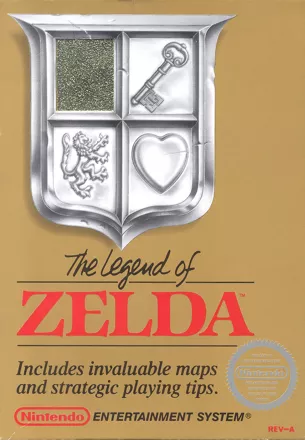
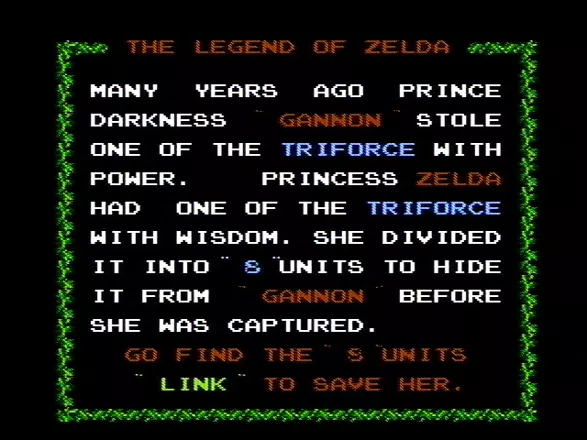
In one of the darkest times in the Kingdom of Hyrule, a young, pointy-eared boy named Link takes on an epic quest to restore the fragmented Triforce of Wisdom and save the Princess Zelda from the clutches of the evil, power-hungry Ganon.
The Legend of Zelda marks the first title of the Zelda series. Players must make their way through the various forests, graveyards, plains, and deserts of the Overworld to find the secret entrances of the eight dungeons in an attempt to piece together the broken Triforce. Once all pieces are joined, Link will be able to gain entry to Death Mountain, home of Ganon, and prison of Princess Zelda.
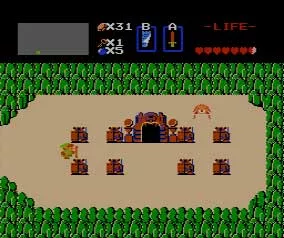
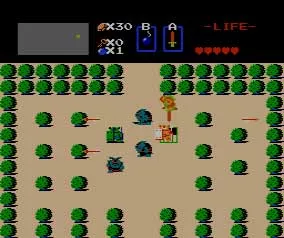
The game is drawn in a top-down perspective. Link begins his quest in the Overworld, which features forests, mountains and lakes and is divided into several screens. Link can explore the Overworld freely, though when he enters a screen, he will encounter several enemies. He can attack them with his sword. If Link is at full health, he can toss his sword to attack enemies from afar, but when he is hurt, even slightly, he can only fight in melee range.
Link's health is represented by hearts; initially he can have a maximum of three hearts, but as he progresses in the game, he will find heart containers that increase his maximum health. The enemies are varied - some attack from up close, some shoot projectiles. When killed, they often leave behind an item - a heart to restore energy, rupees that function as money (and can be used to buy stuff in various shops in the Overworld), or bombs which can be picked up and set down to attack enemies or destroy some walls. Some items function as weapons or armor, while others are used to solve puzzles. When enemies are killed, they stay dead and will not re-appear once the screen is entered again.
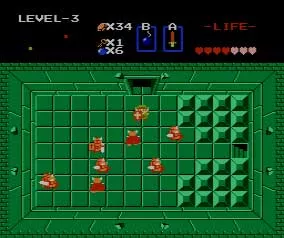
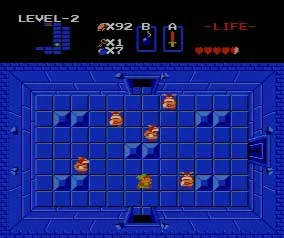
To find the Triforce pieces, Link must explore dungeons. Once he finds an entrance to the dungeon and goes in, he must explore the rooms, fight enemies and collect keys until he finds the boss monster he must defeat. He will then be able to pick up a Triforce piece and gain a permanent health increase. Once he does so, however, all the monsters in the Overworld come back to life.
If Link dies on his quest, he can continue it; he will go back to his start position in the Overworld (or the entrance to a dungeon), but with the items he managed to collect so far. When Link finishes his quest, the player can choose to play the "second quest", which is essentially a harder version of the game.
The Legend of Zelda is known for several factors that were advanced at the time: a continuous world that could be freely explored, power-ups that would permanently enhance the main character's abilities, and a battery back-up save feature that allowed players to retain their progress instead of having to start over. The gameplay balanced out frequent action sequences with discovery, secrets, and exploration.
Spellings
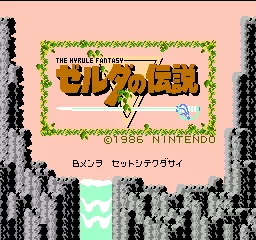
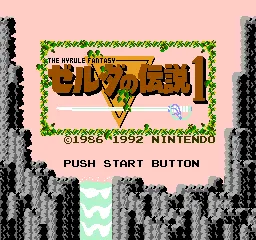
- ゼルダの伝説 - Japanese Famicom Disk spelling
- ゼルダの伝説1 - Japanese Famicom Cartridge spelling
- 젤다의 전설 - Korean spelling
Groups +
Screenshots
Promos
Videos
Add Trailer or Gameplay Video +1 point
See any errors or missing info for this game?
You can submit a correction, contribute trivia, add to a game group, add a related site or alternate title.
Credits (NES version)
7 People
| Executive Producer |
|
| Producer |
|
| Director |
|
| Designer |
|
| Programmer |
|
| Sound Composer |
|
Reviews
Critics
Average score: 85% (based on 60 ratings)
Players
Average score: 4.0 out of 5 (based on 298 ratings with 15 reviews)
Over rated game for an overrated console.
The Good
The Legend Of Zelda is often acclaimed. As the best game ever. Or the best rpg. Or best Nintendo game, or some such. Yet I have always thought it was overrated. Even Nintendo Power rated it higher than Super Mario Bros. Yes somehow Zelda is better then the game that made Nintendo.
The upside to the Zelda series is that the games got better. (Zelda 64 anyone?) And it helped spawn better games. I.e. Landstalker.
The Bad
The downside is just about every thing else. The Graphics are lame even for a NES game. How many colors could the NES display like 4? Because this is not a colorful game. And all the colors are bland. Compare Super Mario Bros. to Zelda and you’ll see.
The Sound/ Music well the sound effects are nothing special. And the only tune I liked was the main theme. Which would sound better in latter Zelda’s.
The Gameplay is as liner as it gets. You go from dungeon to dungeon with no villages to break up the tedium. If Hyrule has no villages who does Zelda rule over? They could have at least had one town, I mean come on. Oh yes and the dungeons have to be done in a specific order, making the game even more linear.
The Storyline is for the most part non-existent. For some reason an old man gives a little kid a sword and tells him to save Zelda, a Princess without a Kingdom, so not only is it stupid, but the player never feels that they must save Zelda.(How come Nintendo can’t get over the “save the princess” thing?)
The Bottom Line
The Bottom Line is that you should skip this one and play The Legend of Zelda: Link’s Awaking. Or Zelda 64.
NES · by MasterMegid (723) · 2006
The Good
The Legend of Zelda is most noted for its incredible setting in a world known as Hyrule. There are so many secrets and paths to find, including numerous items and dungeons to complete. The difficulty is a double edged sword, what I like about it is the fact that it's tough enough to give you a true challenge. The controls are very simple, The sound effects and music are pretty much classic.
The Bad
Going back to the difficulty, what I hated about it (when I first played it especially), is that the game didn't give you a direct hint about where any of the hidden heart containers, doors and rupees were...stuff like this would slay beginners to the Zelda series. I highly suggest watching a playthrough of it online before even attempting to beat it yourself.
The Bottom Line
The Legend of Zelda is an overhead view, action/adventure super-saga, pitting you, Link (Or whatever you decide to name your hero!), against Ganon, Lord of Darkness. The objective, go to all eight dungeons and gather the eight pieces of the Triforce of Wisdom, then battle Ganon himself for the Triforce of Power and Princess Zelda. Gathering secret rupees and heart containers, along with sword and shield upgrades will aid you in your battle. This may be a difficult game, but the road to the Triforce is worth it...but when you win...are you going to go for the Second Quest?....
NES · by Crazy Horse (10) · 2011
A necessary NES gaming experience.
The Good
My personal favorite feature in this game was the music. The Overworld (main) theme was great, and the dungeon theme and the one for Ganon's castle were some of Kondo's (Koji Kondo) finest, and first, at that! This game set up a foundation for one of the best game series in all time. It was also the first game that I ever saw where one could be eaten by peanut butter sandwiches. (like-like's) This game featured some Japanese-to-English translation errors that are simply hilarious. An example: in the intro, it goes through all of the items in the game. A certain group of the items has a short text about who they belonged to before. If I remember right it says: "ITEMS THAT ONCE GANON". (please forgive the all caps, that's the way they did it on the NES...)
Also, "LET'S PLAY MONEY-MAKING GAME". Truly classic. The Hidden content is also very well done, and the second quest option is quite a cool addition.
The Bad
Difficulty. This is a hard game, and that is one thing that I think Most NES games can testify to. It definitely takes mastery. Also the graphics were somewhat lacking in terms of colors, although it does add some perhaps unintentional humor when certain things have to turn Red or Blue when you get a new tunic. (sigh) such is the nature of the 16-color palette.
The Bottom Line
Go to theZelda Classic homepage now!
Oh, it's also a very good game, an enjoyable game. Experience true nostalgia today! (with the above link) or, go to <a href="http://cgi.ebay.com/ws/eBayISAPI.dll?ViewItem&item=3058989571&category=11030"
this lot on ebay.
NES · by J. David Taylor (27) · 2003
Discussion
| Subject | By | Date |
|---|---|---|
| Not much fun to play now, except for seeing how it was a leading game in the action/RPG combination. | Andrew Fisher (697) | Mar 27, 2024 |
| Legend of Zelda tribute on MTV | Daniel Saner (3503) | Mar 14, 2011 |
| Super-epic orchestral take on Zelda music | J. P. Gray (115) | Jun 2, 2008 |
| RPG Controversy | SharkD (425) | Oct 31, 2007 |
Trivia
1001 Video Games
The NES version of The Legend of Zelda appears in the book 1001 Video Games You Must Play Before You Die by General Editor Tony Mott.
Cartoon
The Legend of Zelda was popular enough to have a TV cartoon based on it in the late 1980s-early 1990s. It was part of the Super Mario Bros. Super Show, and aired only on Fridays during its original run in the US.
Cartridge
The Legend of Zelda was the first NES cartridge was released with a shiny gold colored plating, breaking away from the usual gray color.
Cereal
The Legend of Zelda was popular enough to have a breakfast cereal based on the game called the "Nintendo Cereal System" and was co-packaged with Super Mario Bros. cereal. The sweetened corn bits were in the shape of Link, Link's shield, boomerang, key, and a heart.
Character names
- Link was named as such because of Shigeru Miyamoto's desire to "link" the player and the character together.
- Zelda was named as such when Miyamoto learned that F. Scott Fitzgerald's wife was named Zelda. Feeling that the name was appropriate, the princess was named Zelda.
Famicom Disk System
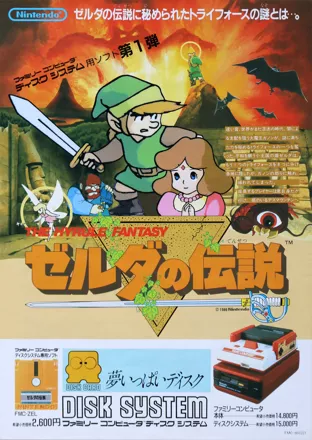
In Japan, The Legend of Zelda was the first original game released for the Famicom Disk System add-on, being the only launch title not previously released on cartridge. The Japanese cartridge version was not released until 1994, and was the very last first-party Famicom release. As there had been three sequels produced in the meantime, the cartridge version was titled The Legend of Zelda 1 to avoid
Innovations
In the United States, The Legend of Zelda was the first NES cartridge to include a battery-backed save feature.
Microphone
The instruction manual says that Pols Voice -- an enemy in the game that looked like a ghost with large rabbit ears -- "hates loud noises", although the flute item has no effect on it. This text actually refers to a microphone which was built into the Famicom's controller, but was not included in the NES; blowing or shouting into the microphone killed these creatures.
Sales
As of 2004, The Legend of Zelda has sold eight million units.
Version differences
A modified version of the game, complete with updated graphics, a smaller overworld, and completely different dungeons was released in 1995 for the Satellaview, the Super Famicom's (Japanese Super Nintendo) Japanese-only satellite-based add-on.
Called BS Zelda (the 'BS' standing for Broadcast Satellaview), several sources from Japan allude to this as being intended as a "third quest", much like the second quest accessed via the secret code.
When the game was 'rebroadcast' in 1996, Nintendo changed the map layout again. This revision apparently had a smaller broadcast audience than before, and is known only as "~map2~". This second map could again be thought of as a "fourth quest". Additionally, Link was replaced by the Satellaview mascots: A boy who wore a backwards baseball cap, and a girl who had red hair.
Awards
- Electronic Gaming Monthly
- November 1997 (Issue 100) - ranked #10 (Readers' Top 10 Games of All Time)
- November 1997 (Issue 100) - ranked #13 (Best 100 Games of All Time)
- February 2006 (Issue #200) - #5 on the "Greatest Games of Their Time" list
- Game Informer
- August 2001 (Issue #100) - #1 in the "Top 100 Games of All Time" poll
- October 2004 (Issue #138) - One of the "Top 25 Most Influential Games of All Time"
- GameSpy
- 2001 – #10 Top Game of All Time
- The Strong National Museum of Play
- 2016 – Introduced into the World Video Game Hall of Fame
Information also contributed by 雷堂嬢太朗 -jotaro.raido-, Big John WV, Captain Canuck, Guy Chapman, Indra was here, Maw, ModestMr.Green, Son of Kyuss and vedder
Analytics
Upgrade to MobyPro to view research rankings!
Related Games
Released 2011 on Wii, 2016 on Wii U, 2021 on Nintendo Switch
Released 1991 on SNES, 2006 on Wii, 2014 on Wii U...
Released 1998 on Nintendo 64, 2007 on Wii, 2015 on Wii U
Released 2006 on Wii, GameCube, 2016 on Wii U
Released 2002 on GameCube, 2013 on Wii U
Released 2015 on Nintendo 3DS
Released 2015 on Nintendo 3DS
Released 2007 on Nintendo DS, 2015 on Wii U
Released 2009 on Nintendo DS, 2015 on Wii U
Related Sites +
-
Classic NES Series for the Game Boy Advance
Covers the line-up of the new Game Boy Advance series of NES Classics. -
LegendZelda.Net
Game-dedicated page for The Legend of Zelda. -
Links' Legends
A very informative site about the history of Link and Zelda games -
NES Manual
The complete manual for The Legend of Zelda is reprinted here -
OC ReMix Game Profile
Fan remixes of music from The Legend of Zelda. -
RPG Classics' Zelda shrine
Contains lots of useful information on this game, including maps, descriptions of items and enemies as well as complete walkthroughs. -
Zelda.Com
Nintendo's Official Website. -
Zeldapower.com Forums
Message board for all Zelda games
Identifiers +
Contribute
Are you familiar with this game? Help document and preserve this entry in video game history! If your contribution is approved, you will earn points and be credited as a contributor.
Contributors to this Entry
Game added by NetDanzr.
Nintendo 3DS added by ResidentHazard. Wii U added by Michael Cassidy. Wii, Game Boy Advance added by Guy Chapman. Nintendo Switch added by Kam1Kaz3NL77. NES added by Servo.
Additional contributors: PCGamer77, Jeanne, Guy Chapman, chirinea, Exodia85, NH, Alaka, monkeyislandgirl, samsam12, Zaibatsu, Patrick Bregger, sgtcook, Thomas Thompson, yenruoj_tsegnol_eht (!!ihsoy), FatherJack, firefang9212, SoMuchChaotix.
Game added February 24, 2001. Last modified February 16, 2024.